
In the new era of technological developments, where information circulates at high speed, continuous coordination among departments and stakeholders involved in the various phases of an enterprise is required. Continuous, real-time communication poses significant challenges, especially when constant coordination and precision in the movement of an entity's gears are required.
The Importance of CRM Systems
For these and many other reasons, the era we live in has conceived a new idea of communication: that of systems. Customer Relationship Management (Customer Relationship Management [Customer Relationship Management]).
Practical Example
Imagine a modest accounting firm with fewer than 10 employees and about 50 clients. All employees need knowledge about the clients and their portfolios. At a minimum, they need information on the people involved with each client and the ability to communicate easily.
If the accounting office wants to survive, it must offer more than the routine service of accounting entries and tax filings. In the context of rapid technological developments, a significant portion of the recording processes can be automated, saving time on data collection and processing.
Modern Technology
In addition to the rapid obsolescence of information and the need to make decisions in real time, the legal, accounting, and tax regulatory framework has also been significantly simplified. The ongoing increase in the threshold for large businesses and the simplification of rules for small businesses have led to the replacement and significant reduction of routine, low-value-added work performed by interns in the economics field in general.
The Need for Adaptation
For this reason, accountants must adapt their practices, offering not only routine services but also focusing on adding value through consulting and support services that clients value. This change must begin with how we communicate and conceptualize our client. Clients are not just computer files and routine processes; they require real-time interaction and engagement in their challenges.
Building a Functional System
To have this capability, we need to have set up a functional client system with real-time information, from which we can interact with colleagues both inside and outside the office. Information must be accessible in real time both inside and outside the office. Ideally, we should have data on the client, address, contacts, matters being handled, fees received, and much other information.
Benefits of CRM Systems
These and many other benefits can be achieved with CRM systems, which are becoming more and more usable and necessary every day. In principle, anything we can conceive of to manage communication with customers, with or without technological interaction, is a CRM system. For example, using email to build agendas, calendars for meetings, notepads for notes, and electronic files to manage data and track cases.
Implementation of CRM Systems
All of these processes can be best followed, especially when the office has more than one employee. If there are two or more employees, internal processes must be established to facilitate coordination and interaction. This requires managing shared folders and making adjustments.
If there are 10 employees and they work with at least 100 clients from various categories, a motivated team will seek continuous changes, the addition of new clients, and a well-thought-out procedure for handling new cases.
Wouldn't it be better if this entire process were handled on a single platform? All office collaborators would be clear about their own work, their colleagues' tasks, and would never miss a simple assignment. This is supported by CRM systems, which improve service delivery and provide a clear view of the current phase and upcoming goals.
Popular CRM Platforms
Some of the most widely used CRM platforms over the past decade include:
- Salesforce
- Zoho CRM
- Bitrix24
- HubSpot CRM
- Capsule CRM
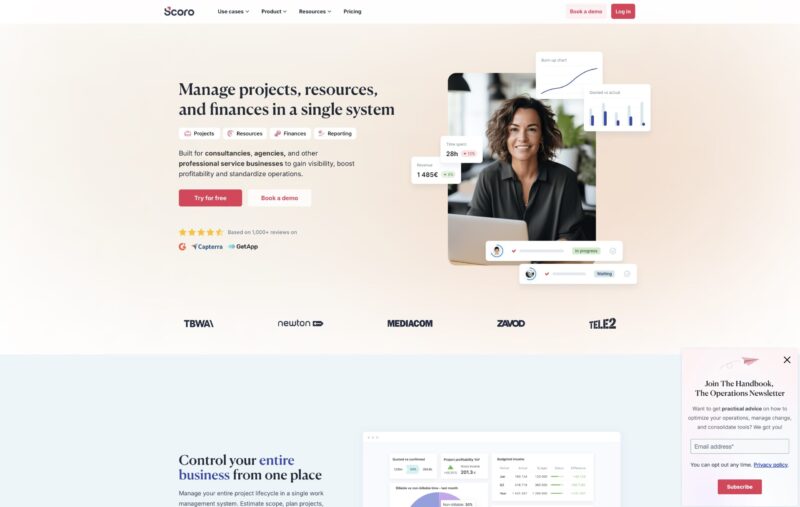
- Scoro CRM
- Monday.com
- Oracle CRM
- Microsoft Dynamics
These systems have also been developed in specific sectors, taking into account the work-related specifics of various activities.
In our experience, we have used and are very familiar with both of the above platforms: CapsuleCRM and ScoroCRM (the CRM platform we currently use). We have tested all of the above alternatives, as well as others, in the past and continue to do so.
Surely, beyond the long list of successful CRM systems, there are many more new and old names that, in some respects, may be even more functional for other sectors. The above list has been compiled specifically for the service sector of a consulting firm and for the simplicity it offers. We are aware that the list is much longer.
Conditions for Success
But is it enough to simply have a CRM system to succeed and resolve issues in a timely manner? Not necessarily. Just like implementing a simple accounting platform, CRM systems also require clarity on the goals we want to achieve and how to use them in the processes we're trying to improve.
The secret to their success is proper implementation, without overloading daily work, but by helping and adapting to the need for real-time communication.