
Managing our time and actions is a constant challenge. In today's world, where information and communication constantly bombard us, it becomes increasingly difficult to organize our tasks and priorities.
To overcome these challenges, the method “Getting Things Done”David Allen's GTD offers a practical, proven solution that helps bring order to everyday chaos.
What Is GTD and How Does It Work?
The GTD method is a simple and flexible system for managing tasks and reducing stress. Instead of trying to remember everything you need to do, GTD suggests you get all those things out of your head and organize them in an external system, such as a notebook, a task-management app, or a digital list.
For example, if you realize you need to make an important phone call, instead of trying to remember it all day, write it down immediately on a list. This will free your mind to think about other things without worrying that you might forget the call.
The Five Steps of the GTD Method
David Allen divides the GTD method into five simple steps:
Capture
Gather everything that requires your attention. This can be anything, from a work task to an idea for a new project, or even a reminder to buy milk. Example: If someone sends you an email with a task, add it to your list to process later.
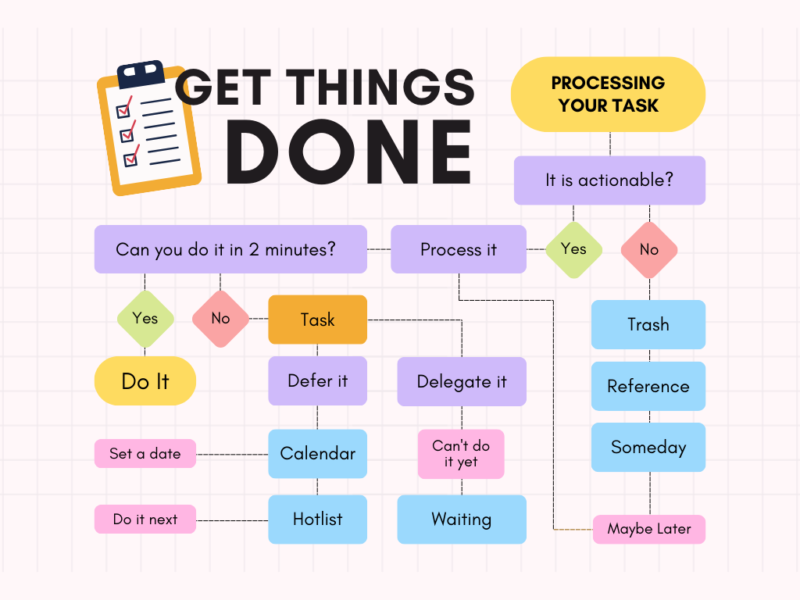
Processing (Clarify)
Decide what to do with everything you've captured. If something can be done in two minutes, do it immediately. If not, add it to your to-do list, delegate it, or save it for later reference.
Example: If it only takes you two minutes to respond to an email, do it immediately and remove it from the list.
Organization (Organize)
Put everything in its proper place. You can put immediate tasks on a “to-do” list, break large projects into sub-tasks, and put future ideas on a “Someday/Maybe” list.
Example: If you have a big project at work, such as preparing a presentation, break it down into small steps and put each step into a specific list.
Review
Regularly review your lists and tasks to make sure you're on the right track. This includes a weekly review of all tasks and projects to see what needs to be done next.
Example: Every Friday, go through your lists to see what's been completed and what needs to be done next week.
Execution (Engage)
Complete the tasks you have organized and prioritized. Focus on one task at a time and concentrate on finishing it.
Example: If it's time to prepare the presentation, close every distraction and focus solely on that task until you finish it.
How GTD Helps in Everyday Life
Implementing GTD in everyday life doesn't require any sophisticated technology or complex systems. You can simply start with a notepad and a pen. The key is to start capturing every task, idea, or reminder that comes to mind and organizing it in an external system.
This will help you free yourself from the stress of trying to remember everything and allow you to focus on completing the most important tasks.
For example, if you have a day packed with meetings, use GTD to organize your tasks in the intervals between meetings. Note the small tasks that can be completed in a few minutes and focus on the more important tasks when you have more free time.
Conclusion
David Allen's “Getting Things Done” method is a powerful tool for anyone who wants to better manage their time and tasks. By following the five simple steps of capturing, processing, organizing, reviewing, and executing, you can achieve mental clarity and boost your productivity. The benefits of GTD are both immediate and long-term, and any effort to implement this method will reward you with a more organized and peaceful life.
Source: Allen, D. (2015). Getting Things Done: The Art of Stress-Free Productivity. Penguin Books.