




- Instruction No. 26, dated September 8, 2023, explains how Law No. 29/2023 is applied in practice. It has been amended, most recently by Instruction No. 9, dated March 12, 2026.
- The phone, laptop, and work internet are not considered a fringe benefit when they remain part of the employer's inventory.
- Rent paid on behalf of an employee, private trips, and cosmetic treatments are in-kind benefits and are taxed as wages.
- Reimbursements for travel, accommodation, and per diems are not taxable when supported by documentation as part of official duties.
- In-kind revenues are valued at market value and converted at the daily exchange rate.
Instruction No. 26, dated September 8, 2023, is the document used more than the law itself in daily work. The law says what is taxed. The instruction says how it is calculated, what document is required, and where the limit is.
Below are the rules that affect almost every business with employees, taken from the text of the guidance. The text appended at the end is the September 2023 version and is therefore read together with subsequent amendments, including Instruction No. 9, dated March 12, 2026.
Read also: Social Security and contributions
In-kind benefits. What is taxed on wages and what is not.
This is the part where people most often make a mistake, because the business thinks that in-kind profit doesn't affect the payroll. It does.
| What does the employer offer? | Treatment |
|---|---|
| Work phone, computer, laptop, or tablet that remains in the employer's inventory. | It is not a benefit in kind; it is treated as a business expense. |
| Phone and internet expenses for work tasks. | It is not a benefit in kind. |
| Rent of the employee's housing paid by the employer | In-kind benefit, taxed as salary. |
| Cosmetic treatments and plastic surgery | In-kind income, taxable |
| Private trips, private accommodation, and vacations | In-kind income, taxable |
| Vehicles, marine vessels, houses, plots of land, or land granted to the employee. | In-kind income, taxable |
The valuation is made at market value. When payment is in foreign currency, it is converted at the rate on the date of purchase or payment. Any in-kind benefit must be accompanied by a document proving the expense, namely the electronic invoice, the lease agreement, or the payment document.
Reimbursements for travel, accommodation, and per diems
These are not taxable, but on one condition: they must be proven with documentation that they were carried out as part of contractual obligations and as part of economic activity.
Without documentation, reimbursement is treated as cash payment and counts as personal income from wages. So the distinction between a recognized expense and a hidden wage is the paperwork, not the intent.
Representation and sponsorship expenses
Representation expenses are documented, general-purpose costs that the company incurs to present its products or services to partners and clients, either domestically or abroad.
For participation in fairs and exhibitions abroad, the guidance provides special treatment for exporting taxpayers who, in the last three years, have generated over 70% in export revenues, excluding producers using customer-supplied materials.
Sponsorship has its own dossier. Documents are required showing the needs, the use of funds during the year, and the expected benefits, plus statements from the sponsor and the sponsored party. The full list of known expenses is on our website. deductible expenses.
When the self-employed person is reclassified as an employee
The basic rule is well known. When income comes primarily from a single client, the relationship can be treated as employment.
The overlooked exception does not come from the guidance; it is in the law itself, Law No. 29/2023, Article 12, paragraph 1, subparagraph c, last paragraph. When the self-employed individual provides services only to non-residents, or only to entities without a permanent establishment in Albania, the reclassification rule does not apply and he is considered to derive business income, taxed under Article 24(2).
Since the guidance was changed in March 2026, the way the administration assesses this case is confirmed with the regional director before a decision is made on the form of registration.
This exception directly affects Albanian professionals working for foreign clients. The comparison between salary and self-employment is on our page. Wage or self-employment.
Foreign Controlled Entities and the 30% Threshold
When an individual owns a company abroad, the rules on controlled foreign entities apply only if two conditions are met simultaneously.
First, the entity is of a type considered controlled under the law. Second, passive income exceeds 30% of that entity's total profit. When both are met, the corresponding profit is reported by the individual on the individual return.
Every time there is a tax or financial change that affects your business, we notify you directly by email with a practical explanation.
Send me free notificationsFrequently Asked Questions about Directive 26/2023
Is the laptop I give to the employee taxable?
No, when it remains part of the employer's inventory and is used for work tasks. Yes, if it is transferred to the employee's ownership.
Is the rent I pay for an employee taxable?
Yes. Housing rent paid by the employer is a non-cash benefit and is taxed as wages.
Is documentation required for business meals and travel?
Yes. Without documentation proving the connection to the duties, the reimbursement is treated as income from wages and is taxed.
How is an in-kind benefit valued?
The market value, converted into lek using the exchange rate on the date of purchase, creation, or payment.
Does work for a single foreign client qualify as employment again?
No, when services are provided only to non-residents or to entities without a permanent establishment in Albania. The exception is provided by the law itself, Article 12, paragraph 1, letter c.
The guidance is lengthy, but the section that pertains to your payroll is short and clear. If every benefit you provide to an employee is backed by a document, the rest is just calculations.
Full text of Directive No. 26, dated September 8, 2023
In support of Article 102, paragraph 4, of the Constitution of the Republic of Albania, and in implementation of paragraph 2 of Article 70 of Law No. 29/2023, dated March 30, 2023, “On Income Tax,’ the Minister of Finance,
Read also: Payroll tax, how it is calculated by tax brackets
INSTRUCTIONS:
General Provisions
The purpose of this directive is to establish the criteria and procedures for implementing the provisions of the law. No. 29/2023, dated March 30, 2023, “For income tax.”.
1. Purpose and objective of the law
- The Law “On Income Tax” establishes the legal framework for income taxation, as well as the rules applicable to tax obligations of natural persons and entities as defined in the law.
- For all categories of direct income, which include personal income and corporate income, the law defines the tax base, tax rates, exemptions, procedures and deadlines for filing and payment, as well as any other procedure or obligation necessary for the administration of income tax liabilities.
- Also, this law establishes the rules for calculating, declaring, and paying the tax on income from inheritances, gifts, and gambling winnings.
2. Field of application
3. In determining the tax liability of tax residents of Albania, whether these are natural persons or entities, the principle of taxing their worldwide income applies, that is, income earned in the territory of the Republic of Albania and income earned outside the territory of the Republic of Albania. For income earned outside the territory of the Republic of Albania, foreign tax paid is credited, up to the amount of the tax payable in Albania that is attributable to that income earned outside the territory of the Republic of Albania.
4. As a general principle, in determining the tax liability of non-resident taxable persons in Albania, whether these are natural persons or entities, the principle of taxation of income sourced in Albania applies, but also their worldwide taxable income that is attributed to a permanent establishment in Albania, or even their taxable income from all sources that has a source in Albania, in accordance with Article 4, “Source of Income,” in a given tax year.
5. Meanwhile, in implementation of the double taxation treaties that Albania has signed with other countries and which are in force, the income and tax rates are determined with respect to the portion of tax that must be paid in Albania, as well as the methods for eliminating double taxation through the mechanism of exemption from withholding tax or the credit of tax paid in Albania.
3. Definitions
- The terms used in the law No. 29/2023, “On Income Tax”, have the meaning given to them in Article 3 of the law.
- If any term used in the Income Tax Law is defined differently in the legislation of certain fields, the definitions provided in this Law shall be used for the purposes of calculating and paying taxes and interpreting the Income Tax Law.
- The terms used in Law No. 29/2023, “On Income Tax,” shall have the meaning given to them in Article 3 of the law.
- If any term used in the Income Tax Law is defined differently in the legislation of certain fields, the definitions provided in this Law shall be used for the purposes of calculating and paying taxes and interpreting the Income Tax Law.
4. Source of income
- In application of the “residence” principle, tax residents of Albania, whether entities (legal persons) or natural persons (individuals, the self-employed, traders), pay in Albania tax on income earned both within and outside Albania. Meanwhile, tax non-residents, whether entities (legal persons) or individuals (individuals, the self-employed, traders), in application of the “source of income” principle, pay tax in Albania only on income earned from sources within the Republic of Albania.
- In this sense, based on the principle of the source of income, determining the types of income that can be earned in Albania and that are subject to taxation in Albania is important for tax planning by resident and non-resident taxpayers.
- Article 4 of the Law “On Income Tax” has established a non-exhaustive list of categories of income that arise from a source in the Republic of Albania. Thus, income sourced in the Republic of Albania that may be subject to income tax is not limited to the categories listed in paragraphs “a” through “k” of this article, but may also include income in other categories sourced in Albania. In any case, to qualify income as part of a specific category, its nature is analyzed and it is assessed whether it is taxable income.
- Income sourced in the Republic of Albania can be identified based on payments made by tax residents of Albania to tax residents or non-residents of Albania, regardless of the payer's obligation to withhold tax at source or the recipient's obligation to declare the income received and to pay the tax due on that income.
- Income sourced in the Republic of Albania may also be identified, and based on payments made by non-resident taxpayers in Albania to resident taxpayers in Albania, regardless of the payer's obligation to withhold tax at source or the recipient's obligation to declare the income received and to pay the tax liability in in connection with this income. As an example, we mention the income and payments to resident individuals in Albania from online platforms such as Google, TikTok, Instagram, Facebook, YouTube, etc., Airbnb, Booking, etc., or on e-commerce platforms such as Amazon, Alibaba, etc. The methods for declaring and paying in Albania the tax obligations on income taxable in Albania and related to the use of these sites, and the platforms for declaring and paying those obligations, are developed by the tax administration and made available to users.
- Employment- and contractual-relationship-related income includes income paid by one or more employers who are tax residents of Albania or who are not tax residents of Albania.
- In cases where payments in connection with employment are made by a non-resident employer, and the work is not performed in Albania, the employee applies the provisions of the applicable double taxation avoidance agreement, if Albania has such an agreement with that country, and if no such agreement is in force, and the individual meets the requirements of a resident of Albania for tax purposes, he or she declares income sourced outside the territory of Albania as employment income, and simultaneously credits the foreign tax paid in accordance with the provisions and limitations of this law.
- In cases where payments in connection with an individual's employment have been made by a non-resident employer, and the work was performed in Albania, the employee who meets the conditions of a tax resident in Albania, declares the income from this employment relationship, and simultaneously calculates and pays the income tax on employment in accordance with the provisions of this law. If a double taxation avoidance agreement is in force, the provisions of the agreement shall apply.
- Incomes under paragraph “c”, which are payments by a resident employer in connection with the employment of an individual, even if the work is performed outside the Republic of Albania, include cases where an employee of an Albanian resident employer is required to perform employment on behalf of the employer outside the territory of the Republic of Albania. Tax is withheld at source by the tax-resident employer in Albania. If a double taxation avoidance treaty is in force, the provisions of the treaty shall apply. If, under the relevant agreements, employment income is taxed only in the other state, the Albanian employer includes the employee on the payroll but does not withhold tax on the employment income through the payroll.
- The revenues provided for in paragraph “dh” of Article 4 provides that taxable income includes those types of income generated from real estate and rights over it, the mineral resources on and under the territory of the Republic of Albania, including rights to exploit them, as well as the revenues that may be generated from movable property located in the Republic of Albania.
This paragraph clarifies that revenues arising from rights to exploit Albanian resources and natural assets are considered to have their source in Albania, are taxable in Albania, and will be treated in the same way as other income from real estate. These rights, in particular, include licenses and agreements that allow the extraction of minerals or of oil and gas. Also, the revenues derived from information and data related to these rights are subject to the provisions of paragraph “dh.” Example. Seismic information, other technical information and analyses that may be available regarding the existence of natural resources, e.g., oil, gas, chromium, etc., information which is transferred to third parties.
- Paragraph “e’ treats as income sourced in Albania the proceeds from the transfer of the rights referred to in paragraph “dh” of this article. Subparagraph “i” of paragraph “e” specifically covers gains from the direct sale of rights to exploit natural resources, or information relating to such rights. Subparagraph “ii” of paragraph “e” covers indirect sales of shares, rights and information covered by paragraph “dh.” It is based on the principles of Article 13(4) of the OECD and UN Model Income Tax Conventions. Gains from the sale of shares (or similar interests) arising from the property, rights, or information referred to in paragraph “dh” are treated as sourced in Albania. However, at least 50 percent of the accounting value of these shares must derive from the assets, rights, or information in question. These provisions are primarily important for the sale and purchase of shares between nonresidents of Albania in connection with assets and rights located in Albania, whereas tax residents of Albania are taxed on their worldwide income.
- Dividend income under paragraph “e” of Article 4 of the law does not include the transfer of post-tax profit of “permanent establishments” registered in the Republic of Albania (branches of non-resident companies). But in the event that a non-resident Albanian entity has established in the Republic of Albania both a permanent establishment (branch) and a legal entity under Albanian law, which, through the mechanism of transfer pricing or the allocation of income and expenses to the “permanent establishment,” whose taxable profit is not taxed in Albania, aim to minimize the profit of the created legal entity and to avoid tax obligations, the provisions of Article 71/2 of Law No. 9920, dated 19.5 2008, “On Tax Procedures in the Republic of Albania,” with the aim of allocating expenses, revenues, and net profit fairly, tax and post-tax profit that is subject to distribution as a dividend, by recharacterizing transactions between the non-resident legal entity, its permanent establishment in Albania (branch), and the legal entity established in Albania.
- The incomes listed in Article 4, paragraphs “a” through “k” are categories of income that may potentially be taxable in Albania for the calculation of the tax liability, while the specific types of taxable income within each category (income from employment, business, capital, inheritances, gifts, gambling) and the respective tax rates are explicitly defined in the other articles, chapters, and sections of the law.
5. Permanent seat
The forecasts regarding the “permanent seat” follow the forecasting model and are similar to the definition of this concept, according to “Model Tax Convention on Income and Capital”A UN and OECD publication. This is because Albania applies the principles of these model conventions in its negotiations with other countries regarding bilateral agreements for the elimination of double taxation.
Accuracy in defining the concept of “permanent establishment” is important, as it determines Albania's right to tax the profits derived from an enterprise of another state.
Article 2 of the law provides that non-resident individuals are subject to income tax in Albania.
For the total of their worldwide taxable income, when that total income is attributed to a permanent establishment that the nonresident taxpayer has established in the Republic of Albania; and
To the extent not covered by paragraph (a) above, their taxable income from all sources that have a source in the Republic of Albania, in accordance with Article 4 of this law, in a given tax year.
The method for taxing the income of non-residents.
A non-resident person establishes permanent establishments in Albania. If the non-resident person establishes permanent establishments in Albania in accordance with Article 5 of the law, that person is required to register the permanent establishment as a branch of the foreign company with the National Business Center. This permanent establishment registered as a branch shall comply with the provisions of this law and other tax laws regarding the maintenance of documentation, the calculation of income, expenses, taxable profit, and the payment of corporate income tax. The income attributable to this permanent establishment is the taxable income listed in Article 4 “Source of Income” of this law. The branch's expenses include operating expenses and depreciation of assets located in Albania, but without any transfer of parent company expenses or allocation shares of general administrative expenses. The branch's post-tax profit may be transferred to the non-resident entity that has established the permanent establishment in Albania. The non-resident's obligation to register a “permanent establishment” arises as soon as the non-resident anticipates that it meets the criterion for creating a “permanent establishment,” preferably before commencing economic activity in Albania.
A nonresident individual does not establish a permanent establishment in the Republic of Albania, but receives income paid by an Albanian resident, or by a nonresident, for work and services performed on behalf of the Albanian resident. According to paragraph 2(f) of Article 5, “Permanent Establishment,” it is considered that a nonresident has not established a “permanent establishment,” in Albania by performing services, including consulting services provided through his employees or other individuals, only if these activities continue (for the same person or an associated person) in the Republic of Albania for a total period or periods of less than six months during any twelve-month period. In cases where a resident taxpayer “B” receives services and makes no payment for them, but the payment for those services is made by a non-resident taxpayer of the Republic of Albania “A” for another tax non-resident “C,” the value of this service will be considered temporary financing for the Albanian tax resident “B” and then a payment (compensation) from the Albanian tax resident “B” to the non-resident “A.” Transactions must be supported by contracts, invoices, and verifiable payments.
With respect to the implementation of the foregoing, in cases where between the Republic of Albania and the taxpayer's country of residence, which provides services and receives payments from Albanian tax residents, a double taxation avoidance agreement is in force between the Republic of Albania and the taxpayer's country of residence, which supplies services and receives payments from Albanian tax residents, the provisions of those agreements shall apply. If the Agreement contains no provisions regarding the allocation of the right to tax any category of income, the general principle of taxing a nonresident by withholding at source shall apply.
6. Tax year
For the purposes of declaring and paying tax obligations, the tax year is the same as the calendar year, beginning on January 1 and ending on December 31.
7. Personal income tax taxpayer
- A personal income tax taxpayer is considered any natural person, including individuals, natural persons engaged in trade, and the self-employed, who declare and pay personal income tax.
- Personal income tax paid by natural persons, whether individuals, traders, or the self-employed, includes:
- Tax on individuals' employment income;
- Tax on business income of merchants and self-employed individuals;
- Tax on income from investment.
- Natural persons are also subject to income tax on gifts, inheritance, and gambling winnings, regardless of the fact that these categories of income are addressed in Chapter VI of the law.
8. Residence of natural persons
- Determining whether a natural person (an individual, trader, or self-employed person) meets the conditions for tax residency in the Republic of Albania is important for calculating their tax liabilities on a worldwide basis, that is, for income earned both within and outside Albania.
- An individual is considered a tax resident of Albania if he or she meets even one of the conditions listed in letters “a” through “d” of Article 8 of the law.
- Having a stable place of residence means having a dwelling that is owned, gifted, inherited, rented for at least six months, etc., in which one lives. A permanent residence is considered a permanent home; that is, the individual must have adapted and maintained it for permanent use and not merely as a place intended for short-term stays of less than six months. If an individual has a permanent residence in two or more states (in Albania and in another country, e.g., Italy), they are considered a resident for tax purposes in the country where they have their center of vital interests. That is, where they have their family or their life and economic interests.
- For tax purposes, an individual is considered an Albanian resident if they stay in Albania during a tax year, continuously or intermittently, for a total of more than 183 days, regardless of nationality or the country where they have their vital interests. In calculating the time of stay in Albania, days of physical presence are included, meaning not only workdays but also arrival and departure days, and vacation days. For example, if an individual comes to Albania on March 30, 2022, and stays until October 10, 2022, they will be considered a resident of Albania, as they have spent more than 183 days in Albania within the tax year.
- Section 8(c) of the law defines the residence of a consular, diplomatic, or similar official appointed by the state to serve in embassies, consulates, or international organizations abroad as a tax resident of Albania, even though they have lived for years outside Albania.
- The trader and/or self-employed person is considered an Albanian tax resident when they meet the requirement of paragraph “c” of Article 8 of the law.
- Has the center of their vital interests in the Republic of Albania, implying significant personal ties in Albania (has family, minor children, spouse, cohabitant/partner) or even economic ties in Albania (owns businesses, manages assets, has investments, etc.).
- If the residence of a natural person cannot be determined according to the above criteria, reference may be made to the provisions of the Conventions or International Agreements accepted and signed by the Republic of Albania.
9. Documentation
- Personal income taxpayers maintain documentation and data in accordance with the requirements of this law. They also maintain documentation and data in compliance with accounting legislation (the Law “On Accounting and Financial Statements") and national accounting standards.
- Taxpayers who file an income tax return must substantiate every reported income item with the appropriate documentation.
- Regardless of the obligations they have under the law on accounting and financial statements, self-employed individuals and traders are required, for tax purposes, to keep and present records related to their activities. These data include records of sales and purchases in the fiscalization system, including the books generated by this system for invoiced transactions, as well as cash sales recorded through the electronic cash register. Natural person traders and self-employed individuals also record their activities in simple books in accordance with Annex No. 1 of this guidance.
- Individuals who report income from employment must have:
- the employment or service contract;
- payment documentation showing the withholding tax (annual payroll summary issued by the employer);
- Any legal document proving the expenses for which a deduction from taxable income will be claimed (Article 22, paragraphs 1(c) and 2), including the family certificate, documents for his dependent children, and other persons who may be under his guardianship.
- In cases where the taxpayer claims a foreign tax credit, he must have documents relating to any foreign tax paid that is allowed to be deducted from the tax payable in Albania, including but not limited to: clear evidence of the income tax return filed in the other country, the foreign tax payment document, or other original documents from the competent foreign authorities confirming payment of taxes in that country and that may be credited against the tax payable in Albania.
10. Taxable personal income
- Taxable personal income under the law includes income from employment under Article 12, income from business under Article 13, and income from investments (capital income) listed in Article 15 of the law.
- Personal income is taxable regardless of whether it is paid in monetary form (leka or foreign currency) or in kind. In cases where personal income is received in kind, it is valued at market value, converted into lek at the exchange rate on the date of its acquisition, creation, or payment, thereby determining the taxable base on which tax is applied under the law and the corresponding tax liability. To determine the market value, recognized methods and practices are applied, such as, for example, establishing the price of the goods or services received in kind by referring to prices for identical or similar products on the market. As a general principle and criterion in assessing these benefits, it should be borne in mind that the taxable value, as income from employment for the employee, must not be lower than the amount expended on the personnel that constitutes a deductible expense for the employer.
- The types and categories of in-kind income, but not limited to them, may include:
- payments for services rendered or goods supplied to an employee, self-employed person, or trader, not in cash but in assets other than money;
- assets (goods, inventory, etc.) donated to the employee by the employer;
- Rent paid by the employer on behalf of the employee;
- payment for aesthetic treatments, plastic surgeries, etc. of this nature;
- payment for medical treatments, when not otherwise provided for in this law and directive;
- Payment for private travel, private accommodation, vacations, etc., of this nature, paid by the employer on behalf of the employee, but not related to the employment relationship or the performance of duties (services outside the workplace, transportation, per diems, accommodation);
- Other movable or immovable assets acquired by the employee, such as vehicles, motorcycles, watercraft, houses, plots of land, and land.
- In-kind payments must be accompanied by supporting documentation proving the expense incurred in connection with the asset/service paid for, such as:
- Electronic invoices paid for aesthetic and medical treatments, travel, accommodation, purchased assets, and in-kind rewards.
- The lease agreement and payment documentation for rent paid by someone other than the tenant must not be less than the levels set forth in the applicable regulations for minimum rent.
- Documented cost of goods or inventory donated to the employee.
- The market value of goods/services provided in exchange for other goods/services received.
- For purposes of personal income tax, the following goods provided to an employee and payments made on his behalf are not considered in-kind benefits:
- In cases where the employer, for work needs, provides the employee with telephone equipment, computer/laptop/work tablet that remains part of the employer's inventory, or pays for telephone or internet expenses in connection with their job duties, these are not considered employee fringe benefits and are treated as business expenses.
- In the case of foreign employees, expenses such as the costs of relocating and transferring a foreign employee, visa application fees, and other similar expenses will be considered business expenses and not personal benefits. Expenses of this nature will be considered personal benefits only if they are provided as such in the preliminary agreements or employment contracts with this category of individuals, and in that situation they will be considered deductible expenses for the employer.
11. Categories of personal income that are not subject to personal income tax
In paragraphs “a” through “f” of Article 11, the categories of personal income that are exempt from personal income tax are listed as follows:
- Incomes received as a result of coverage under the mandatory social security and health insurance scheme include any individual income derived from payments made by the Social Security Fund and the Health Care Fund. Payments made by the Social Insurance Fund include any type of payment for old-age pension, disability, compensation, etc. Payments made by the Health Care Fund, regardless of their nature, are tax-exempt income for the individuals who receive them.;
- Economic assistance from public budgets for individuals with no income or low income, as defined in the applicable legislation in force, includes such payments provided by the central and local governments.;
- Income exempt on the basis of international agreements ratified by the Assembly of the Republic of Albania. Such agreements must clearly define the entities exempt from taxation. Typically, such agreements provide exemptions for foreign staff (non-resident individuals in Albania), whereas resident individuals generally are subject to domestic tax legislation and do not benefit from these ratified agreements. Exemptions that may be provided in documents not ratified by the Assembly of Albania, and therefore do not prevail over domestic legislation, are not applicable;
- Financial compensation paid to property owners as compensation for expropriations carried out by the state in the public interest, paid from the central or local budgets, as well as financial compensation provided by the state to former owners for property expropriations prior to 1991.;
- Financial compensation paid to former political prisoners and their descendants, and received under the applicable legislation in force.;
- Awards and prizes granted to athletes, artists, researchers, scientists, etc., whether by state institutions or local government bodies, for results and achievements in science, sports, and culture. The exemption from calculating and paying tax on these income items does not relieve recipients of the obligation to file an annual income tax return in accordance with the law.
- Scholarships for pupils and students awarded by the central or local government to high-achieving pupils and students, in accordance with the relevant sectoral acts;
- Compensation benefits obtained through final court decisions, as well as certain reimbursements for litigation costs. The term “compensation” does not include wage benefits for individuals who were terminated from employment and for whom the court order requires payment of unpaid wages. These benefits will be taxed as if the wages had been paid each month for the period covered by the court order.
- Revenues from grants and subsidies in agriculture and livestock farming funded by state budget or other sources.
12. Employment income
- Any benefit an individual receives that is related to an employment relationship is considered income from employment and is taxed as such, regardless of whether it is called or labeled a salary, wage, reward, bonus, allowance, compensation, etc. The main principle for income to be considered employment income is that the taxpayer must follow the instructions of the payer of the income, i.e., the employer, or of the person (also acting in the role of employer) who has assigned a task/function, in order to receive the salary/wage/remuneration/bonus/compensation or allowance, or other similar elements. Within the concept of employment income are basic wages, whether for time worked or quantity produced, any permanent additions to the basic wage, such as allowances for position, seniority, difficulty, distance from home, the special nature of work or service, as well as other wage supplements and bonuses. Likewise, income that an individual receives in the form of bonuses from a special fund, or from other funds established by various legal or statutory acts of companies, such as the 13th salary, or various payments of this nature, are considered employment income and are consolidated on a monthly basis for the purpose of calculating the tax liability.
- Even if the payments are made for an employment or service relationship that will be realized in the future, or for employment relationships or duties that have occurred in the past, the beneficiary is considered to have received employment income and will be taxed under the rules for employment income at the time the payroll report for this income is filed by the employer.
- Director remuneration, remuneration as a member of a company's board of directors or legal body, and management and participation fees for serving on steering committees by employees of the paying entity itself are also considered employment income.
- In cases where such payments, which may be periodic, monthly/quarterly/annual, as the case may be, are made at the individual's place of continuous employment, the payer—that is, the payroll agent—consolidates all income on a monthly basis and withholds tax in accordance with the applicable legal rates.
- In cases where such payments, which may be periodic, monthly/quarterly/annually, as the case may be, are made not at the place of employment but by a different entity with which the beneficiary individual has no employment relationship, the paying entity withholds 15% tax, as defined in Article 65, paragraph 1(b) of the law.
- Even in cases of transferring or loaning employees from one entity to another, the individual income received by the employees will be treated as employment income and taxed as such. If a partner in a company organized under the Labor Code is considered an employee and receives a periodic monthly salary, those earnings are treated as employment income and are taxed on the payroll at progressive rates. If the partner receives income for any service or work that does not have the nature of employment income, they pay 15% tax on the gross income, except in cases where the income is received as dividends or profit distributions, which are taxed at the rate provided by law.
- The letter “c” of paragraph 1 of Article 12 is an “anti-avoidance clause” and is intended to protect the tax base on employment income, by shifting the taxpayer from “employed” status to “self-employed” status, with the sole purpose of obtaining tax advantages by applying more favorable tax rates.
- If self-employed, 80 % of gross income (revenue collected) derives from a single client, or 90 percent of the gross income (gross receipts) from fewer than three clients, for purposes of calculating the annual net income tax liability (gross receipts minus deductible business expenses) /monthly, the wage tax rates will apply. For the purposes of applying this provision, the calculation of the tax liability under this paragraph will be made by the self-employed individual who meets these criteria on his annual tax return. In cases where the income received under this paragraph is paid regularly each month, the self-employed individual calculates the tax on a monthly basis. If the contracts between the self-employed individual and the service client are annual but payment is made in installments, e.g. two or three times a year, the income received is spread over all the tax periods to which it belongs (the months) and the tax is calculated based on the amount of income for each month. Meanwhile, for the purposes of declaring business income, this income will be reported as zero on the personal business income declaration, since it is considered employment income. The rule in this paragraph also applies if the self-employed individual has received any payment from a non-resident Albanian client. This paragraph applies regardless of whether the self-employed individual provides services alone, has unpaid family members, or has employees.
- In cases where the self-employed person, a tax resident with a permanent establishment in Albania, provides 100 percent of the services exclusively to non-resident persons, who do not have a permanent establishment in Albania in the form of a branch or a representative office, letter “ç” of paragraph 1 of Article 12 does not apply. In these cases, the self-employed person calculates and pays tax in accordance with Article 24, paragraph 2 of the law.
- Employment income also includes immediate payments made in cases of job reduction, job loss, or termination of the employment relationship. If an employee, for the above reasons and based on the employee's obligations under the terms of the contract, receives an income from his former employer in the form of a severance bonus, or a closure bonus, or a termination for various reasons, the income paid will be considered:
- income in the month it is paid and will be taxed according to the payroll tax rates if this bonus is paid monthly,
- They are taxed under paragraph 1(b) of Article 65 at a rate of 15% of the amount received, if paid in a single sum, since it is considered compensation and not employment income.
- Based on the principle that employment income is taxed in the country of employment, even in cases where the workforce is provided by an employment agency that is not a taxable resident of Albania, such as cases where foreign agencies provide Albanian legal entities with foreign labor, but the payment for the labor is made to the foreign agency under the contract, the tax calculated and withheld as payroll tax shall be no less than 80% of the total fee paid by the Albanian entity to the foreign employment agency.
Example. An Albanian construction company has requested that a Chinese employment agency supply it with 50 construction workers, who will work for a six-month period. The total payment, which includes labor costs and the agency's commission, is 380,000 euros. For the purposes of implementing paragraph 3 of Article 12 of the law, the gross wage fund is assumed to be 380,000 × 80% = €304,000. Each employee is assumed to have received on average: 304,000 : 6 months : 50 employees = €1,013 per month. This will be the basis on which the tax liability for each employee will be calculated, while the obligation to declare and pay the tax rests with the Albanian construction company.
- The following employee benefits are not considered employment income and are not part of the taxable base on which payroll taxes are calculated:
- The value of meals consumed, non-alcoholic beverages, work equipment, medical treatment, and other benefits provided, in premises operated by or on behalf of an employer, and that are available to all employees under similar conditions and that create better working conditions for employees. Employee benefits under this paragraph are considered outside the taxable base only when provided in-kind by the employer, whether for goods or services, i.e.: i. or when they are organized and provided by the employer itself, e.g., food and non-alcoholic beverages in the entity's cafeteria, the entity's on-site doctor or dentist; ii. or when the employer obtains these services from third parties and its employees receive meals at a contracted restaurant, or undergo medical examinations or visits at a clinic (excluding payments for aesthetic treatments, plastic surgeries, etc. of this nature). In cases where the employer makes payments in cash considered to cover nutritional or medical treatment, the purchase of equipment such as uniforms, etc., Such cash payments received by the employee will be considered part of his personal income from salary and will be taxed as such.
- Reimbursements by the employer of travel, accommodation, and per diem expenses. Such benefits must be justified with documentation to prove that payments, such as employee benefits, are part of fulfilling their contractual duties and were made as part of the entity's economic activity and for management purposes. The supporting documentation must also include:
- Written authorization from the appropriate level of management for work-related services, indicating and justifying the purpose of the trip as work-related and connected to the functions performed by the beneficiary.;
- Paid invoices as supporting documents, transportation tickets, accommodation invoices, or other supporting documents issued in the name of the company where the individual is employed, as they relate to accommodation and travel expenses.
- Compensation in the form of assistance for employees in cases of illness, accidents, or living hardships they face, but only within the provisions of the applicable legislation in force when such provisions exist. Such payments and benefits must be supported by documentation (e.g., assistance in the event of a family member's death, payment for medical treatments, etc.), but the total benefit amount must not exceed 20% of the recipient employee's annual employment income.
- In cases where employers insure employees with insurance companies for life, health, and work-related accidents, such payments in the form of contributions for life, health, and work accident insurance, made by the employer on behalf of the employee are not considered part of the wages on which payroll taxes are calculated.
- In implementation of the conventions or international agreements accepted and signed by the Republic of Albania or the Albanian government, individuals who, although they may meet the criterion of being Albanian tax residents, but who enjoy diplomatic status and are part of foreign diplomatic missions or international bodies and organizations in Albania, are exempt from income tax on earnings from salaries and compensation for their employment relationships while performing their official duties in the Republic of Albania.
- In cases where an individual receives income in the form of wages, compensation, damages, etc., but which relate to his past employment and the payment is made in a single lump sum or in several installments, the income received is treated;
- If the court's decision is accompanied by an obligation for the employer, in addition to salary, to pay the employee's social security contributions, the income received is treated as employment income for the years in which it was paid, and tax is calculated accordingly.
- If the Court's decision treats them as income in the form of compensation or damages, without the obligation to pay contributions for past months and years, income tax is calculated at 15 percent on the gross payment received by the employee.
Example 1. If an individual was dismissed by the employer on January 1, 2024, but due to legal proceedings there is a final decision dated December 31, 2029, for the payment of wages from the date of dismissal until the date of the court's decision (a decision accompanied or not by an obligation to reinstate to the position), the employer calculates the individual's payroll taxes for each month from the date of departure until the date of the decision, regardless of the payment method applied, in a single amount or in installments. In these cases, when due to the enforcement of final court decisions, resulting in the reflection of salaries on supplemental pay rolls for past periods, the fines and interest generated by the system are removed by the tax administration, since, first, the system is designed to calculate fines and interest in accordance with legal provisions for late filing and payment in normal filing and payment situations, whereas the cases in question are not related to violations by the taxpayer-employer but to the enforcement of a court decision.
Example 2. If an individual was terminated by the employer on January 1, 2024, but due to the litigation of the case there is a final decision dated December 31, 2029, for the payment of compensation from the date of termination of employment until the date of the court's decision, or for a period of several years or several months (a decision accompanied or not by an obligation to reinstatement), the employer calculates the individual's tax on this compensation at a rate of 15% on any payment received, whether in a lump sum or in installments.
13. Business income
- For the purposes of the Law “On Income Tax,” business income of natural persons, including traders and self-employed individuals, includes, but is not limited to, the income items listed in letters “a” through “gj” of Article 13 of the law. Such income shall be treated as business income if it has not previously been treated as employment income, e.g., if the conditions of letter “c” of paragraph 1 of Article 12 or of letter “b” of paragraph 1 of Article 65 are met:
- The income of a natural person who is a trader or self-employed from any of his business activities, of whatever kind or nature.;
- Income that a sole trader or self-employed individual receives in the form of interest, dividends, profit sharing, or any honoraria, but only in cases where such income is part of the business carried on by the sole trader or self-employed individual and not part of his individual investments. Example. If a self-employed taxpayer receives interest from his business accounts, or any profit sharing from a stake he may have in another business, a stake that was financed with the business assets of the self-employed individual and not from his personal accounts, these categories of income will be treated as business income;
- Revenues from the sale of securities, which are effectively linked to and part of his business;
- Revenues from leasing a business, regardless of whether the lease includes all or part of its tangible or intangible assets. Example. A taxpayer, a natural person engaged in trade, has converted his first-floor apartment into a shop, registered it as such with the Cadastre Agency, and included it as a contribution to the assets of the business he operates. If this trader leases part of the shop to another trader or self-employed person, the rental income will be considered part of his business income. But if he rents out another apartment he owns as an individual, the income he derives from that rental is considered individual rental income, is taxed as such, and has no connection to the trader's business.;
- Revenue from the sale of any type of business asset or liability, including the sale of the entire business. If the assets are recorded as part of the business, the proceeds from their sale will be business income. If the entire business is sold, including both tangible and intangible assets, the total amount realized from the sale is taxable business income, regardless of the fact that the amount realized may be higher (due to the customer list, goodwill, position, etc.). than the value of the assets sold as part of the business.
- Capital gain realized from the transfer of the business's assets and liabilities in a business reorganization, as defined in Article 46 “Applicable Rules on Business Reorganizations” of this law;
- Gifts, grants, or subsidies received by a natural person who is a trader or self-employed, which are given for his business and regardless of who the donor or subsidizer is. Such entries in the business accounts are considered business income for tax purposes. If the financing of the economic activity of the natural person, whether trader or self-employed, is provided by the individual registered as the owner of that business, the amount reported as financed by the owner in the form of a loan must be substantiated as having come from the individual's personal income, which was previously taxed at the individual business level or as dividends from a legal entity, or taxed as personal income from wages, interest, rents, royalties, etc. previously taxed income. If these business financings in the form of a loan from the owner are presented in the entity's financial statements, the entity's operations and the owner's loan must be subject to an in-depth review of the activities of the natural person, as well as the individual registered as the natural person, regarding the income, expenses, sales prices, and any other significant element affecting the VAT base, income, expenses, and taxable profit.
- Any service fee charged by an individual to a third party in the course of his business.
- Capital gains from the revaluation of business assets when those assets are contributed in kind to a company's capital, whether upon its formation or in a capital increase;
- If the asset has been revalued under the provisions of the laws on real estate revaluation, and the tax related to these revaluations has been paid, the individual does not treat the revalued amount of the asset as income from business, but at the same time does not treat it as a business expense.does not amortize it against the cost of goods and services sold. Meanwhile, if this revalued asset is sold, the capital gain from the sale of the asset will be calculated as the difference between the sale price and the revalued amount. In cases where the revaluation of the asset was carried out not in accordance with any specific law on asset revaluation, but by the entity itself, the revalued amount is not taken into account as either income or a business expense, and at the same time it is not taken into account as a reference value for calculating the capital gain in the event of a sale.
- If the asset has been revalued before being included as a business asset, and that revaluation was not carried out under the laws enacted for real estate revaluation, the revalued amount is recognized as business income and simultaneously amortized each year as a business expense. Example. If the initial value of a warehouse where the individual's economic activity will be conducted is 1 million lek and the individual revalues it to 5 million lek before including the warehouse as a business asset, the difference of 5–1 = 4 million lek will be considered business income, and at the same time will be depreciated as a business expense. The income and expense for the revalued amount of 4 million lek that will be reflected in the income and expense accounts must be equal each year, respectively 5% of the calculation base, i.e., equal to the annual depreciation rate of this asset.
- Incomes from the issuance/earning of virtual assets, as well as incomes from virtual asset transactions that are effectively linked to the taxpayer's business.
- Annual taxable business income is defined as the total amount of business income, less the corresponding expenses that are documented and incurred for the purpose of generating, maintaining, and securing income. Annual taxable business income and deductible expenses shall be calculated in accordance with Chapter 4 of this law.
14. Special regime for traders and self-employed individuals
- For the purposes of reporting business income for tax purposes, a taxpayer who is an individual, trader, or self-employed person may use:
- the complete tax return form, in which he must itemize every deductible business expense and declare them in accordance with legal requirements, calculating the gross income from the sale of goods and services, deductible expenses, the taxable net income from the business and the calculated income tax. In this case, the taxpayer will maintain complete records of the expenses incurred and reflected in the electronic invoices issued by suppliers of goods and services, recordings of asset depreciation calculations by group, if any, recordings of interest paid and other deductible expenses. Meanwhile, gross business income must be reflected through electronic invoices for business-to-business sales and fiscalized invoices for business-to-consumer sales.
- At his request, a taxpayer subject to income tax on business income who has realized turnover—that is, gross business receipts as defined for income in Article 13 of the law—not exceeding 10,000.000 lekë for the tax year, may opt to apply the simplified form of taxable income declaration under Article 14 of the law, by reflecting as expenses, deductible from income, the presumed amount of one-third of turnover (gross income), pursuant to paragraph 1 of Article 14 for each business category. Meanwhile, the gross business income must be substantiated and documented through electronic invoices for business-to-business sales and fiscal device invoices for business-to-consumer sales. If the taxpayer's economic activity does not cover a full year, for the purpose of determining whether the entity may opt to apply the special regime for declaring expenses as a single estimated amount, the gross income of the period is converted into annual income. To perform the conversion, divide the total income for the tax year by the number of months the taxpayer was in business during that tax year and then multiply by 12. If the income converted into annual gross income does not exceed 10,000,000 lekë, the taxpayer has the right to opt for the presumptive expense method as a single amount equal to a percentage of the period's gross income. Regardless of the taxpayer's ability to opt for the presumptive expense method, they are required to comply with their obligations under the fiscalization legislation for accepting invoices for the purchase of goods and services from their suppliers. documenting every other business expense, as well as recording sales of goods and services based on the requirements of this law. He is also required to comply with the retention periods for tax documentation, for both purchases and sales, in accordance with applicable legal provisions, as well as any other legal obligation regarding the provision of information and data for tax verification and audit purposes. in accordance with the procedures and obligations provided for in the Law “On Tax Procedures in the Republic of Albania” and the subordinate acts implementing it.
- The declaration of taxable income, whether using the full-expense accounting method or the presumed method, is made through the income statement included in this guide.
- A natural person, trader or self-employed individual, may choose the method under the special regime with a fixed rate of presumed expenses, or apply the deduction of expenses based on documentation and invoices, provided that the switch from one method to the other does not occur more frequently than once every three years. Thus, if a natural person chooses to use the special regime, he will apply it for at least three tax periods. At the end of the three-year period, the natural person trader/self-employed chooses to keep documentation for expense tracking, he notifies the regional directorate where he is registered of the change in the documentation regime required for the recognition of tax expenses.
- The taxpayer who has deducted expenses in a single amount under the special regime is not allowed to claim any deduction or other compensation except for the personal allowance, pursuant to Article 22 “Deductions from Taxable Base” of this law.
15. Investment income
- Investment income for individuals is different from their income from employment or from business income in cases where the individual is a sole proprietor or self-employed.
- The category of income from investments, or income from passive capital, includes income such as: income from interest on savings deposits, checking accounts, term or non-term accounts, income from interest on Treasury bills or bonds, income from dividends or profit distributions, income from honoraria, capital gains from the disposal of equity stakes in companies, or securities such as stocks, capital gains realized from life insurance policies, return of investment from private pension plans, capital gain from the disposal of real estate, income from the rental of real estate, income from mining/gain of virtual assets or even income from transactions with virtual assets.
- Such income listed in point 15.2 above is considered the individual's income, but if any of these incomes, as explained in paragraph 1 of Article 13, is part of the trader's or self-employed person's business, it is treated as part of business income.
- Exempt investment income shall be considered to include income from the disposal of movable assets, except for the disposal of vehicles, airplanes, and ships if they are sold within less than 12 months from purchase, Income from the transfer of the right of ownership of agricultural land by a registered farmer to a natural person or entity engaged in agricultural activity, as well as in cases where the legal successor inherits the land for the same purpose and activity. Income from investments in Eurobonds issued by the Government of Albania is also exempt from income tax when the investor is a non-resident Albanian individual.
- In cases of the sale of shares or equity interests in a company, the sale price must take into account the remaining value of the assets, as well as any other current assets in goods or monetary instruments. The sale price of the shares must represent the fair market value of the assets represented by those shares. Example. The sale price of 100% of a company's shareholding, which has on its balance sheet total assets of 100 million lek and liabilities of 30 million lek to third parties (banks, suppliers) and 70 million lek in equity (share capital, reserves, retained earnings), in circumstances where the accounting value of these assets represents their market value, the share being sold should be valued at 100–30=70 million lek. If necessary, in these cases, the valuation of the assets being transferred is also carried out by authorized experts. At the same time, the recipient of the shares must verify that the amount of money used to purchase them is from funds for which taxes have been paid, in accordance with Albanian legislation (earnings previously taxed as salary, dividends, interest, copyright royalties, technical services for which tax has been withheld, etc.), or transfers from abroad through the banking system, for which the quota beneficiary must verify their origin and source. The National Business Center applies the procedures required by the applicable laws and regulations regarding the registration of changes in company capital.
16. Taxable income from the investment in the disposal of securities and virtual assets
- Incomes generated from the disposal of securities or financial instruments are taxable income and are considered investment income. In this case, the taxable basis is the difference between the sale price and the purchase price of these disposed assets.
- Any expense directly related to the purchase and sale of securities or financial instruments, such as brokerage fees, etc., for purposes of calculating the tax base, is not added to or deducted from it.
Example. A client has purchased shares of Company X on a regulated market/exchange, on a multilateral trading platform, or on an organized trading platform at a price of 10,000 lek per share. Although the client (individual) must also pay the brokerage commission, which may be 11 TPB of the transaction value, for tax purposes neither that expense nor any related amount is added or deducted. If this client sells this share at a price of 12,000 lek, regardless of the brokerage commission, the taxable basis in this case is the difference 12,000 – 10,000 = 2,000 lek per share. The tax that individual X must pay is 300 lek (2,000 * 15%).
- For stocks or other financial instruments listed on an exchange, the bid and ask prices are determined by the following trading documents on the date of the transaction, such as:
- Bank document proving payment on purchase, or income in case of sale;
- Confirmation of the trade by the commission firm that executed the order on behalf of the client.
- If taxable income from the alienation of securities or financial instruments results in a loss in a tax year, such a loss can be offset against taxable investment income from the alienation of other securities or financial instruments in the same tax year.
Example. Individual X, during a tax period, incurred a loss of 10,000 lek as a result of the disposal of share A, but at the same time, within the same period, realized taxable income of 15,000 lek from the disposal of bond B. The loss from the trading of stock A is offset by the taxable income from the trading of bond B. As a result, the taxable income (tax base) from the disposal of these securities will be 5,000 lek (15,000 – 10,000). The tax that individual X must pay in this case is 750 lekë (5,000 * 15%).
- Income generated from the disposal of virtual assets is determined as the difference between the sale price and the purchase price of those assets. If the taxable investment income from the disposal of virtual assets results in a loss in a tax year, the taxable investment income is considered zero; that is, it is not offset by taxable income arising from the disposal of other virtual assets.
- For virtual assets listed on trading platforms, the buy and sell prices are determined by the following trading documents as of the transaction date, such as:
- Bank documents, documents from virtual asset trading platforms, or documents from the relevant digital wallet, which verify the payment made for the purchase of the virtual asset or the receipt of proceeds from the sale of the virtual asset.
- Documents from the trading platform or from the third-party custodian, verifying ownership of the virtual asset in the case of purchase or the reduction of the virtual asset portfolio in the case of sale.
- In the case of acquiring virtual currency through the mining process during a tax period, the taxpayer reports this asset on the annual personal income tax return, valuing it at the market price on the date the virtual currency is received in the digital wallet. This value will be considered taxable income. In the case of acquiring virtual assets through the mining process for business purposes, the taxpayer accounts for the production of the virtual asset at market value, while also calculating the expenses related to its mining. The difference between the income from virtual assets (accounted for at market price) and the expenses for acquiring them will be considered taxable income.
- In the case of securities or financial instruments acquired by inheritance or gift, the purchase price for tax purposes is the taxable value of the securities or financial instruments gifted or inherited at the time of acquisition.
17. Taxable income from investment in the disposal of real estate
- The procedures for calculating income, costs, and gains, by cases and subcases, regarding capital gains related to the disposal of real estate by individuals, are clarified in the guidance issued by the minister responsible for finance and the head of the State Real Estate Cadastre Agency.
- In the case of real estate acquired by inheritance or gift, or by relinquishment of ownership, the purchase price for tax purposes is the taxable value of the gifted or inherited property at the time of acquisition, as determined under the applicable practices. This value applies in cases where the subsequent transaction after the inheritance/gift/abandonment essentially again has a nature of gift/inheritance/renunciation, and there is a lawful act of inheritance/gift/renunciation for the legal beneficiaries, pursuant to Articles 361 and 363 of the Civil Code. In any case or form of transfer other than those described above, the purchase price shall be equal to the amount paid by the beneficiary in that transaction, and if no payment was made due to a legal tax exemption, that amount shall be zero.
18. Annual taxable income from the investment
- Annual taxable income from investment must include any such income as defined in Article 15 of the law and is considered the total amount of taxable income from investment.
19. Rules for Controlled Foreign Entities
- Article 19 of the law sets out the rules for taxing a natural person who has an interest in a controlled foreign entity (CFE).
When an individual has an interest in a foreign controlled entity, whose profits are not subject to tax or are exempt from tax in Albania, any undistributed profit, which stems from “passive income,” must be included in the taxable income from the individual's investment.
It may happen that a structure is created. offshore by taxpayers to avoid paying domestic tax. Instead of making direct investments, individuals send capital to an entity headquartered outside Albania, in a country with low tax rates (or a 0% tax rate), which then makes the investments. In particularly aggressive forms of these arrangements, part or all of the capital is lent to businesses controlled by the taxpayer operating in Albania. The interest on the loan is then deducted from the business's taxable profit in Albania. The income from these investments is received by the foreign entity, subjecting it to a low or zero tax rate. If the taxpayer needs the funds, they can take measures to use the monetary resources in a non-taxable form. Article 19 removes the advantage of these arrangements by subjecting to immediate taxation the income received from such a structure. offshore.
- To determine whether the EHK rules apply, two issues must be taken into account:
- if a foreign economic unit is of the type that would be considered a QEI, pursuant to paragraph 2 of Article 19; and
- if passive income exceeds 30% of EHK's total profit.
- Any foreign entity is considered a controlled foreign entity when the following conditions are met:
- the natural person, or together with related persons, has a direct or indirect participation outside Albania of more than 50 percent of the voting rights, or directly or indirectly owns more than 50 percent of the capital, or enjoys the right to receive more than 50 percent of the profits of that entity; and
- The actual tax paid on its profit by the entity is less than 50 percent of the tax that would have been imposed on the entity had it been a resident entity in Albania.
- The first step in determining the EHK, according to paragraph “a” above, is to identify whether the natural person has direct or indirect control over the voting rights, capital, or profits of the EHK, and then to determine the level of control.
The General Directorate of Taxes (GDT) operationally tracks the identification of the natural person who has control of the EHK. The GDT effectively uses information on financial accounts obtained through the automatic exchange of information. These exchanges are based on the common reporting standard and will provide information on financial accounts controlled by Albanian taxpayers, for entities covered by Article 19, which uses the 50 percent standard.
The DPT must compare the statements made in the individual income tax return with the data obtained through the CRS.
- The second step is to compare the tax paid by the EHK with the tax that would have been paid if the company had been resident in Albania. For this purpose, the resident individual submits the supporting documents for the tax paid by the EHK, which also specify the tax rate.
The example below presents a comparison of the tax paid by the EHK with the tax payable in Albania.
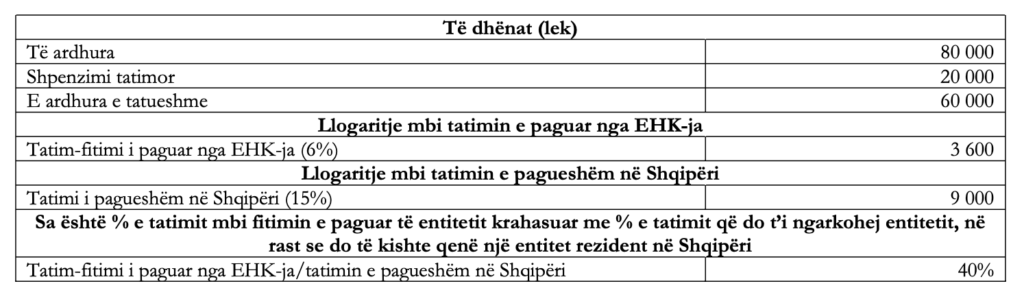
From the above example, it follows that the tax paid by EHK is less than 501 TP3T of the tax that would have been charged to the company if it had been resident in Albania.
From the test conducted on the sample, it results that the condition specified in paragraph (b), point 2, of Article 19 of the law is met.
- Upon completion of the analysis to determine whether the EHK rules will apply, the passive income analysis is conducted. Passive income will be considered:
- interest or any income realized from financial assets;
- honoraria or any other income derived from intellectual property;
- dividends and income from the sale of securities;
- income from finance lease.
Any undistributed profit arising from these passive income sources must be included in the taxable income of the individual investor who holds an interest in an EHK. Such income will be reported by the individual on their personal income tax return.
Continuing the above example, assuming the amount of passive income is 30,000 lekë, then the passive income exceeds 30% (50% of 60,000 lekë), of the EHK's total income, then we are in the circumstances for applying the provisions of Article 19 of the law. The amount of 30,000 lekë will be declared through the individual income tax return.
These income will be taxed according to the tax rate specified in paragraph 3 of Article 24.
- When the entity distributes profits to a natural person and those distributed profits are included in the natural person's taxable income, the amounts of income previously included in the tax base, under this article, are deducted from the tax base for the purpose of calculating the amount of tax due on the distributed profits.
- When the EHK has paid tax in the state of residence or domicile on the income included in the individual's taxable base under this article, that tax may be credited against the overall tax liability. The tax credit shall be calculated in accordance with Article 25, “Credit for Foreign Tax.”.
20. Taxation of private pensions
- For the purposes of the law on private pension funds, an individual may be a member of a closed-participation pension fund, established by one or more employers where participation is limited to employees, or an open-participation pension fund established by the management company where any individual may participate. Based on Article 20 of the Law on Income Tax, the monthly contribution made by any member of a private pension fund, regardless of its form (closed or open participation), up to the level of the nationally approved minimum wage, is deductible from his personal income for tax purposes. The supporting document is the contract that the fund member has with the private pension fund's management company.
If the contribution to the private pension fund is sourced from an employment relationship, it is deducted from taxable personal income before the withholding agent calculates personal income tax.
- During the period when the private pension fund is managed by the management company, the return on investment and capital gains from investments made with the pension fund's assets are not subject to tax.
- Contributions made by the employer and any other contributor, in the name of and for the account of a pension fund member, for tax purposes are not considered the member's personal income.
- Early withdrawal of assets from the pension fund is taxed at the applicable personal income tax rate on the full value of the assets withdrawn early, including contributions. Early withdrawal is the withdrawal of the value of assets from the individual pension fund account before meeting the conditions to receive private pension payments, in accordance with the provisions of the law on private pension funds.
- When a member of the pension fund meets the conditions for receiving a private pension, they may, at their election, receive an immediate lump-sum payment of the value of the assets in their pension fund account or periodic payments in the form of a pension corresponding to that value, extended for a period no shorter than that provided for in the law on private pension funds.
If the fund member chooses to receive the immediate payment of the value of his assets in a private pension fund before the scheduled period for receiving them in monthly installments, as specified in the law on private pension funds, The full value of the withdrawn assets, including contributions, is taxed at the prevailing personal income tax rate.
If a fund member chooses to receive periodic monthly payments in the form of a pension, as defined in the law on private pension funds, these income are taxed only on the investment return, at the applicable tax rate. The return on investment, which is the result obtained from investing the assets and capital gains, is calculated for tax purposes by the private pension fund's management company using the average purchase price method of the shares.
The tax on the return of investment is withheld by the private pension fund's management company and deposited into the state budget in accordance with the provisions of the income tax law.
Example. Member X of the private pension fund has made payments on certain dates in the form of contributions, which translate into pension units in the private pension fund, according to the table below.
| Date of purchase | Number of shares | Price (leka) | Value e purchase (money) |
| January 5, 2023 | 45 | 100 | 4,500 |
| February 3, 2023 | 55 | 120 | 6,600 |
| March 2, 2023 | 150 | 130 | 19,500 |
| April 15, 2023 | 150 | 140 | 21,000 |
| Total | 400 | 51,600 |
The average purchase price of the shares is the total purchase value divided by their number (51,600/400 = 129 lekë).
To the Member, on June 5, 2023 (after having met the legal requirements for receiving a pension), pursuant to the contract with the management company for the periodic receipt of the pension, 10 shares from his account in the private pension fund will be redeemed, at a price per unit of 170 lek. The total value of these units at the time of redemption is 1,700 lek (10 units * 170 lek/unit). The purchase value of these units is the product of the number of units and their average purchase price, equal to 1,290 lek (10 units * 129 lek/unit). The return on investment (profit from the sale of shares) for member X, calculated by the private pension fund's management company, is the difference between the value of the shares at the time of redemption and their purchase value (1,700 lekë, 1,290 lekë = 410 lekë), while the tax on the return of investment, calculated at the current applicable rate, is 61.5 lekë. On July 5, 2023, the member will be redeemed for 10 more shares, but the sale price of the shares has now changed (increased) to 172 lekë per share. The return on investment in this case will be (1,720-1,290=430 lekë), while the tax on the return on investment is 64.5 lekë.
- For members of the pension fund who have invested their previously taxed individual savings in the fund, a 10% deduction is allowed from the tax liability for the return on investment at the applicable rate.
21. Annual tax base
- For the purpose of determining the individual's annual taxable income base, all three categories of income are taken into account: annual taxable employment income, annual taxable business income, and annual taxable investment income. This annual taxable base is reduced by the compensations and deductions provided by law.
- For the three categories of personal income that constitute the taxable base, tax rates are applied separately to each category, as specified in the law:
- Employment income is taxed at progressive rates of 13% and 23%;
- Net business income is taxed at progressive rates of 15% and 23%.;
- Investment income is taxed at the respective rates of 81% for dividends and profit distributions and 15% for other investment income.
22. Deductions from the tax base
- A personal income taxpayer with income from employment and from business may deduct from the respective tax base for the tax period:
- an amount of 600,000 lekë, if the annual income is up to 600,000 lekë, or an amount of 50,000 lekë per month, if the monthly income is up to 50,000 lekë;
- an amount of 420,000 lekë, if annual income is above 600,000 lekë up to 720,000 lekë, or an amount of 35,000 lekë per month, if monthly income is above 50,000 lekë up to 60,000 lekë;
- an amount of 360,000 lekë, if annual income is over 720,000 lekë, or an amount of 30,000 lekë per month if monthly income is over 60,000 lekë;
- a compensation amount of 48,000 lek per year for each child under his care who is less than 18 years old. .
- The request for personal deductions, by a personal income taxpayer with employment income, may be made through the relevant declaration to his monthly payroll tax agent. The personal deduction may be claimed only once per tax year.
- The taxpayer who claims the personal deduction or part thereof under letters “a,” “b,” and “c” of paragraph 22.1 may not claim it more than once in a month. The payroll tax agent is required to consider the deductions on a monthly basis and to calculate and withhold income tax on the payroll for the employee who has signed the personal status declaration with this payroll tax agent. The employee may not sign the personal status statement with more than one payroll tax agent for the same monthly calendar period.
- The request for a deduction from the tax base for the compensation of his dependent child is made only once by the family member with the highest annual taxable income, via the annual income declaration or the personal income tax return for business income.
Example
Individual “A” works full-time as a financier at the company “XX” and has a gross salary of 70,000 lekë per month or 840,000 lekë per year. Meanwhile, he also works part-time at an accounting firm for a salary of 40,000 lekë per month, or 480,000 lekë per year.
Calculation e discount from base taxable:
Individual “A” chooses to sign the Personal Status Declaration with the accounting office. The accounting office withholds income tax on employment and is also required to take into account the monthly deduction from the tax base. Specifically, individual “A”'s taxable income from the accounting office is 40,000 lekë per month. The law provides that for salaries up to 50,000 lekë/month, a deduction of up to 50,000 lekë/month applies. In this case, the employee has a salary of 40,000 lekë/month.month at the accounting office, where after applying the tax deduction the taxable base remains zero, and in this case the employee has zero tax liability on the employment income they receive at the accounting office.
Company “XX,” in accordance with paragraph 1 of Article 65 and paragraph 1 of Article 24 of the law, applies a progressive tax of 13% and 23% on wages and does not apply any deductions to the tax base.
A personal income taxpayer with annual taxable income from employment and/or annual taxable income from business of less than 1,200.000 lekë may deduct, in addition to the individual amounts under the paragraph above, current expenses for the education of his dependent children, up to a maximum of 100,000 lekë;
The request for a deduction from the tax base for education expenses is made by the family member with the highest annual taxable income, through the annual income tax return.
23. Request for a discount
- Child support for the child in his care and education expenses are required from the family member with the highest annual taxable income. He must submit supporting documents, such as the family status certificate, contracts with educational institutions, payment receipts for the children, or documents for payments for foreign language courses, etc.
- A personal income taxpayer with employment income may, through the Personal Status Declaration, request personal deductions from his payroll tax agent on a monthly basis, in the amounts specified in Article 22(1)(a), (b), and (c). The personal deduction may be claimed only once per tax year. A taxpayer who claims the personal deduction, or any part of it, may not claim it more than once in a month. Other deductions, apart from the personal deductions in accordance with Article 22, paragraph 1(a), (b), and (c), may only be claimed through the annual income tax return.
24. Tax rate
- For employment income, the applicable progressive tax rates are 13% and 23%. The reduction of the tax burden for low-income employees is not achieved by applying a 0% rate to a specific pay segment, but by reducing the tax base (gross salary) by a fixed amount provided for in Article 22 of the law. Specifically, after applying the tax deductions under Article 22 for annual employment income up to 2,040,000 lekë (equivalent to monthly income up to 170,000 lekë), a 13% tax rate applies. For the portion of annual employment income above 2,040,000 lek (above 170,000 lek per month), a tax rate of 23% applies.
- For annual business income, for which the taxable basis is the taxable net income—that is, the difference between income and deductible expenses—the progressive rates apply as follows:
- 15% on net taxable income (taxable profit) up to 14,000,000 lek in a tax year;
- 231 TP3T for every additional lek of taxable net income (taxable profit) above 14,000,000 lek per year.
- If a natural person who is a trader or self-employed, after deducting from gross income every deductible expense and every allowance permitted under Article 22 of the law, declares an annual taxable profit of 12,000.000 lekë, the tax he will pay will be 12,000,000 × 15% = 1,800,000 lekë.
- If a natural person who is a trader or self-employed, after deducting from gross income all deductible expenses and any allowable deductions under Article 22 of the law, declares a taxable profit of 20,000,000 lekë, the tax they will pay will be: 14,000,000 × 15% + 6,000,000 × 23% = 2,100,000 + 1,380,000 = 3,480,000 lek. Therefore, the tax the taxpayer will pay on a taxable profit of 20,000,000 lek is 3,480,000 lek.
- Investment income is taxed at 81 percent for dividend/profit-sharing income and 151 percent for any other item of investment income. Except as otherwise provided by law, no expenses are deductible against investment income.
- Examples of tax calculation:
Individual “A” works in a programming office and her gross salary is 230,000 lekë per month or 2,760,000 lekë per year. Individual “B” (the spouse of Individual “A”) has a business trading plumbing and sanitary equipment and has net income of (taxable profit) 3,250,000 lekë/year. Meanwhile, individual “A” has a term deposit from which she receives interest of 20,000 lekë/year, while individual “B” holds shares in the company “XX,” which for this year has paid dividends of 25,000 lekë/year. Individuals “A” and “B” also have three children, aged 13, 15, and 19, respectively.
- Calculation of income tax on employment income:
Individual “A” has employment income of 230,000 lekë per month or 2,760,000 lekë per year, Thus, her income exceeds the amount of 60,000 lek per month, and the deduction from the taxable base that individual “A” receives, as referred to in paragraph 1 of Article 22 of the law, is 30,000 lek per month. Also, individual “A” has two children under the age of 18, for whom a tax-base allowance of 48,000 lekë per child is granted, i.e. 96,000 lekë in total; however, since he is the spouse with higher income, he will be the individual “B” is the one who will claim this tax-base relief, as well as the deductions provided in paragraph 2 of Article 22. The income tax on employment income that individual “A” will pay will be:
Annual employment income of 2,760,000 lekë per year is reduced by the deductions provided for under this law. 2,760,000 lekë per year, 360,000 lekë per year = 2,400,000 lekë per year
The annual income, after deductions and offsets are applied, is taxed:
2,040,000 lek/year * 13% + (2,400,000 lek/year – 2,040,000 lek/year) * 23% = 265,200 lek/year + 82,800 lek/year = 358,000 lek per year tax that individual “A” pays on employment income.
- Calculation e tax on to receipts from business:
Individual “B” has annual net income as a self-employed person in the amount of 3,250,000 lekë. Referring to paragraph 1 of Article 22, his income exceeds 600,000 lek per year, so the tax-base deduction he receives is 360,000 lek. Individual “B,” as the highest-earning taxpayer in the family, will receive a tax-base offset of 48,000 lekë for each child under the age of 18, i.e., 96,000 lekë in total for the two children under 18. Meanwhile, individual “B” does not benefit from the tax base deductions provided in paragraph 2 of Article 22, since annual income exceeds 1,200,000 lekë.
The annual net income from the business is reduced by the tax deductions and allowances provided for in this law.
3,250,000 lekë/year, (360,000 lekë/year + 96,000 lekë/year) = 2,794,000 lekë/year
The annual net income (taxable profit), after applying deductions and credits, is less than 1,400,000 lek per year, and this income is taxed as follows:
2,794,000 lekë/year × 15% = 419,100 lekë/year tax that individual “B” pays on business income.
- Calculation e tax on to receipts from investment:
The income from the term deposit of individual “A” and the dividend income that individual “B” received from investing in stocks are investment income.
The tax on investment income that individual “A” will pay on the interest earned from the time-deposit will be: 20,000 lekë/year * 15% = 3,000 lekë
The investment income tax that individual “B” will pay on the dividends received from the stock investment will be: 25,000 lekë/year × 81% = 2,000 lekë
25. Credit for foreign tax
- Article 25 deals with the credit for tax paid by resident personal income taxpayers in the Republic of Albania in other countries (outside the territory of the Republic of Albania) on the income they have earned in those countries. But this reduction shall not exceed the level of tax that would have applied to those incomes if they had been earned within the territory of the Republic of Albania, under Albanian fiscal legislation.
- The amount of foreign tax paid in other countries is evidenced by supporting documentation, including the tax return and payment in that country, or the document issued by the foreign tax authority where the income was earned. The supporting documentation must include the resident taxpayer's identifying information, the nature of the income received, the gross amount of the income and the tax withheld in the other country, as well as the tax year in which the income was earned.
- If the taxpayer has earned income from foreign sources in more than one country, the foreign tax credit is calculated separately for each country based on the document issued by the foreign tax authority.
- Foreign tax credit is calculated separately for each of the items of income included in the taxable base, as well as for annual investment income.
If an individual with Albanian residency earned personal income in 2023, for example from renting property in Italy, and paid tax there, they must credit the tax paid in Italy on their Annual Individual Income Tax Return. (DIVA) for 2023, which is filed in 2024.
Example. The individual “A.V.” owns a property in Bari that he rents out. The gross annual income received in 2023 from renting out this property is €12,000. At the same time, he paid 2,400 euros in tax there, or 20% of the gross income.
Since the individual “A.V.” is obligated to file a personal income tax return in Albania, as his 2023 income exceeds 1,200,000 lek, he will also report the income earned in Italy of 12,000 euros on DIVA, but at the same time will credit the tax paid there of 12,000 × 15% = 1,800 euros, since this is the tax creditable in Albania (while in Italy he paid 2,400 – 1,800 = +600 euros more in tax).
The same situation would apply to income earned outside Albania in the course of their business by individual traders and self-employed persons. They can also credit the tax paid outside Albania on income for the 2024 year, but only up to the amount of that income's taxable portion in Albania, in the relevant 2024 tax return, which must be filed by March 31, 2025.
26. Calculation of the tax payable on personal income
Personal income tax is calculated based on taxable income, in accordance with Article 24 of the law, at the tax rates specified for each category of income.
From the calculated tax, taxes previously paid by the taxpayer are deducted, such as tax paid in a foreign country, withholding tax, withholding tax on employment income by the payroll tax agent, and prepayments under Article 63 of the law.
If the calculation of the tax payable (as per the above paragraph) results in a negative amount, the personal income taxpayer may request the overpaid tax and the tax administration will refund the overpaid amount no later than 60 days from the date of the request. The request is made through the taxpayer's account in the system e-Cats. The tax administration, after verifying the documentation that substantiates the tax paid—namely the withholding tax on employment income by the payroll tax agent and the prepayments—approves the refund request. No later than 60 days from the date of application, the tax administration refunds the amount of tax overpaid.
If the taxpayer does not request a refund of the overpaid personal income tax, that amount is considered an advance payment of personal income tax for the next tax period.
Corporate Income Tax (Corporate Profit Tax)
27. Taxpayers for corporate income tax
Corporate income tax is subject to:
- Entities established under the Law “On Traders and Commercial Companies,” or under special laws, are subject to corporate income tax (“corporate income tax taxpayer”).
- Simple societies as provided for in the Civil Code.
- Any other entity, including non-resident entities, that establishes permanent establishments in Albania, in the form of a branch or any other form, and to which profits sourced in Albania are attributed and which are not provided for in subparagraphs “a” through “d” of paragraph 1 of Article 27 of the law.
- Entities that are treated under a special tax regime, such as operators subject to the fiscal system for hydrocarbons. These include, for example, persons carrying out authorized hydrocarbon operations in accordance with the applicable hydrocarbons legislation. The taxable profit of these persons is calculated and taxed in accordance with the provisions and benefits set forth in the special law on the fiscal regime in the hydrocarbon sector.
- Entities exempt from corporate income tax under paragraph 2 of Article 27 of the law, which are required to file with the tax authorities the tax return and financial reporting statements, within the same deadlines as entities subject to corporate income tax, are:
- Foundations or nonbank financial institutions established or transferred by decision of the Council of Ministers, which aim to support the government's development policies by granting loans;
- Entities that carry on only religious, humanitarian, charitable, scientific, or educational activities, whose assets or profits are not used for the benefit of their organizers or members and that operate within the limits of their nonprofit activities;
- work organizations or chambers of commerce, industry, or agriculture, whose assets or profits are not used for the benefit of an individual or their member;
- Entities provided for in international agreements ratified by the Assembly;
- Film production studios licensed and subsidized by the National Film Center.
28. Residence
- The definition of the concept of an entity's residence is important for determining and allocating taxing rights. Entities established under the applicable Albanian legislation, or under any foreign legislation, and that establish permanent establishments in Albania, are subject to taxes under this Law.
- Also, if an entity, whether established under Albanian legislation or not, exercises management and control of its operations in the Republic of Albania at any time during the tax year, it is considered an Albanian tax resident for tax purposes.
- The management and control of an entity's operations is considered to be exercised in the Republic of Albania if:
At least two of the following three conditions are met:
- Decisions regarding the management and execution of the entity's day-to-day business are made in the Republic of Albania.;
- at least 50 percent of the entity's board members or directors are residents of the Republic of Albania;
- at least 50 percent of the entity's capital or voting rights are owned, directly or indirectly, by persons resident in the Republic of Albania.
29. Exclusion from participation
- For cases where entities that are subject to corporate income tax under the law hold participations, quotas, or shares in other entities, the dividend or profit distribution received from those other entities and treated as income by the entity holding the participations is treated as follows:
- Income received as dividends or profit distributions is not added to the profit on which corporate income tax is calculated, provided that two conditions are cumulatively met:
- the receiving entity holds shares or participations of at least 10%, in value or number, in the share capital or voting rights of the distributing entity;
- The shares or minimum participation have been held for an uninterrupted period of at least 24 months.
- In all other cases, income received as dividends or profit distributions is added to the profit on which corporate income tax is calculated.
- The rules under paragraphs “a” and “b” above also apply to non-resident entities for corporate income tax purposes, if the participation relates to business activities carried out by a nonresident in Albania through an entity established by him in the Republic of Albania.
- The guarantee referred to in paragraph 3 of the article means a guarantee issued by a second-tier bank in Albania, which at all times guarantees that, upon request by the tax administration, it will transfer the amount of the guarantee to that administration's account.
- Example
In the declaration of taxable income from corporations for the 2024 tax year, we have companies B, C, and D, which, among other assets, also hold equity in company A, as follows: 1. Company B, which as of July 1, 2020, holds 50.1% of the share capital or voting rights of Company A.
- Company C, which as of November 15, 2023, owns 411,000,000 shares of the share capital or voting rights of Company A.
- Company D, which as of September 10, 2022, owns 91.33% of the share capital or voting rights of Company A.
The position on the payment of corporate income tax for each company, and the calculation of the taxable amount taking into account the provisions of Article 29 of the law, will be:
| 1. For society A | |
| 1.1 Taxable profit | 1.000.000 ALL |
| 1.2 Corporate income tax (15%) | 150,000 lek |
| 1.3 Dividend to be distributed | 850,000 lek |
| 2. For society B | ||
| 2.1 | Company B's taxable profit (excluding the income from the dividend received from the investment in Company A) | 800,000 lek |
| 2.2 | The dividend received from the investment in the share capital of Company A is exempt from Company B's taxable profit, since the conditions provided in paragraph 1 of Article 29 of the law regarding the participation exemption are met. (850,000 lek x 50% = 425,000 lek). At the same time, by meeting the criteria set out in subparagraph “b” of paragraph 1 of Article 29. | Excluded |
| 2.3 | Corporate income tax 15% (800,000 lek x 15%) | 120,000 lek |
| 2.4 | Dividend to be distributed (800,000 lekë – 120,000 lekë + 425,000 lekë) | 110,500 lek |
| 2.5 | Tax on dividends for shareholders (8% × 1,105,000 lek) | 88,400 lek |
| 3. For society C | ||
| 3.1 | C corporation's taxable income (excluding the dividend income received from the investment in corporation A) | 900,000 lek |
| 3.2 | The dividend received from the investment in the share capital of company A is not exempt from participation, since it does indeed hold at least 101 TP3T of the share capital of Company A, but has held that share capital for less than 24 months and has not simultaneously provided the tax administration with a guarantee for the amount of tax that would be payable in the absence of the exemption. Therefore, the criterion set out in paragraph 1(b) of Article 29 is not met, nor are the provisions of paragraph 3 of Article 29 fulfilled. The dividend due to Company C is 850,000 lek x 411 TP3T = 348,500 lek.Withholding tax paid by Company A on this distributed dividend: 348,500 lekë × 8% = 27,880 lekë. | 348,500 lek |
| 3.3 | Tax payable on corporate income 15% (1,248,500 lekë × 15%) | 187,275 lek |
| 3.4 | The tax payable on corporate income, based on Article 40 of this law, is reduced by: a) the credit for foreign tax under Article 42 of this law; b) withholding tax under Title V of this law; c) advance payments of corporate income tax made during the tax year. Since we have withholding tax on the dividend distributed by Company A, we will have a reduction in the corporate income tax payable in the amount of 8% * 348,500 lekë | (27,880 lek) |
| 3.5 | Corporate income tax payable: 187,275 lekë – 27,880 lekë | 1,593.95 euros |
| 3.6 | Dividend to be distributed [1,248,500 lekë – (159,395 lekë + 27,880 lekë)] | 1,061,225 lek |
| 3.7 | Tax on dividends for shareholders (8% x 1,061,225 lekë) | 84,898 lek |
| 4. For society D | ||
| 4.1 | Company D's taxable profit (excluding the income from the dividend received from the investment in Company A) | 600,000 lek |
| 4.2 | The dividend received from the investment in the share capital of Company A is not exempt under participation since it owns less than 10% of Company A's share capital. Therefore, the criterion set out in letter “a,” point 1 of Article 29 is not met. The dividend due to Company D is 850,000 lek x 91% = 76,500 lek. The withholding tax paid by Company A on this distributed dividend is 76,500 lek * 8% = 6,120 lek. | 76,500 lek |
| 4.3 | Tax payable on corporate income 15% (676,500 lekë × 15%) | 101.475 lek |
| 4.4 | The tax payable on corporate income, based on Article 40 of this law, is reduced by: a) the credit for foreign tax under Article 42 of this law; b) withholding tax under Title V of this law; c) advance payments of corporate income tax made during the tax year. Since we have withholding tax on the dividend distributed by Company “A,” we will have a reduction in the corporate income tax payable by the amount of 8% * 76,500 lekë. | (6.120) |
| Corporate income tax payable: 101,475 lek – 6,120 lek | 95,355 lek | |
| 4.5 | Dividend to be distributed [676,500 lekë – (95,355 lekë + 6,120 lekë)] | 575,025 lek |
| 4.6 | Tax on dividends for shareholders (8% × 575,025 lekë) | 46,002 lek |
30. Rules for limiting interest
- For purposes of applying the interest limitation rule, interest is considered a deductible expense to the extent it does not exceed thirty percent (30%) of the entity's earnings before interest, taxes, depreciation, and amortization (EBITDA) for the taxable year.
- EBITDA will be calculated by adding to taxable income the tax-adjusted amounts for excess interest, as well as the tax-adjusted amounts for depreciation and amortization. Tax-exempt income will be excluded from the entity's EBITDA.
- “Excess interest,” or the excess cost of borrowing, arises when an entity's interest expenses exceed the taxable interest income and other economically equivalent taxable income it receives.
- Calculation of the deductible costs of loan overage and transfer.
Step one, calculating EBITDA = taxable profit + taxes + interest expenses + depreciation and amortization.
The second step is to calculate the allowable excess interest expense, which is calculated according to the formula:
Surplus e expenses net to interest = expenses e discountable to interest , to receipts e taxable from interest.
In deductible interest expenses, the provisions of Article 50, paragraph 1, letter “dh” are taken into account.
Example
To The data financial for societies A and the B are given in the table e below;
| Society A (in pound) | Society B (in pound) | |
| Earnings Before Interest, Taxes, Depreciation, and Amortization | = 100 million | = 100 million |
| × maximum interest-to-EBITDA ratio known as deductible expense | three times three times three | three times three times three |
| = The maximum allowable amount for glitter expenses, expressed in value. | =30 million | =30 million |
| Surplus e expenses net to interest | +10 million | +40 million |
| Expenditures net to of interests to unaffordable of the period (the lesser amount between the items “net interest expense excess” and “maximum of permitted as deductible expenses, stated in value | 0 | ten million |
- Company A has a surplus of net interest expenses of 10 million lek and an EBITDA of 100 million lek. This surplus of net interest expenses arises from the interest on loans/borrowings/financings that Company A has with third parties. Because Company A has a net interest-to-EBITDA ratio below 30%, it can deduct all of its net interest expense.
- Company B has a surplus of net interest expenses of 40 million lek and an EBITDA of 100 million lek. This surplus of net interest expenses arises from the interest on loans/borrowings/financings that Company B has with third parties. Because Company B has a net interest-to-EBITDA ratio above 30%, it cannot deduct all of its net interest expenses. In this case, Company B is allowed to deduct 30 million lek in net interest expenses, and 10 million lek are not allowed to be deducted but are carried forward to future tax periods..
- Interest for which a deduction is denied is carried forward for the next five years. For this purpose, taxpayers maintain records of carryforward interest by the years to which it relates. Excess interest is carried forward on a FIFO basis.
- The rule set forth in this paragraph does not apply to:
- banks, non-bank financial institutions, insurance companies, and leasing companies;
- Interest on loans used to finance a long-term public infrastructure project, provided that the project operator, borrowing costs (loan interest), business assets, and revenues are located and generated in the Republic of Albania.
31. Provisions and write-down of bad debt for financial institutions
- For financial institutions whose activities are regulated by regulatory authorities, in determining taxable profit, a deduction is allowed for amounts that will be allocated and/or increased, but limited to:
- For the insurance and reinsurance activity, in the mandatory technical provisions established in accordance with the law in force for insurance and reinsurance activities; and
- For the operations of commercial banks, other nonbank financial institutions, and savings and loan associations, provisions created in accordance with standards developed by the International Accounting Standards Board and certified without qualification by external auditors.
- Bank expenses for annual and extraordinary contributions, in accordance with the applicable legislation on the recovery and extraordinary intervention of banks in the Republic of Albania, are expenses recognized in determining taxable profit.
- Full write-off of bad debt is allowed if the following conditions are cumulatively met:
- The entity has taken all possible legal actions to collect the debt. The provisions of the loan/security contract clauses regarding conditions and penalties in the event of non-repayment of the loan/interest must have been enforced. In any event, a final court judgment is necessary;
- Due to the impossibility of its collection, even though all legal remedies provided for in paragraph “a” above have been exhausted, the bad debt is removed from the requesting entity's accounting;
- In any event, the provisions created under paragraph 1 above must be added to taxable income.
- In the case of banks, branches of foreign banks, and non-banking financial entities, licensed by the Bank of Albania to conduct lending activities, the write-off of bad debt related to the lending process is recognized as a deductible expense for the determination of taxable profit, provided the following conditions are met:
- in case the loan is secured by movable or immovable property:
- 365 days after the filing of the request for the commencement of compulsory enforcement with the legal garnishee; or
- at the time of the execution of the movable or immovable property, whichever date is earlier;
- in case the loan is not secured by movable or immovable property, 365 days after the issuance of the writ of execution by the court.
- in case the loan is secured by movable or immovable property:
- If a bad debt provision has previously been created for a specific case, but that case has been resolved, the amount collected/recovered must be added to taxable income in the year it is recovered, except when transferred in connection with a business reorganization under section 46, “Applicable Rules on Business Reorganizations,” of this Act.
32-39. Articles 32-39 procedures concerning:
- transfer of prices;
- comparability of transactions;
- price transfer methods;
- the valuation of combined controlled transactions;
- the range of market indicators;
- documentation requirements;
- the corresponding rules; and
- Advance pricing agreements.
They are clarified in the specific guidance of the minister responsible for finance regarding international taxation.
40. Income and calculation of the tax payable on corporate income
- Corporate income tax is declared by taxpayers on an annual basis. For economic activity carried out during a full tax year, from January 1 to December 31, the declaration of taxable income must be filed by March 31 of the following year.
- In cases where the taxpayer discontinues economic activity during the year, the declaration of taxable profit may be made at any time during the year, but no later than March 31 of the following year, and it covers the economic activity up to the date of the declaration. In cases where the activity begins in a specific month of the year and ends in the same year, the principle of the above paragraph applies to the declaration of taxable profit.
- For the calculation of the profit tax liability, the applicable tax rate is applied. The profit tax calculated under the provisions of the Law “On Income Tax” is payable. The profit tax liability to be paid is reduced by:
- Foreign tax paid, but within the criteria and limitations of Section 42, “Credit for Foreign Tax on Corporate Income.”;
- Any tax that the entity has paid under Chapter 5 of the law, and which, pursuant to paragraph 1 of Article 58, has been withheld at source by the payer of the income. Example. If entity A has received payment from entity B in respect of a granted copyright, and entity B has made a payment under the contract of 1,000.000 lekë, withheld 15% source tax, i.e. 150,000 lekë, this amount paid as tax is creditable against entity A's corporate income tax liability;
- Prepaid income tax payments made by the entity, in accordance with the provisions of the relevant article of the law.
- The amount of corporate income tax liability resulting after subtracting the above payments from the calculated income tax is the amount due. If the difference calculated in point 40.3 is negative, the taxpayer may claim the overpaid tax and the tax administration will refund that amount to the taxpayer no later than 60 days from the date of application, without the need to initiate any tax audit. If the taxpayer does not claim the overpaid corporate income tax, this tax shall be considered a prepayment for the corporate income tax of the following tax year.
41. Tax rate
- The standard corporate income tax rate in Albania is 15%.
- Any rates deviating from the standard rate that may be applied continuously or temporarily to certain sectors and industries must be specified in this law or in other laws providing for fiscal treatments, such as the Law “On the Fiscal System in the Hydrocarbon Sector”; the Law “On Technological Development Zones,” etc.
42. Credit for foreign tax on corporate income tax
- Entities resident in the Republic of Albania are entitled to a credit for foreign tax paid in respect of permanent establishments they may have established in other tax jurisdictions outside Albania and to which the profits realized in those countries are attributable.
- Example
During 2024, an Albanian resident entity conducts economic activities in Albania but has also established a permanent establishment in Italy. From its operations in Italy and Albania, the entity has realized a net profit as follows:
- from the activity in Albania: 30,000,000 lek;
- from the activity in Italy: 16,000,000 lek.
This entity, being an Albanian tax resident, is subject to tax in Albania on profits earned from all sources, both within and outside the territory of the Republic of Albania.
Therefore, the tax liability in Albania will be:
- Total profit: 30,000,000 lek + 16,000,000 lek = 46,000,000 lek;
- Corporate profit tax: 46,000,000 × 15% = 6,900,000 lek.
With respect to the profit realized in Italy—a profit that is attributed to the permanent establishment created in Italy and that is normally taxed in Italy—this entity is required to pay corporate income tax in Italy as a nonresident that has established a permanent establishment. Assuming the tax rate in Italy is 36% on taxable profit, then the tax paid in Italy will be:
16,000,000 x 36% = 5,760,000 lek
The taxpayer has submitted to the tax administration the complete documentation proving payment of this tax in Italy. Meanwhile, the Albanian entity applies the tax reduction as follows:
The lesser of the corporate income tax that would have been payable as if the income earned in Italy had been earned in Albania and the corporate income tax paid in Italy on the income earned in Italy is deducted.
- The corporate income tax that would have been payable if the income earned in Italy had been earned in Albania is calculated as follows:
16,000,000 x 15% = 2,400,000 lek
- The corporate income tax paid in Italy on income earned in Italy, as calculated above, is in the amount of 5,760,000 lek.
For the above, the amount of creditable tax will be the lesser of the tax calculated under letters “a” and “b.” In this case, the creditable tax is 2,400,000 lek. This amount will be used to reduce the tax payable in Albania as follows:
6,900,000 lekë – 2,400,000 lekë = 4,500,000 lekë will be the final corporate income tax liability payable in Albania.
- Example
Suppose that an Albanian resident entity during 2024 carried out economic activities in Albania but established a permanent establishment as a branch for conducting economic activities in North Macedonia. From its activities in both Albania and North Macedonia, the entity realized
taxable profit as follows:
- Gain realized in Albania: 10,000,000 lek;
- Profit realized in North Macedonia: 6,000,000 lek. Corporate income tax liability to be declared:
10,000,000 + 6,000,000 = 16,000,000 × 15% = 2,400,000 lekë
The corporate income tax rate in North Macedonia is 10%. Therefore, for the taxable profit realized in this country, the entity has paid the tax as follows:
6,000,000 x 10% = 600,000 lek.
The taxpayer has submitted to the tax administration the complete documentation proving payment of this tax in North Macedonia. Meanwhile, the Albanian entity applies the tax reduction as follows:
The lesser amount between “the corporate income tax that would have been payable as if the income realized in North Macedonia had been realized in Albania” and the corporate income tax paid in North Macedonia on the income earned in that country.
- The corporate income tax that would have been payable if the income earned in North Macedonia had been earned in Albania is calculated as follows:
6,000,000 x 15% = 900,000 lek.
- The corporate income tax paid in North Macedonia on income earned in that country, as calculated above, is in the amount of 600,000 lek.
For the above, the amount of creditable tax shall be the lesser of the tax calculated under letters “a” and “b.” In this case, the taxable amount is 600,000 lek. This amount will be used to reduce the tax payable in Albania as follows:
2,400,000 lek – 600,000 lek = 1,800,000 lek will be the final corporate income tax liability payable by the entity in Albania.
- The credit (reduction) of corporate income tax paid outside Albania, for profits earned outside Albania, in no case shall exceed the tax payable in Albania, but may be less than or equal to the tax payable in Albania, if those profits were realized in Albania.
- The amount of foreign tax paid, without being limited to those, is evidenced by the relevant documentation:
- Copies of the tax return filed in the place where it has established its permanent establishment;
- Banking documentation evidencing payment of the obligation for corporate income tax/personal income tax in the respective country.
- For other categories of income such as: interest income, honoraria, dividends, etc. of this nature, which have been received by an entity resident in Albania as payments from a non-resident company, and the non-resident company that made the payments, based on that state's domestic legislation, has withheld and paid withholding tax in its country of residence for the purpose of crediting the foreign tax paid, the Albanian resident entity submits documentation evidencing the tax payments. This procedure must be applied in those cases where such income is taxable in Albania at the applicable tax rate.
43. Taxable profit
- In principle, taxable profit includes all taxable income, less deductible expenses. Taxable profit is determined based on the net accounting result presented in the annual financial statements, which are prepared in accordance with the Law “On Accounting and Financial Statements.” This result is also determined by applying all restrictions provided for in the Income Tax Law and its implementing regulations.
- The preparation of the taxable profit statement is based on the data, records, and statements maintained by the taxpayer in fulfillment of the obligations under the Law “On Accounting and Financial Statements,” as well as the secondary legislation issued pursuant to this law. The starting point for calculating taxable profit and completing the relevant return is revenues by category, expenses by category, and then the profit before income tax, as presented in the income statement and in the implementing regulations.
- In any case, for the purposes of the corporate income tax return, the provisions of the tax legislation are given priority, as well as accounting standards or the Law “On Accounting and Financial Statements,” provided they do not conflict with any specific provision of the law. “On Income Tax.”.
- The taxable profits of persons carrying out hydrocarbon operations authorized in accordance with the applicable hydrocarbons (exploration and production) legislation are determined according to the rules and incentives provided in the special law on the fiscal system in the hydrocarbon sector.
44. The principle of the market
The procedures and standards applied to ensure that transactions between related parties comply with the arm's-length principle are specified in the specific guidance issued by the minister responsible for finance.
45. Long-term contracts
- Long-term contracts typically involve economic activities in the execution of a project for which supply contracts for goods or services are entered into between the client and the contractor for a period exceeding 12 months and which are primarily carried out in the construction sector, assembly, production of investment components, or services related to these contracts:
- For these types of contracts, the tax periods must be harmonized when allocating the expenses incurred to realize the revenues received. Expenses on such contracts should be recognized in the period in which they are incurred. Meanwhile, the revenues related to a long-term contract that must be recognized and reported in the taxable income statement correspond to the portion of the contract completed in the relevant tax year.
- The completion percentage is determined in two ways, depending on the method the taxpayer chooses:
- or by referring to that year's cost report with the total estimated and budgeted expenses;
- or by referring to national and international accounting standards.
- Tax-deductible expenses related to long-term contracts are taken into account in the tax year in which they are incurred, in accordance with accounting standards.
46. Applicable rules on business reorganizations
- Capital gains are not taxed at the time of business reorganizations such as mergers, divisions, partial divisions, stock exchanges, and transfers of business units. This allows enterprises to develop and grow without disruption.
- With respect to the assets transferred in business reorganizations, no presumed capital gains subject to tax should be calculated. The exception is cash payments that exceed the amount treated as cash.
47. Tax calculated on the transfer of business assets
- Article 47 also ensures that capital gains are taxed when business assets are transferred abroad. This includes transferring assets to a related foreign entity or the complete relocation of the entity abroad (changing tax residence to another country). When a company transfers its residence to another country, its business assets are treated as if sold at their open market value on the date of the change of residence. This ensures that capital gains in Albania are taxed when the assets leave the country and are no longer under the control of the Albanian tax authorities. The capital gain realized through such a transfer of assets or through the company's change of residence is taxed at the standard rate of 15 percent.
- The transfer of business assets is considered taxable in the following cases:
- A resident taxpayer transfers business assets from his domestic head office to a permanent establishment abroad, and the Republic of Albania no longer has the right to tax the transferred business assets due to the transfer;
- a taxpayer resident transfers their tax residence to another country, excluding those business assets that remain effectively connected with a permanent establishment in the Republic of Albania.
- The taxable base subject to tax is the amount equal to the market value of the transferred business assets minus their tax basis at the time the business assets are disposed of.
48. Deductible expenses
- For purposes of calculating corporate income tax, business expenses are considered deductible from income if they meet the following conditions:
- They are not subject to the restrictions provided in Article 50 of this law.;
- They are actual expenses incurred in the direct interest of economic activity.;
- These are expenses related to the necessary and normal conduct of the taxpayer's activities;
- These are expenditures made with the purpose of realizing and securing profit, preserving assets and capital as a source for generating income, or expenditures to ensure, at the appropriate time, the renewal or replacement of capital, such as depreciation expenses.;
- Whether they have been or will be covered by the taxpayer's assets;
- They must be reflected in the taxpayer's accounting, except in cases where otherwise provided, such as depreciation calculated under Article 51, interest that will be carried forward as a result of exceeding the EBITDA limit, or expenses for technical services that have not been paid.
- To be proven by taxpayers with the necessary legal documentation:
- Electronic invoice that meets the criteria set forth in the law on invoicing and the monitoring system for turnover, VAT, and tax procedures, in relation to business-to-business transactions.
- A legally recognized document for cases where payments are made in the form of service fees in the interest of business, for public entities, or for other legal bodies recognized by the Republic of Albania.
- Business expenses incurred but not invoiced through the fiscalization system, such as, but not limited to, interest or bank commissions charged to the taxpayer, or any other business expense not invoiced via fiscalization.
- An expense considered by the taxpayer to be deductible, claimed as such based on the fact that it is reflected in a formally valid electronic invoice, does not automatically lead to its being considered deductible, because the expense must be a real transaction actually performed and representing the actual supply of goods or services, and not a fictitious transaction for which an electronic invoice has been issued.
49. Deductible expenses for land exchanged for construction
- For the construction sector, the methodology for recognizing revenue from sales and operating expenses, as well as the consideration of landowners' profit share and the land costs themselves, have been determined by a decision of the Council of Ministers.
- Enterprises that operate in the construction and/or sale of buildings for residential, manufacturing, commercial, or service purposes recognize as revenue: the income from the enterprise's operations, if they are solely contractors in construction, the revenues from the sale or lease of the properties if they are both the builder and the owner of the constructed properties. In determining revenues from the construction process and from the sale, the following are taken into account:
- costs and declared profit in contracting situations for contractors;
- Real estate sale contracts and the prices reflected in them;
- Data declared by real estate agencies, construction or investment companies regarding the sales prices of construction products, which can be used within the framework of alternative valuation methods;
- the applicable reference prices for m2 of the construction product according to its intended use and in accordance with applicable secondary legislation; in cases where contract prices exceed reference prices, the former are taken into account.
- reference rental prices according to the applicable secondary legislation; in cases where contract prices exceed the reference prices, the former are taken into account.
- Expenditures in the construction sector include the project-specific costs of the construction process, as well as other deductible expenses incurred during the design, implementation, and sale phases of the construction product.
50. Non-deductible expenses and deduction limitation
- Business expenses listed in Article 50 of the law are not deductible from taxable profit:
- Purchase costs, improvement costs, and other expenses incurred in improving land, lots, or building sites are not deductible business expenses. These costs are not deductible from income, whether as expenses in the year they are incurred or as depreciable costs over multiple periods in cases where the land or building plot is held by the entity as an activity asset, or when it is used as the site on which other entity assets, such as buildings, installations, machinery, etc., are constructed or placed. The tax treatment of the cost of acquisition, improvement, and other expenses, with respect to the improvement of land or building plots held by entities that develop and sell building plots, is determined in the Council of Ministers' decision implementing this law.
- Costs of acquisition, improvement, renovation, and reconstruction of depreciable assets. Such costs include initial purchase expenses and those incurred within one year that are intended to improve the future economic capacity of the assets. To determine whether, during a year, expenditures related to the purchase, improvement, renovation, and reconstruction of depreciable assets will be considered an increase in the asset's value (capitalization) or ordinary maintenance expense, the taxpayer applies the rules provided in the National and International Accounting Standards for this purpose.
- Depreciation of fixed assets is allocated as an expense over the annual periods, based on the depreciation rates, years, and other rules of Article 51 of the law. No long-term asset is considered an immediately deductible expense in the year of purchase or creation, except as otherwise provided by law.;
- The increase in the company's share capital or in the contributing capital of a partnership affects the balance sheet accounts by reflecting the increase in contributions to assets and to capital/contributions in liabilities, and does not affect the expense accounts.;
- Dividends calculated/distributed to shareholders or partners, as well as dividends from other entities under the law, because they are items that are calculated after revenues, expenses, profit, and corporate income tax have been declared.;
- Interest paid by the taxpayer that exceeds the 12-month average interest rate on annual market-rate loans as officially published by the Bank of Albania. Each entity considers the interest rate published on the official website of the Bank of Albania (https://www.bankofalbania.org/Statistikat/Statistikat_ Monetary_Financial_and_Banking/Monetary_Aggregates.html), in the month in which the loan is taken. Excluded from this rule are interest paid on loans granted by licensed microcredit institutions, which are considered fully deductible.
- Administrative penalties, including fines, late‐payment interest, or other penalties that a taxpayer pays to an authority for violations of the relevant legislation, as well as criminal penalties or sanctions that a taxpayer pays or is required to pay for failure to fulfill contractual obligations to other taxpayers.
- The creation of reserves and other special funds, as well as the establishment or increase of provisions. Statutory reserves and other reserves are created from profit after tax. Provisions for risks that the taxpayer may incur in the course of economic activity are not allocated to deductible expenses, and in cases where the taxpayer has created provisions for risks and has recorded them as non-deductible expenses, he recovers them, the income from the recovery is not recognized as taxable income. Excluded from the above rule are cases provided for by law relating to insurance and reinsurance activities, as well as the activities of banking institutions or other financial institutions.
- Corporate profit tax, creditable VAT, and excise calculated by entities liable for excise.
- In cases where taxpayers are subject to VAT and are entitled to claim input VAT paid on the purchase of goods and services, the VAT paid is not part of the cost of the goods and services purchased and is not reflected as an expense. If the taxpayer is not entitled to a credit for the VAT paid on the purchase of goods and services, the value of the purchased goods or services, including VAT, is considered a deductible expense.
- Taxpayers who produce excise-taxable goods, such as fuel producers, alcoholic beverages, beer, etc., do not include the calculated excise tax as part of the cost of the goods sold and do not reflect it as an expense. Taxpayers who import excise-taxable goods include the excise paid on import as part of the cost of the goods purchased, a cost they pass on to the selling price. Any other taxpayer who, for business needs, purchases goods subject to excise tax—whether the excise tax was calculated by the domestic producer or paid on import—the cost of the purchased goods, including the excise tax as part of it, is a deductible expense.
- In cases where a taxpayer, in the role of a tax agent, withholds tax at source for the income recipient who provided the service, treats the gross amount of the paid invoice as a deductible expense, whereas the tax withheld for the service provider is not a deductible expense;
- Transaction costs that exceed the limit of 0.3 percent of annual revenues for all taxpayers. .
Expenses that exceed the 3% limit of documented expenses incurred for participation, presentation at fairs or exhibitions abroad, for exporting taxpayers, excluding manufacturers using commissioned materials, who have generated over 70 percent of their revenues from exports in the last three years.
Representation expenses include documented general-nature expenses that a company incurs for presenting its products or services in its dealings with business partners or clients, at home or abroad, such as expenses for organizing business meetings, participation in trade fairs, presentation of new projects or products, inauguration of completed investments, etc. of this nature.
- Expenses incurred as personal consumption by shareholders, partners, administrators, and their family members. Such personal expenses are not covered by the taxpayer's funds and other assets. Examples. Food, accommodation, fuel, private travel, rent payments, home purchase payments, entertainment payments, payments for health or aesthetic care, private phone subscription payments, and other similar expenses, payment for entertainment, payment for accommodation, rent or other expenses of employees who are not part of the taxpayer's payroll, regardless of the terms of the contract with the supplier of goods or services where these employees are employed, as well as any other payment or expense that is of a personal consumption nature and that is not an expense related to and that does not affect the increase or preservation of the taxpayer's income and profit.
- Expenses that exceed the limits set by law or by regulations. Limitation of per diems. The benefits for employees who, for the taxpayer's work needs, are sent on assignment outside their effective place of work are limited to:
- Accommodation inland, up to 6,000 lek per day;
- Accommodation abroad, up to 150 euros per day;
- Meal allowance for in-country services, up to 4,000 lek per day and 2,000 lek for a partial day.;
- Meal allowance for out-of-country services, up to 80 euros per day and 40 euros for a partial day;
- The fee for domestic travel shall not exceed the price of approved interurban tickets for public transportation.;
- Payment for travel abroad: an invoice is submitted, and payment is made for air, sea, rail, and automobile transportation tickets, as well as for transport to and from the airport by any means. In cases where travel is made by vehicle, deductible expenses include fuel consumption based on purchase documents and payment documentation. toll-eve, etc., of this nature.
- Gifts and donations that the taxpayer may make, excluding symbolic gifts, but within the limits permitted in paragraph “j” of section 50.1 of this guidance.
- Invoices for expenses for technical, consulting, and management services invoiced by non-residents and declared, Under the applicable legislation, if these invoices are not paid by the taxpayer and the withholding tax is not transferred to the state budget revenue account within the deadline for filing the annual tax return. If such expenses are paid later, they are deductible in the tax year in which they are paid, but not if they are paid later than December of the year following the year the invoice was issued.
- Payroll expenses, bonuses, and other forms of personal income related to employment relationships, paid to employees, including administrators, and not made through the banking system or electronic money institutions.
- Expenses related to amounts paid in cash that exceed the limits set by the provisions of the Law “On Tax Procedures in the Republic of Albania.”.
- Life and health insurance expenses for the taxpayer's employees that exceed 51% of their gross wages for the tax year. Such expenses within the allowed limit are documented by the contract between the taxpayer and the insurance company, as well as by the insurance policies for each employee.
- Expenses for scholarships awarded to students of public and private educational institutions, as opposed to those determined by the Council of Ministers. .
- Expenses for contributions made by the employer on behalf of his employees to a private pension plan that exceed the limitations of paragraph 5 of Article 20 of the law. Such expenses within the permitted limit are documented by the contract between the taxpayer and the Private Pension Fund, as well as by the payments made for each employee under the scheme.
- Expenses that are related to revenue generation but are not included in this year's taxable profit. Such expenses should be treated as prepaid expenses and will be allocated on the income statement in the period when the income generated as a result of these expenses is recognized.
- Bribes and kickbacks that may be reflected in the taxpayer's documentation, regardless of any criminal code provisions.
- Expenditures incurred for sponsored activities that exceed the following limits:
- up to 5 percent of pre-tax profit for publishers of printed materials and publications of literary, scientific, and encyclopedic works, as well as for cultural or artistic activities;
- up to 5 percent of pre-tax profit for sports activities; Sponsored amounts, within the above limit for activities of sports teams affiliated with sports federations recognized by the applicable legislation, for the purposes of calculating income tax for the tax period, are deductible at three times the value of the sponsored amount. Carrying them forward to future tax periods is not allowed. This deduction is permitted only after the issuance of the “Sponsorship Authorization” by the Director General of Taxes. Paragraph “ii” applies only to sponsoring entities with an annual taxable profit exceeding 100 million lek.,
- up to 3 percent of pre-tax profit for sponsorships of other activities not included in paragraphs “i” and “ii” above;
For taxpayers who realize an annual taxable profit exceeding 100 million lekë, the amounts sponsored for sports team activities, to federations recognized by the applicable sports legislation, which are within the 51% tax-pre-tax profit limit for the purposes of calculating the tax on profit for the tax period, these sponsorships are deductible up to three times the amount of the sponsored sum. Carrying them forward to future tax periods is not allowed.
Example
One taxpayer has resulted with profit to taxable 1.000.000.000 money.
Sponsorship expenses for that fiscal year are 40,000,000 lekë, i.e., 41% of pre-tax profit, which is less than the permitted sponsorship rate of 51% of pre-tax profit. For the calculation of income tax, the amount of Sponsored 40,000,000 lek will be recognized as spending discountable three times that amount, i.e., 120,000,000 lek. Tax on The calculated corporate profit to be paid is 132,000,000 lek (1,000,000,000 – 120,000,000 lek)
*15%.
In order to claim recognition as deductible expenses equal to three times the amount sponsored, the taxpayer must have the “Sponsorship Authorization” issued by the Director General of Taxes. The following procedure applies to the issuance of the authorization by the Director General of Taxes:
Sponsorship authorization is granted for sponsorships of sports team activities, part of sports federations recognized by the applicable legislation in the field, and each sports team must verify that it is part of the sports federations recognized under the applicable sports legislation in order to be subject to such sponsorship by taxpayers.
The documentation that the sponsoring taxpayer submits to the General Directorate of Taxes to obtain the sponsorship authorization includes:
For the sponsorship beneficiary, documentation must be provided that verifies that:
- He participates or is entitled to compete at the amateur or professional level as defined in Law No. 79/2017 of April 27, 2017, “On Sport,” and is a member of a sports federation.;
- has been operating in accordance with the applicable sports legislation for at least one year;
- No unpaid tax obligations;
- has not been convicted by a final court judgment for criminal offenses in the field of tax evasion, non-payment of tax obligations, or document falsification;
- has fulfilled all obligations arising from the legislation on social and health insurance;
- is not subject to bankruptcy and/or liquidation proceedings or any other similar procedure;
- It has not been suspended by court order. For the sponsoring taxpayer, it is presented as follows:
- a declaration in which it commits to providing sponsorship for the sports team that is part of the sports federation seeking financial support;
- the sponsorship agreement between the sponsor and the beneficiary;
- Bank documentation verifying the amount of sponsorship transferred to the sponsored person's bank account.
Additional documentation accompanying the request of the sponsoring taxpayer and the sponsored entity:
- The sponsor and the sponsored party present a program on the development of the sport which outlines: sponsorship needs, the use of sponsorship funds during the year (highlighting the funds that will be used for the development, improvement, and renovation of sports infrastructure, the identification of talents and training needs, covering the expenses arising from the organization of sporting competitions), as well as the benefits expected to result from this sponsorship.
- The declaration of the sponsored person and the sponsor, by which they guarantee the truthfulness of the data in the documents and statements submitted in the application;
- Written authorization from the sponsor and the sponsored party, acknowledging the authority of the tax authority to conduct all necessary verifications and inspections at any time in order to ensure compliance with the law and the rules set forth in the tax legislation and the sponsorship legislation.;
- Self-declarations that the sponsor and the sponsored are not in a situation or circumstance of conflict of interest.
The documentation and/or verifications requested above are submitted in original format or as notarized copies of the required documentation.
Granting the Sponsorship Authorization
The Director General of Taxes reviews the submitted documentation within 30 days of the submission of the complete required information. After reviewing the documentation, he decides to approve or deny the Sponsorship Authorization.
The application for obtaining the Sponsorship Authorization is denied if:
- It is determined that the applicants do not meet all the requirements according to the procedure set forth in this guidance; or
- From verifications and inspections that may be conducted at any time at the sponsor's and the sponsored party's premises, it is established that the parties have submitted false or distorted information, data, or documentation regarding the requirements of the procedure.
Recognition as a deductible expense takes effect after the issuance of the “Sponsorship Authorization” by the Director General of Taxes, a procedure that should not take more than 30 calendar days from the date of application.
- losses, damages, spoilage, and shortages during production, transit, storage, and trade, beyond the limits set forth in applicable special statutory and regulatory acts in force.
- For goods subject to excise duty, offcuts, losses, damages, and scraps during the production, storage, transportation, and trade processes are calculated in accordance with the legal and regulatory provisions of the applicable excise legislation.
- For manufacturing industries that use fuel in the technological process, the standards for combustible raw materials are determined in accordance with Government Decree No. 612 of September 5, 2012, “On the implementing provisions of the Law ‘On Excise Taxes,’ as amended.”.
- For tobacco, offcuts and losses in the processing-manipulating process are calculated in accordance with the provisions of Government Decree No. 687 of June 18, 2009, “On the determination of the level of allowable offcuts during the processing-manipulating process of tobacco.”.
- For losses and waste in the production process for which there are no specific legal or regulatory acts, their permitted quantity and value will be calculated based on the data in the production process technology card or scheme regarding these waste or damages.
- Except for excise goods, which are covered by Government Decree No. 612, dated September 5, 2012, “For the implementing provisions of the Law ‘On Excises,’ as amended, for other goods, losses during transport or storage will be recognized only if there are applicable legal or regulatory acts that establish loss rates during transport.”.
- For electricity, distribution losses will be considered the loss percentage determined in Government Decree No. 171, dated February 25, 2015, of the Council of Ministers, “On the approval of the financial recovery plan for the electricity sector.”.
Taxpayers who claim to have firo or legal losses in their technological process must have the data and supporting documentation filed with the Regional Tax Directorate, for: i. the technological card of the line, plant, etc.; ii. the description of the production process; iii. the facility's floor plan; iv. the norms for raw material consumption and labor hours per unit of finished product (the production technology card); v. the materials used in the production process and the stages at which they are used.
If required by the competent authority under applicable legislation, the technology cards must be confirmed.certified by a recognized institution with the technical capability to confirm the technical cards, such as: the National Agency of Natural Resources (AKBN), the National Food Authority (AKU), Institute of Building Materials, General Directorate of Standards, Directorate of Patents and Trademarks, National Agency of Medicines and Medical Devices, the responsible state inspectorate, as well as any other institution that oversees specific fields of activity and approves/supervises various technological cards.
The tax administration, in the in-depth inspections it conducts, analyzes the process flowcharts or technological schematics accompanying the machinery or respective production lines from their manufacturer, and carries out verifications regarding the level of losses incurred during the production/processing.
- Any claimed expense whose amount is not substantiated by documents provided by the taxpayer, or for which the document does not represent an actual transaction carried out by him, in accordance with the principle that substance prevails over form as referred to in the applicable law on tax procedures.
- But in cases where, even though an expense is claimed as deductible and supported by an invoice issued by a seller of goods or services, it will be considered a fictitious, non-deductible expense if the following conditions are met:
- The taxpayer-seller does not actually and realistically carry out economic activities involving goods and services that have been invoiced to the buyer;
- We are in the presence of a “Carousel” VAT fraud scheme involving invoices. The procedures, facts, and circumstances for applying this paragraph are detailed in the tax audit procedural manuals.
51. Depreciation
- For the depreciation of business's long-term assets, the linear method is used for all categories. Long-term assets of each category are depreciated individually.
- The basis on which depreciation is calculated for each group is the cost of acquiring or creating the asset, plus the cost of its reconstruction during the tax year. The costs of reconstructing an asset in a year are determined in accordance with National and International Accounting Standards, so that they are recorded as an addition to the asset's value and are depreciated over time.
- If an asset is retired during a tax year, the remaining book value for tax purposes is deductible in that year, provided that any potential gain from the retirement is included in taxable income. Disposition means its sale, whether as an asset or for scrap, or even its disposal as waste if the type of asset is such that it has no use value, even as waste or scrap. The taxpayer must demonstrate that it was impossible to recover any amount from the asset discarded as waste.
- Revaluations of any category of long-term business assets, performed in compliance with accounting standards and principles, or in implementation of any law in force for the revaluation of real estate, are not taken into consideration for the purpose of the base upon which depreciation is calculated.
- For those assets purchased before the law's effective date for which the depreciation method has changed, depreciation as of January 1, 2024 will be applied under the new depreciation method.
Example. Company A purchased a building for 1,000,000 lek on January 1, 2022. In accordance with the law, it calculated depreciation for the years 2022 and 2023 using the residual value method, as follows:
| Year (I) | Value e activity on which is calculated depreciation (II) | Depreciation Rate (III) | Value e depreciated (IV = II * III) | Value e unamortized e active in end to of the year reporter (V = Second – Fourth) |
| 2022 | 1.000.000 ALL | 5% | 50.000 ALL | 950.000 ALL |
| 2023 | 950.000 ALL | 5% | 47.500 ALL | 902.500 ALL |
| 2024 | 902.500 ALL | 5% | 45.125 ALL | 857.375 ALL |
| 2025 | 902.500 ALL | 5% | 45.125 ALL | 812.250 ALL |
| 2026 | 902.500 ALL | 5% | 45.125 ALL | 767.125 ALL |
| 2027 | ……………. | …. | …………… | ……………. |
Due to the change in depreciation method from residual value depreciation to straight-line depreciation for the year 2024 and thereafter, depreciation will be calculated according to the table above until the asset's book value is zero.
52. Inventory valuation
- For the valuation of inventories, including work-in-process, the taxpayer may use any of the valuation methods provided for in accounting legislation. However, the method he uses for his valuation must be applied consistently for at least five years.
- Possible impairments or revaluations of inventories, financial assets, and intangible assets, after their initial recognition in accordance with accounting rules, are not recognized for the purpose of calculating taxable profit. This rule also applies to financial assets and intangible assets. Thus, for such assets, revaluations—whether increases or decreases—will not be taxable nor deductible.
- The petty cash inventory (e.g., account 32 in accounting) is depreciated 50% in the year of its purchase and 50% in the following year. Inventory of minor items includes materials for consumption or use as specified in the instructions of the minister responsible for finance,
“For the procedures for preparing, presenting, and reporting annual financial statements in general government units.
53. Write-offs of bad debt
- Except for financial institutions, including insurance companies, if a revenue from the sale of goods or services has been recorded in the accounting as such, but the collection of the money is not possible, the taxpayer treats it as a bad debt, in accordance with the provisions of Article 53 of the law. If the debtor is a related party as defined in this law, the write-off of the bad debt is not allowed. The write-off is allowed if the taxpayer believes that the debt will not be fully or partially settled, provided that he has taken the necessary steps to collect the debt. The taxpayer bears the burden of proof to convince the tax administration that he has taken the necessary steps to collect the debt, including but not limited to entering into contracts with private debt collection companies or other measures and information that justify writing off the debt for tax purposes.been collected.
- The taxpayer fully writes off the amount of this debt if it is verified that he has taken all possible legal actions to collect the debt but has been unsuccessful, and, having no hope of recovery, has written it off as a bad debt in his accounting records. Taking all possible legal actions means the outcomes of the judicial process and the results of engaging private collection agencies.
54. Carrying losses
- Losses from economic activity arising in a given tax year may be carried forward, that is, offset against the profits of the five following tax years. Losses declared by the taxpayer that the tax administration has audited and concluded cannot be carried forward should not be carried forward by the taxpayer. The administrative act denying the carryforward of losses may be accepted by the taxpayer; otherwise, a decision from the administrative and/or judicial appeal bodies is required.
Example 1
million pound
| Number. | Years | Profit loss taxable | Allowed loss for carryover from periods previous | Carryover loss | Profit/loss for the year after carrying forward past losses | Taxable income |
| 1 | 2024 | -10 | -10 | 0 | ||
| 2 | 2025 | 1 | -10 (2024) | -1 | -9 | 0 |
| 3 | 2026 | 2 | -9 (2024) | -2 | -7 | 0 |
| 4 | 2027 | 1 | -7 (2024) | -1 | -6 | 0 |
| 5 | 2028 | 3 | -6 (2024) | -3 | -3 | 0 |
| 6 | 2029 | 2 | -3 (2024) | -2 | -1 | 0 |
| 7 | 2030 | 6 | 0 | 0 | 6 | 6 |
In 2030, the remaining loss from 2024 of -1 million lek (10-1-2-1-3-2) is not carried forward because five years have passed since the allowance for carrying forward the loss incurred in 2024. In 2030, the taxable profit of 6 million lekë will be taxed at the applicable tax rate.
Example 2
million pound
| Number. | Years | Taxable gain/loss | Loss e allowed for carryover from the periods of previous | Carryover loss | Profit/loss for the year after carrying forward losses of past | Taxable profit |
| 1 | 2024 | -10 | 0 | -10 | 0 | |
| 2 | 2025 | 1 | -10 (2024) | -1 (2024) | -9 | 0 |
| 3 | 2026 | 2 | -9(2024) | -2 (2024) | -7 | 0 |
| 4 | 2027 | 1 | -7 (2024) | -1 (2024) | -6 | 0 |
| 5 | 2028 | 2 | -6 (2024) | -2 (2024) | -4 | 0 |
| 6 | 2029 | -2 | -4 (2024) | 0 | -6 | 0 |
| 7 | 2030 | 8 | -2 (2029) | -2 (2029) | 6 | 6 |
Any loss may be carried forward and reduce the taxable profits of the next five years, with each year's loss shown separately, under the principle “earlier loss carries forward before later loss.” If a loss cannot be carried forward against the profits of the next five years, the loss carryforward is terminated.
- If the taxpayer reports a taxable loss in a year, but may also have allowable losses to carry forward from prior years, and in that year a direct or indirect change in ownership occurs that exceeds 50% of shares, shares or voting rights, the carryforward of the loss incurred in that year or the right to carry forward losses from previous years is not permitted. This limitation applies in cases where the change in ownership is accompanied by a change in the type of activity that the taxpayer was engaged in and will engage in:
Example 1
A taxpayer engaged in the production of plastic pipes began investing in this economic activity in 2023. The economic activity in 2024 results in a loss of -4 million lek, while there is a carried-forward loss from 2023 of -10 million lek. In 2024, a change in ownership of this enterprise occurs, a change that exceeds 50% of shares, quotas, or voting rights. But this enterprise, in 2024, and in subsequent years, continues to operate in the production of plastic pipes, consequently, based on paragraph 2 of Article 54 of the law, the taxpayer will continue to carry forward the losses of 2024 and those of 2023, pursuant to the provisions of paragraph 1 of Article 54, where the losses of 2024 will be carried forward for up to 5 future tax years, while the losses of 2023 will be carried forward for up to 3 future tax years (pursuant to the provisions of Law No. 8438, dated 12/28/1998), in accordance with the principle “first loss, before last loss.”.
Example 2
A taxpayer engaged in the production of plastic pipes began investing in this economic activity in 2024. The economic activity in 2025 results in a loss of 4 million lek, while there is a carried-forward loss from 2024 of 10 million lek. In 2025, a change in ownership of this enterprise occurs, a change that exceeds 50% of shares, quotas, or voting rights. However, in 2025 this enterprise decides to sell the plastic pipe production line and use the building where this activity took place for the wholesale trade of industrial goods. In this case, based on paragraph 2 of Article 54 of the law, the taxpayer is not entitled to continue carrying forward the losses of 2025 and those of 2024, as provided in paragraph 1 of Article 54.
Example 3
A taxpayer engaged in the production of plastic pipes began investing in this economic activity in 2024. The economic activity in 2025 results in a loss of 4 million lek, while there is a carried-forward loss from 2024 of 10 million lek. In 2025, a change in ownership of this enterprise occurs, a change that exceeds 50% of shares, quotas, or voting rights. But in 2025, this enterprise decides to sell the plastic pipe production line and use the land for construction. In this case, based on paragraph 2 of Article 54 of the law, the taxpayer does not have the right to continue carrying forward the losses of 2025 and those of 2024, as provided in paragraph 1 of Article 54.
Losses that may be transferred if we are in a business reorganization under the provisions of this law and the relevant legislation, the restrictions of the second paragraph of Article 54 shall not apply. In such cases, the carried-forward losses may be used by the absorbing company to reduce taxable profits during the remaining taxable periods for future years, in accordance with paragraph 1 of Article 54 of the law.
Example
If a taxpayer has carried the 2024 loss to the 2025 and 2026 income years, while in 2027 the taxpayer's business is reorganized, the 2024 loss not yet carried, may be carried forward under the reorganized structure to the income of years 2027 through 2029.
55. Tax on changes in ownership for specific sectors
- Article 55 applies to entities that:
- They hold rights to exploit the resources in the Republic of Albania.
- engage in activities in the field of telecommunications;
- They carry out activities as financial institutions.
Entities engaged in economic activities in the aforementioned fields are authorized/licensed by the competent authorities of the Republic of Albania.
Gains from indirect sales or transfers of assets located in Albania, or from equity interests related to those assets, included in paragraph 1 of Article 55 of the law, are subject to capital gains tax in Albania. An indirect sale occurs when a company owns an asset in Albania that a third party wishes to purchase. However, the company does not sell the asset to the third party; instead, the third party buys the shares of the company that owns the asset, thereby acquiring the asset “indirectly.” The purchased shares may be those of the company that owns the asset in Albania, or even of other companies that hold shares, directly or indirectly, in the company that owns the asset in Albania. There is usually a chain of interlinked companies between the asset located in Albania and the ultimate indirect owner, and the sale can occur at any link in the chain of shareholders.
- The legal entity holding the asset in Albania is considered the beneficiary of the income from the sale of shares/quotas/rights, which is equal to the market value of the portion of the asset treated as transferred. The market value of an asset is what a third party would take into account when negotiating the terms of a share sale that results in a change of ownership. Knowing the terms of the share sale helps determine the market value of an asset treated as sold. Also, other relevant methods of determining fair value may be used. The amount of income treated as received from the sale will then be reduced by the cost or proportionate carrying value of the asset, determining the gain or loss on the deemed sale of the asset. The resulting gain will be included in the calculation of the income of the person who held the asset in the year in which the transfer of the asset occurs. Any loss that may result from this difference will be deductible, but if this loss contributes to an overall loss for the year, it may be offset. Therefore, in cases where the transfer involves equity shares tied to assets located in the Republic of Albania, the gain from the transfer of the shares is calculated as the difference between the sale price of the shares and their purchase price.
- Article 55 applies in all cases if the legal entity is resident or non-resident in Albania and if the assets are attributed to the assets of a permanent establishment in Albania, but provided that for the three preceding years the average realized turnover exceeds 500,000,000 (five hundred million) lek. Tax on any gain arising from the transfer of assets is applied to all assets regardless of their value, whether they are movable or immovable.
- In order to avoid double taxation, when a legal entity pays corporate income tax on its income, due to a transfer provided for under paragraph 2, the sale of the shares that caused the change of ownership (the deemed transfer) is exempt from capital gains tax.
Example 1
An Albanian company is wholly owned by a company incorporated in the Cayman Islands, which in turn is wholly owned by a person resident in another country. The Albanian company owns real estate with a market value higher than its cost. A third party wants to buy the real estate, not directly, but by purchasing shares in the company registered in the Cayman Islands. (It is assumed that more than 50% of the value of the shares in the Cayman Islands company is attributable to the real estate in Albania.) Therefore, the Albanian company will undergo a change of ownership and will thus be treated as if it had transferred the real estate at fair market value and then reacquired it. The transaction will result in a gain that is taxable for the Albanian company. Article 55 exempts from capital gains tax the sale of shares in the Cayman Islands company, provided that the sale is taxed in the resident Albanian company.
- A legal entity that undergoes a change of ownership must notify the tax authority within 45 days of the change. The notification must include details of the change, such as the parties involved in the transactions causing the change, as well as their relationships with the legal entity in question. The notification also includes the terms of the transaction, including sales revenues and how those revenues were calculated.
- Point 5 of Article 55 extends the notification requirement of paragraph 4 beyond changes of ownership to which the deemed transfer rule under point 2 applies (changes of ownership exceeding 20 percent). This is effectively a notification requirement for indirect sales, those in which the gain from the sale of shares is realized and is subject to taxation. As such, the notification requirement applies only to indirect transfers of the asset.
Example 2
It is assumed that an Albanian company is wholly owned by a company incorporated in the Cayman Islands, which in turn is wholly owned by a person resident in another country. The Albanian company owns real estate with a market value exceeding its cost. A third party wants to buy the real estate located in Albania, not directly, but by purchasing 15% of the shares in the Cayman Islands company. Suppose that more than 50% of the value of the shares in the Cayman Islands company is attributable to the real estate located in Albania.
The change in ownership of the Albanian company is less than 20%, so the rule set out in paragraph 2 of Article 55 does not apply. However, the gain realized from the transfer of the shares is sourced in Albania, therefore the Albanian company is required to notify the tax authority of the sale of 15% of the shares in the Cayman Islands parent company.
- The notification obligation does not apply if the sale of shares results in less than a 10% change in the ownership of the Albanian company. The 10% threshold presupposes that the Albanian company may not be aware of the sale transaction. However, even if there is no notification obligation, if the change is below 10%, the sale of shares remains taxable in Albania, provided that the shares derive more than 50% of their value from real estate assets in Albania.
56. Withholding agent on interest income
- The withholding agent is required:
- To withhold tax when making any of the payments listed in Article 58, “Incomes and Payments Subject to Withholding Tax at Source,” of this law.;
- To transfer the exact amount of tax, within the required deadline for withholding tax, to the account of the competent tax authority.;
- To submit the detailed statement “Statement of Withholding Tax,” identifying each income recipient, whether an individual, a sole proprietor, a self-employed person, or an entity, whether resident or non-resident, and showing the corresponding tax withheld at source;
- To keep records of payments made, of the tax calculated for remittance to the budget, and to make any document available to the tax authority upon request, for the purpose of verifying the accuracy of the calculation, withholding, and/or payment of the tax.
- The withholding agent is required to obtain and retain the income recipient's residence certificate as supporting documentation for the accuracy of the withholding tax return.
- The payment date of income subject to withholding tax means the date on which the payment was made.
- For the payment of a declared dividend on which tax is required to be withheld at source and which has not been paid, the tax must be withheld and remitted no later than the end of the third month following the month in which the entity's statutory body decided on the distribution of the relevant profit. If the competent body of the entity decided to distribute dividends at the meeting held on May 31, 2024, the dividend tax must be transferred to the budget revenue account no later than August 31, 2024.
- The withholding agent is responsible for paying the tax on behalf of another taxpayer just as if it were their own tax liability. The withholding agent is required to report and pay the withheld tax to the tax authorities' revenue account by the 20th day of the month following the month of payment or withholding of the tax, in the case of dividends.
- Employers (the payroll agent) are also considered withholding agents with respect to their obligations to withhold income tax on employment income and to withhold social security and health insurance contributions.
57. Statement of Withheld Tax
- The withholding tax declaration is in accordance with the model in Annex No. 5 attached to this guidance.
- The statement contains all identifying information for the payer and the income recipient, whether an entity—including nonprofit organizations or entities not subject to corporate income tax—a sole proprietor, a self-employed individual, or a natural person.
58. Income and payments subject to withholding tax
- The income categories under paragraph 1 of Article 58—income for which the law provides that tax is withheld at source by the payer at the time of payment—include cases where the payment is made to a resident Albanian taxpayer, or a permanent establishment in Albania.
For the categories of income under letters “a” through “d” of paragraph 1 of Article 58, withholding of income tax shall be carried out regardless of whether the income recipient (an Albanian resident or a permanent establishment in Albania) is an individual, a natural person engaged in trade or business, self-employed, or an entity, but subject to the withholding-tax exemptions provided in paragraph 3 of this article.
- Withholding tax is applied in all cases when payments are made that fall under the concept of royalties as defined in paragraph (c) (copyright royalties, license fees, trademark royalties, usage rights, etc., of this nature). Tax on fee payments is withheld regardless of whether the income recipient is an entity, an individual, a self-employed person, or a trader.
- Withholding tax is applied in all cases when payments are made in connection with gambling income. Typically, gambling winners are individuals for whom the withholding tax on gambling income is the final tax. In this case, the organizers of the games of chance defined in the law on games of chance are the withholding agents and, as such, withhold tax on every payment made to the winner for all categories of games of chance, regardless of the amounts previously wagered by the player.
Gambling organizers record for each player the respective amount won, as well as the tax withheld at source on that amount. The tax administration verifies the accuracy of the reporting and the withholding of tax at source.
- Withholding tax is also applied to payments related to rents, but only when the landlord, the income recipient, is an individual and the tenant is either an entity, self-employed, a trader, or a government entity, NGO, project, program—that is, when the lessee is a person issued with a Unique Identification Number of the Entity and makes rental payments to a beneficial individual, based on the lease agreement, and simultaneously submits a monthly withholding tax statement.
- In summary, tax on rents is withheld at source by the tenant depending on the status of the payer and the beneficiary, as follows:
- In cases where the tenant is: i. an entity subject to corporate income tax; ii. a trader subject to income tax; iii. a self-employed person subject to income tax; iv. an entity not subject to corporate income tax and:
- The landlord is an entity subject to corporate income tax – no tax is withheld.;
- The landlord is self-employed or a trader subject to income tax – no tax is withheld.;
- The landlord is an individual – tax is withheld.;
- The landlord is an entity not subject to income tax – no tax is withheld.;
- In cases where the tenant is an individual and:
- The landlord is an entity subject to corporate income tax – no tax is withheld.;
- The landlord is self-employed or a trader subject to income tax – no tax is withheld.;
- The landlord is an individual – no tax is withheld.;
- The landlord is a non-taxable entity for income tax purposes – no tax is withheld.
- For cases where persons holding a NUIS are: entities subject to corporate income tax, self-employed individuals and traders subject to personal income tax, as well as entities that are not subject to corporate income tax such as public entities, NGOs, etc., make rental payments to individuals, they always withhold tax, which is the final tax paid by the individual landlord. Persons holding a NUIS are required to file a withholding tax return, and part of that return includes the tax on rents.
- In cases where the rent payer is an individual, no tax is withheld if the income recipient holds a NUIS (entity, trader, self-employed person, or even a government entity or NGO), since the payer uses the self-billing system and records the rent payment as an expense. Even if the beneficiary is an individual—i.e., it's a relationship between individuals—no withholding tax is applied. Since there is no obligation to withhold tax at source, regardless of the tenant's status, in this case, the individual who receives the rent self-declares the income and pays the tax liability according to the declaration and payment procedures applicable in these cases.
- In summary, tax on rents is withheld at source by the tenant depending on the status of the payer and the beneficiary, as follows:
- For cases where an entity receives a service from a resident or non-resident individual who is not equipped with a NUIS, i.e., who is not self-employed, the withholding of tax on the payment received is clarified in Article 65, paragraph 1(b) of the law.
- The cases in which withholding tax is not applied under paragraph 1 of Article 58 of the law are listed in paragraph 3 of the same article and include:
- Incomes under categories “a” through “d” of paragraph 1 of Article 58, which may be paid to persons exempt from income tax. The exemption for this category is granted because entities exempt from corporate income tax, even if they realize a profit, do not allocate it for distribution to the benefit of their founders, as is the case with nonprofit organizations.
- For dividends, income from dividends distributed under the conditions set forth in Article 29, “Participation Exemption,” of this law. That is, if an entity owns more than 10% of the capital, shares, or voting rights in the other entity.
- For interests:
- interest income from the issuance of Eurobonds by the Albanian government, paid to nonresident entities without a permanent establishment in Albania, as well as capital gains that may be realized from their trading by the same category of persons.
- interest income paid to banks and other financial institutions.
- Categories of income according to letters “a” through “e” of paragraph 2 of Article 58, income for which the law provides that tax is withheld at source by the payer of the income at the time of payment, includes cases where the payment is made to a nonresident natural person taxpayer, or a nonresident entity without a permanent establishment in Albania.
- Dividends, interest, and honoraria. For these categories of income, tax is withheld at source by the payer. If the income recipient is a resident of a country with which the Republic of Albania has signed and ratified a double taxation agreement that is in force, the provisions of the agreement regarding the allocation of the right to tax shall apply. If the income recipient is a resident of a country with which the Republic of Albania does not have such an agreement in force, domestic legislation applies and tax is withheld in Albania in any case.
- Gains from gambling are subject to tax in Albania.
- Services attributed to a permanent establishment in Albania under Article 4 of this law. If the income recipient is a resident of a state with which the Republic of Albania has signed and ratified a double taxation agreement, the provisions of that agreement regarding the period specified therein and the allocation of the right to tax shall apply. If the income beneficiary is a resident of a country with which the Republic of Albania does not have such an agreement in force, domestic legislation applies in any event and tax is withheld in Albania.
- Insurance services are subject to tax in Albania.
- Income from participation in boards of directors and other advisory or governing bodies. Such income is considered sourced in Albania, being related to the management of activities that have their permanent establishment in Albania; consequently, it is taxed in Albania, regardless of the fact that any board, council, etc., meeting may be held in Albania., online or in any other place.
- revenues from construction, installation, assembly, or related supervisory services. In the event that the income recipient is a resident of a state with which the Republic of Albania has signed a double taxation avoidance agreement that is in force, the provisions of the agreement regarding the period specified therein shall apply, regarding the allocation of the right to tax for construction, installation, and assembly services. If the income recipient is a resident of a country with which the Republic of Albania has no such agreement in force, domestic legislation applies in any event and tax is withheld in Albania.
- Income from the performances of actors, musicians, or athletes, including income from persons who employ artists or athletes or act as intermediaries in organizing shows or performances, is subject to tax in Albania. Such income is usually taxed in the country where the show, event, or activity takes place, even in cases where there is a treaty in force.
59. Withholding tax rate
- For payments related to dividends and profit distributions approved by the entity's governing bodies, the income payer withholds tax at source at the statutory rate of 8%.
- For any other category of income listed in paragraphs 1 and 2 of Article 58, the applicable withholding tax rate is 15%.
60. Tax on inheritances, gifts, and gambling winnings
Income from gifts, inheritances, and gambling received in the Republic of Albania by residents and non-residents is taxed at a rate of 15% without deducting any of their costs. It is not taxed.
the revenues from gifts and inheritances provided for in paragraph 7 of Article 60 of the law.
For the purpose of calculating income from gifts and inheritance, gifted or inherited items are valued at the time of gifting at the nominal value or market value, whichever is greater. If a nominal value is available for the gifted or inherited item, it is compared to the market value of that item, and whichever of them is higher constitutes the basis or income on which the tax rate of 15%is applied. The valuation rules for the value of gifted or inherited items are based on recognized practices through recognized appraisers or currently in force official acts, regarding the methodology for determining the value of items.
Examples
- The value of a painting, a retro vehicle, a gemstone ring, an antique set of utensils, etc., of this nature, whether gifted or inherited, can be determined by licensed experts in the field.;
- The value of a donated or inherited residence may be determined either by licensed experts in the field or by applying the applicable statutory and regulatory provisions for real estate valuation.
Income from inheritance, gifts, and gambling is declared through the annual personal income tax return, in accordance with Article 60.
The tax administration verifies the completeness and accuracy of tax liability statements, pursuant to Article 60. This will include obtaining and utilizing information from a number of third-party sources:
- For property inheritances in Albania, details regarding the value and destination of the inheritances. For this purpose, notaries will be required to submit to the General Directorate data regarding inheritance and gift deeds, such as beneficiary information and the values or assets received.
- Data from banks regarding incoming or outgoing transfers to or from accounts in the country, which may indicate gifts, inheritances, or gambling winnings.
- The General Directorate for the Prevention of Money Laundering to obtain data reported under anti–money laundering regulations.
- Information from the Central Bank regarding cross-border transfers that may represent gifts, inheritances, or gambling winnings received from abroad.
- Information from the Land Registry regarding the transfer of property that does not appear to have resulted from a commercial sale.
- Data on foreign financial accounts obtained through automatic information exchange.
- Data on gambling profits received by operators in the betting industry through withholding tax statements.
The tax administration, in order to obtain this information as needed, may establish communication protocols to receive the aforementioned reports, including their legal basis, reporting frequency, and relevant data.
Article 60 defines the taxation of non-residents in relation to Albanian sources of gifts, inheritances, and gambling winnings. In order to also ensure the fulfillment of these obligations, information sources from third parties must be included:
- For inheritances of properties in Albania, the details of the values and their destination (the inheritances).
- Information from the Central Bank regarding cross-border transfers that may represent gifts, inheritances, or gambling winnings being transferred abroad.
- Information from the Land Registry regarding property transfers that do not appear to have resulted from a commercial sale.
- Data on gambling profits received by operators in the betting industry. It will also be necessary to consider how reporting requirements for transactions with non-residents should be handled.
61. Annual tax return
- The annual tax return of taxable income/profit is filed with the tax administration by:
- entities that declare and pay corporate income tax;
- individual traders and self-employed persons, in relation to the economic activity they carry out;
- individuals who are required to file and pay personal income tax under the provisions of this law.
- Annual personal/business income tax returns are filed with the tax administration by any person required to submit a return.
- Annual tax returns include: i. the annual tax return of taxable profit for corporate income tax entities; ii. the annual personal income tax return for individuals; and iii. the annual business income tax return for sole traders and self-employed persons, which must be filed with the tax authority no later than March 31 of the year following the tax year to which the return relates.
- The legal heirs of the individual are responsible for filing the return if the taxpayer has died. This return must include the total income earned up to the date of death.
- If the taxpayer changes their tax residence, they must file a tax return for any income earned up to the date of the change in residence. Example. If an individual who is a resident of Albania and is required to file an income tax return leaves Albania on July 31, 2024, he is obligated to file an income tax return for the period of his residency in Albania, from January to July 2024.
- Taxpayers“ declaration is made in accordance with the provisions of the Law ”On Tax Procedures in the Republic of Albania" and its implementing regulations. The declaration is submitted electronically, using the relevant declaration forms attached to this guidance:
- The annual corporate income tax return, which is filed by entities that pay corporate profit tax.;
- The annual personal income tax return from business, which is filed by natural persons engaged in trade and by self-employed natural persons.;
- The annual personal income tax return, which is filed by individuals in accordance with the provisions of Article 67 of the law.
Taxpayers who are required to maintain accounting in accordance with the requirements of the Law “On Accounting and Financial Statements” submit the tax return to the tax administration, while the financial reporting statements are submitted to the National Business Center, in accordance with the provisions and deadlines set forth in the relevant legislation, as well as in the system e-Tax. The General Directorate of Taxes and the National Business Center exchange the information they hold electronically, enabling the tax administration to access the financial reporting statements filed by the taxpayer. Based on the Law “On Tax Procedures in the Republic of Albania," the tax administration has the right to request any information provided for in this law, while taxpayers are obligated to provide the requested information to the tax administration. Payment of tax liabilities as declared is made to accounts authorized by the State Budget Treasury.
62. Documentation requirements
- Taxpayers subject to corporate income tax and to business income tax (traders and self-employed persons) calculate the taxable base (net profit) by deducting deductible expenses from taxable gross income. The data are fully reflected in the relevant return, completing every line item.
- For the purpose of recognizing it as a deductible expense, the taxpayer must have an invoice, as defined in the Law “On the Invoice and the System for Monitoring Turnover”:
- Electronic invoice for business-to-business sales issued by resident entities required to issue invoices.;
- Self-invoicing within the meaning of the Law “On Invoicing and the Monitoring System of Turnover.”;
- Import invoice according to customs procedures;
- Invoice issued by a non-resident for services;
- Documents used for paying fees and other similar charges made to institutions such as government agencies, diplomatic entities like embassies, etc.
63. Prepayments
- Calculation of prepayment installments during the tax year for corporate income tax The taxpayer subject to corporate income tax, during the tax year, prepays monthly/quarterly installments of income tax:
- by March 31, for the months of January, February, and March;
- by June 30, for the months of April, May, and June;
- by September 30, for the months of July, August, and September; and
- by December 31, for the months of October, November, and December.
Based on the data from the previous year's taxable income statement, filed by the taxpayer, Declaration that must be filed by March 31 of the following year, the tax administration calculates the monthly and quarterly installments of corporate income tax prepayments for the period April through December of the following year and for the period January through March of the year after that. The prepayment installments are notified to the taxpayer electronically in his account by April 10 of the following year.
The calculated prepayment installments are paid by the taxpayer at the end of each quarter, but they may also be paid on a monthly basis, by the 15th of each month. When the prepayment installments are paid on a quarterly basis, each quarterly installment is calculated as the sum of the monthly installments for the respective quarter.
- Calculation of installments for advance payments of corporate income tax:
- In cases where the taxpayer has more than one prior tax period in which they commenced economic activity, the monthly installments of advance payments of profit tax are calculated as follows:
Example for calculating prepayments for the current year 2023 and beyond:
The profit tax for 2022 was 1,200,000 lekë, while the profit tax for 2021 was 1,080,000 lekë. The monthly/quarterly prepayment installments for 2023 will be:
- Therefore, for the first quarter of 2023, the prepayment installment was determined in April of the previous year, 2022, based on the 2021 taxable income declaration. Specifically: for the period January–March 2023: 1,080,000/12 months = 90,000 lekë/month. The total prepayment for the January-March 2023 quarter will be 90,000 x 3 months = 270,000 lekë.
- For the period April–December 2023: 1,200,000/12 months = 100,000 lek per month. The total for the nine-month period from April to December 2023 will be 100,000 × 9 months = 900,000 lek, or 300,000 lek per quarter, or 100,000 lek per month.
- For the period January–March 2024: 1,200,000/12 months = 100,000 lekë/month. The total for the first quarter of the next year, 2024, is 100,000 × 3 months = 300,000 lek, or 100,000 lek per month.
- In cases where the taxpayer has fewer than one tax period since commencing economic activity, the monthly installments of advance payments of income tax are calculated as follows:
Example
Data: Economic activity began on April 1, 2022. The taxpayer has stated that the estimated profit tax he calculates for the periods April–December 2022 and January–March 2023 may be 100,000 lekë per month.
According to the balance sheet filed for the 2022 business year, the profit tax for the period from April to December amounts to 1,350,000 lek.
Calculation of advance income tax payments for the following periods:
- For the period from January to March 2023, the taxpayer's self-assessment in April 2022 was taken into consideration, and the prepayments for this period will be 100,000 lekë per month, or 300,000 lekë for the first quarter of 2023.;
- For the period April–December 2023: The declared profit for 2022 was 1,350,000 lekë: 9 months = 150,000 lekë per month. Therefore, for the period April through December 2023, the advance profit tax payments will be 150,000 lekë per month, or 150,000 × 3 = 450,000 lekë per quarter, or 1,350,000 lekë for the nine-month period.;
- For the period from January to March 2024, prepayments will be 150,000 lekë per month, or 150,000 × 3 = 450,000 lekë for the three-month period.
- In cases where the taxpayer commences operations in the following year, the monthly installments of advance payments of income tax are calculated based on the taxpayer's projected statement of the estimated amount of income and income tax, divided by the number of remaining months until the end of the year, but without counting the first month of registration. This calculation formula will also serve to determine the monthly prepayment installments of profit tax for the first quarter of the following year. For the following nine-month period from April through December of the next year, the monthly installments of the income tax prepayments are calculated based on the data from the previous year's taxable income statement.
Example
The taxpayer registers on August 10, 2023, and declares that his income tax for the remaining period of 2023 will be 800,000 lek.
His monthly prepayment installments of income tax are calculated as follows:
- For each of the months of the September–December 2023 period: 800,000 divided by 4 = 200,000 lek per month.;
- For each of the months in the first quarter (January, March) 2024: 200,000 lekë per month, or 200,000 lekë per month × 3 months = 600,000 lekë for the first quarter of 2024.
The same methodology will be used to calculate the monthly/quarterly installments of tax prepayments even in cases where previous tax periods resulted in losses.
- Downward adjustment of the monthly installments of corporate income tax prepayments.
The taxpayer, in any month during the tax period, may request and demonstrate to the tax authorities that the profit tax for that tax period will be, in a meaningful way, lower than the profit tax in the preceding period or the second preceding period. In such cases, the tax authority, based on the taxpayer's arguments, documentation, and evidence, reduces the amounts of the calculated prepayments.
The arguments that a taxpayer may present to request the reduction or elimination of the calculated prepayment installments are:
- When reported sales in the past three months, prior to the request for installment reductions, have fallen by more than 20% compared with the average monthly sales over the twelve months before this three-month period. Installment reductions are made in proportion to the reduction in sales of goods and services.
- When purchases reported in the last quarter have fallen by more than 30% compared with the average monthly purchases over the 12 months preceding that quarter, the installments for prepayments are reduced in proportion to the decrease in purchases of goods and services.
- When there are deficiencies in the performance of contracts for the sale of goods or services, contracts of
works, etc., which will significantly reduce the taxpayer's activity and income for the remaining months of the following year, for which a reduction in the monthly installments of the advance profit tax is requested.
- When the contracts under which revenues were generated in previous years expire, or when the contracted public facilities or other public works are completed.
- When misfortunes or damages occur in the taxpayer's business during the following year and will lead to a significant reduction in economic activity.
- When lines are closed, certain activities are curtailed, and the workforce is significantly reduced, etc., as a result of the contraction of operations.
In cases where the conditions under which the prepayment installments were reduced have changed, the tax administration increases them.
- Incremental adjustment of the monthly installments of corporate income tax prepayments.
In cases where, based on the data declared for the first nine months of the following year, it is found that the taxpayer has increased their average monthly revenue from the sale of goods and services by more than 10% compared to the average monthly revenue of the previous year, the tax administration may adjust upward the prepayments for the last quarter of the year. The increase in prepayment installments cannot exceed 75% in accordance with the percentage growth in revenue resulting from the comparison of the current year with the previous year.
Example
The average monthly gross income in 2022 was 100,000 lek.
The average monthly gross income in January 2023 was 130,000 lek. The average monthly increase in income is 30%.
The increase in prepayment installments for the October–December period will not exceed 22.51% (30% × 75%) of the prepayment installments calculated at the beginning of the year.
The taxpayer:
- may accept the assessment of the tax administration;
- may reassess it upward beyond the tax administration's assessment and require higher prepayments; or
- may challenge the increase in prepayments made by the tax administration, according to procedures not provided for in tax appeal regulations.
In cases where the taxpayer himself determines that the estimated income tax for the following year, will be more than 10% higher than the monthly prepayment installments calculated under the law, he must file an estimated profit tax return for the fiscal year no later than September 10. On this basis, the tax administration increases the installments for the months of October–December of the following year.
Example
- Calculated installments for January and March: 300,000 lek (100,000 lek per month).
- The calculated installments for the months of April and September: 1,200,000 lek (200,000 lek per month).
January–September installments: 300,000 + 1,200,000 = 1,500,000 lek.
- The estimated monthly installments for October, November, and December: 600,000 lek (3 × 200,000).
- Installments for the entire fiscal year: 2,100,000 lek (300,000 lek + 1,200,000 lek + 600,000 lek).
The profit tax assessed by the taxpayer, self-declared by September 10, is 2,700,000 lekë, which is over 10 percent higher than the monthly installments of the calculated prepayments [(2,700,000 lek – 2,100,000 lek)/2,100,000 lek = 28%]. Under these conditions, an additional installment of 200 is assessed for the months of October and December.000 lekë per month (2,700,000 lekë – 2,100,000 lekë = 600,000 lekë => 600,000 lekë/3 months = 200,000 lekë/month). In total, the prepayment installment for 3-
For the October–December period, it will be 600,000 lek + 600,000 lek = 1,200,000 lek for this quarter.
If as a result of the audit through in-depth control and tax assessment, If, as a result of the audit through in-depth control and tax assessment, it is determined that the taxpayer's profit in the previous year was declared lower than that resulting from the audit, the tax administration may increase the previously calculated prepayment installments for the following year and the first quarter of the year after that. The increase in prepayment installments is based on the additional amount of profit resulting from the reassessment compared to the declared profit.
The tax administration notifies the taxpayer of the increase in prepayment installments, in accordance with the provisions of Law No. 9920 of May 19, 2008, “On Tax Procedures in the Republic of Albania,” as amended.
- Calculation of prepayment installments during the tax year for personal income tax on business and self-employment income.
The taxpayer subject to personal income tax on business and self-employment, during the tax year, prepays the quarterly installments of the personal income tax:
- by March 31, for the months of January, February, and March;
- by June 30, for the months of April, May, and June.;
- by September 30, for the months of July, August, and September; and
- by December 31, for the months of October, November, and December.
Based on the data from the personal income tax return on business income/self-employment, for the previous year, submitted by the taxpayer, a return that must be filed by March 31 of the following year, the tax administration calculates the quarterly installments of advance payments of personal income tax from business/self-employment for the period April–December of the following year and for the period January–March of the next year. The prepayment installments are notified to the taxpayer electronically in his account by April 20 of the following year.
- Calculation of prepayment installments
- In cases where the taxpayer subject to personal income tax on business/self-employment has commenced economic activity in more than two tax periods, the quarterly installments of advance payments of personal income tax on business/self-employment are calculated as follows:
Example for calculating prepayments for the current year 2023 and beyond:
The personal income tax on business/self-employment for 2022 was 120,000 lek, while for 2021 this tax was 108,000 lek. The quarterly prepayment installments will be:
- For the period January–March 2023: 108,000/12 months = 9,000 lekë per month. The total for the January–March 2023 quarter will be 9,000 × 3 months = 27,000 lekë for this quarter.
- For the period April–December 2023: 120,000/12 months = 10,000 lek per month. The total for the April–December 2023 nine-month period will be 10,000 x 9 months = 90,000 lek, or 30,000 lek per quarter.
- For the period January–March 2024: 120,000/12 months = 10,000 lekë/month. Total for the first quarter of the next year: 10,000 x 3 months = 30,000 lekë. Therefore, for the first quarter of the following year, the prepayment installment was determined in April of the previous year, based on the 2022 personal income statement from business and self-employment.
- In cases where the taxpayer has fewer than one tax period since commencing economic activity, the quarterly installments of the personal income tax advance payments on business/self-employment income are calculated as follows.
- For the period April–December 2023: 120,000/12 months = 10,000 lek per month. The total for the April–December 2023 nine-month period will be 10,000 x 9 months = 90,000 lek, or 30,000 lek per quarter.
Example
The data
Economic activity began on April 1, 2022. The taxpayer has stated that the personal income tax on business/self-employment estimated by him for the period April–December 2022 may be 10,000 lek per month.
According to the balance sheet filed for the 2022 fiscal year, income tax
Personal expenses from the business/self-employment for the period from April to December amounted to 135,000 lek.
Calculation of personal income tax prepayments from business/self-employment for the following periods:
- For the period from January to March 2023, the taxpayer's self-assessment in April 2022 will be taken into consideration, and the prepayment for this period will be 30,000 lekë for the first quarter of 2023.
- For the period April–December 2023: the personal income tax on business/self-employment declared for 2022 was 135,000 lekë: 9 months = 15,000 lek per month. Therefore, for the April–December 2023 period, the advance income tax payments will be 15,000 lek x 3 months = 45,000 lek every three months.
- For the period from January to March 2024, prepayments will be 15,000 lekë x 3 months = 45,000 lekë for this quarter.
- In cases where the taxpayer begins activity in the following year, the quarterly installments of advance payments of personal income tax from business/self-employment are calculated based on the taxpayer's projected statement of the estimated amount of personal income from business/self-employment, and the tax on that income, divided by the number of months remaining until the end of the year, but without taking into account the first month of registration. This calculation formula will also serve to determine the prepayment installment of personal income tax on business/self-employment for the first quarter of the following year. For the following nine-month period from April through December of the next year, the quarterly installments of the business/self-employment personal income tax prepayments are calculated based on the data from the previous year's taxable personal income statement.
Example
The taxpayer registers on September 10, 2023, and declares that the personal income tax on his business/self-employment for the remaining period of 2023 will be 60,000 lek.
His quarterly prepayment installments of tax are calculated:
- For the last quarter October, December 2023: 60,000 lekë,
- For the first quarter of 2024: 60,000 lekë.
The same methodology will be used to calculate the monthly/quarterly installments of tax prepayments even in cases where previous tax periods resulted in losses.
6. Adjustment of personal income tax installments on business and self-employment income.
A downward adjustment of personal income tax installments on business and self-employment income may be requested by the taxpayer at any time, whereas an upward adjustment may only be made for the last quarter of the year.
For the adjustment of installments of personal income tax on business and self-employment, the principles set forth in points 3 and 4 above, as provided for corporate income tax, shall apply.
64. Tax return supplement
- In the event that the taxpayer finds that the tax payable on his most recent income tax return should have been higher or the tax loss lower, he is required to file an additional tax return and pay the difference between the previously declared payable tax and the supplementary payable tax, in accordance with the provisions of the applicable legislation on tax procedures in the Republic of Albania.
- In the event that the taxpayer determines that the tax payable on his most recent income tax return should have been lower or the tax loss higher, he is required to file an additional tax return in accordance with the provisions of the legislation in force on tax procedures in the Republic of Albania.
65. Payroll tax agent
The employer is considered a “tax agent” with respect to employees“ tax obligations, which relate to the income from their employment. The employer, in its capacity as a ”tax agent,“ has the obligations set forth in the Law on Income Tax and the Law on Tax Procedures and is responsible for calculating the tax liability, withholding the tax from the payment and transferring this obligation to the state budget's revenue accounts. By the 20th of the following month, in addition to paying the tax, the employer simultaneously submits a monthly payroll report that reflects all elements of gross pay, deductions from the tax base for calculating contributions, taxable basis for calculating employment income tax, as well as the net pay received by the employee.
The employer, in its capacity as payroll tax agent, withholds tax from wages in accordance with the provisions of Article 24 “Tax Rates” of the law. The deduction from the tax base (from gross wages) provided for in paragraph 1 of Article 22, “Deductions from the tax base,” as provided in paragraph 1 of Article 22, “Deductions from the Tax Base,” may be made by the employer if the employee subject to payroll tax has signed the personal status declaration with that employer, in accordance with Article 66, "Declaration of Personal Status," of the law.
If the employee enters into employment relationships with other employers as well, he is not entitled to the “tax base deduction” with those other employers. Those other employers will apply the progressive tax rate in accordance with Article 24 of the law.
An employee who is in an employment relationship with more than one employer submits the personal status declaration, pursuant to Article 66, “Declaration of Personal Status,” to the primary employer with whom they spend the most work time or who pays the highest salary.
Employees working for more than one employer, based on Article 67, “Annual Personal Income Declaration,” paragraph “1/b,” are required to file the annual personal tax return, in which they calculate the final tax liability from employment with more than one employer, as well as any possible income from other sources.
Example 1
Employee K.P. is employed by the company “Alpha” and has an employment contract with a gross monthly salary of 100,000 lek. At the same time, K.P. works part-time in the evening at entity “Beta,” with which he has an employment contract for a monthly gross salary of 50,000 lekë.
Employee K.P. submits the “Declaration of Personal Status” to employer “Alpha,” and on that basis the company includes the personal income tax liability on wages in its payroll.
100,000 – 30,000 = 70,000 x 13% = 9,100 lek tax.
Employee K.P. must not submit the “Declaration of Personal Status” to the second employer, “Beta.” Employer “Beta” calculates on the payroll the personal income tax liability as 50,000 × 13 ⅓ % = 6,500 lek tax.
At the end of the year, by March 31 of the following year, individual K.P, based on Article 67 of the law, is required to file the “Annual Personal Income Statement,” in which he will recalculate the personal income tax liability on wages, since he has been employed by two employers.
- Monthly income from earned wages: 100,000 + 50,000 = 150,000 lek.
- Tax payable on income realized: 150,000 – 30,000 = 120,000 × 13% = 15,600 lek.
- Monthly tax paid during the year: 9,100 + 6,500 = 15,600 lekë per month.
- Overpaid or payable tax: zero.
Example 2
If the income of the individual K.P., who would work part-time for both employers, were 25,000 lek at the first employer and 25,000 lek at the second employer.
- Monthly earnings from wages received: 25,000 lek + 25,000 lek = 50,000 lek.
- Monthly payable tax on income realized: 50,000 – 50,000 = 0; 0 × 13% = 0 lek.
- Monthly tax paid during the year: i. 25,000 lek, 25,000 = 0 => 0 x 13% = 0 lek tax; and ii. 25,000 x 13 % = 3,250 lek tax. Total tax paid 3,250 lek.
- Overpaid tax: 3,250 lekë; 0 lekë = 3,250 lekë per month or 39,000 lekë per year, which are returned to the employee.
Example 3
If the monthly income of the individual K.P. were 200,000 lek at the first employer and
180,000 lek at the second employer.
- Monthly earnings from wages received: 200,000 + 180,000 = 380,000 lek.
- Tax payable on the income realized: 380,000 – 30,000 = 350,000 lekë per month. (170,000 × 13% + (180,000 × 23%)) = 22,100 + 41,400 = 63,500 lek tax per month.
- Monthly tax paid during the year: i. 200,000 lekë, 30,000 = 170,000 x 13 % = 22,100 lekë tax; and ii. 170,000 × 13% + 10,000 × 23% = 24,400 lek tax. Total tax paid: 46,500 lek.
– Additional monthly tax to be paid: 63,500 – 46,500 = 17,000 lekë per month or 204,000 lekë per year, which the employee must pay by March 31 of the following year according to the “Annual Personal Income Declaration.”.
To be treated as employment income and for the tax liability to be calculated according to the progressive rates of 13% and 23% provided for in the law, the employer must also be responsible for calculating the obligations for social security and health insurance contributions.
Other payments made by an entity.
If an employer makes payments to an individual who, for the purposes of the Labor Code, is not in an employment relationship with them but provides some non-continuous technical service, or if the payment is made for participation in governing or advisory bodies, etc. of the entity, the 15% tax rate applies to the gross payment made. Examples:
- payment to members of supervisory boards, or other governing bodies, who are not simultaneously employees of the paying entity but hold positions or are employed by other entities;
- non-recurring payment, in the context of employment relationships, for any occasional technical service, consultation, study, etc., provided by experts in the field who may be employed by other entities;
- payment for teaching, courses, training by individuals outside the entity, who, for the purposes of the Labor Code, do not enter into an employment relationship with the entity and who are engaged either as employees of other entities, or may be such individuals (e.g. pensioners) who do not carry out such ongoing activities.
If payments not related to an employment relationship, such as those mentioned in paragraphs “b” and “c” above, are made to self-employed individuals holding an NIPT, no tax is withheld.
The employer keeps records of the employment income paid to the employee, as well as the tax withheld. Payroll list according to Annex No. 2 attached, which is also the “Statement for Calculating Social Security and Health Insurance Contributions and Personal Income Tax on Employment Income,” is submitted in the form, manner, and deadlines prescribed by the applicable tax and social security legislation.
Payroll tax agents are responsible for paying the tax on employment income, with the same liability as if it were their own tax debt.
66. Declaration on personal status
- Each employee signs a declaration regarding his personal status before payroll payments begin.
- For registered entities engaged in economic activities, the declaration will be required upon the entry into force of the Law “On Income Tax” Thus, the January 2024 payroll report, which must be filed by February 20, 2024, must reflect the deductions from the tax base for cases where employees have submitted the personal status declaration.
- For newly registered subjects, the personal status declaration will be obtained at the time employment relationships with the individuals commence.
- An employee cannot submit the personal status declaration to more than one payroll tax agent for the same monthly calendar period. If the employee, who may be employed by two entities, has submitted the declaration to employer A but not to employer B, but at the end of the month terminates his employment relationship with employer A and will be employed only by employer B, he has the right, for the purpose of continuing to benefit from the deductions under paragraph 1 of Article 22, to submit the personal status declaration to employer B. Any undue benefit from deductions from the tax base constitutes a violation of tax legislation and is punishable in accordance with the provisions of the Law “On Tax Procedures in the Republic of Albania.” The payroll agent who receives the employee's personal status declaration also simultaneously requires a declaration that the employee is not employed by a second employer or has not submitted a personal status declaration to that employer.
- The personal status declaration includes all information necessary to claim deductions from taxable income under Article 22, paragraph 1, “Deductions from the Taxable Base.”.
- To qualify for the deductions under paragraphs (a), (b), and (c) of paragraph 1 of Article 22, the employee must submit the employment contract in which his gross salary is specified.
- To qualify for the discounts under paragraph 2(a) of Article 22, the employee must submit the contract with the educational institution where the children are studying, as well as the bank transfers or payments of tuition installments.
- The deductions provided for in paragraph 1 of Article 22, “Deductions from the Tax Base,” apply to:
- Employers whose tax base (gross wages) is reduced by these deductions;
- Self-employed individuals and traders whose business income is reduced by these deductions.
- The deductions provided for in paragraph 1 of Article 22, “Deductions from Taxable Base,” do not apply to:
- the reference salary for the purpose of contributions calculated by natural persons who are traders, self-employed individuals; and
- reference wage for the purpose of contributions for unpaid family members of employed persons with individual traders and self-employed persons.
- The personal status declaration form to be completed by the employee is in the model attached as Annex 7 to these instructions.
67. Annual personal income statement
Individuals who are required to file an annual individual personal income tax return are those who:
- have realized gross income of more than 1,200,000 lek per year from all sources; or
- when they are in an employment relationship with more than one employer, regardless of the amount of income they receive from the employers;
- have realized more than 50,000 lek from each other category of income, but which are not subject to final withholding at source. Such income may include:
- Rental income, when the tenant is an individual not registered as a business taxpayer, self-employed, or entity;
- Incomes earned outside the territory of the Republic of Albania, regardless of whether they have been taxed or not.;
- Any other income for which the payer has not withheld any income tax, even though they may have had a legal obligation to withhold it, in accordance with the provisions of Chapter 5 of the law. Failure of the payer of any income to withhold tax does not relieve the recipient of liability for unpaid tax obligations, since the recipient is obligated to pay the tax, while the income payer is penalized under the provisions for a tax agent.
- For the purposes of filing the annual personal income tax return:
- For resident individuals in Albania, the personal identity card number/unique identification number of the entity serves as the tax identification number.
- For non-resident foreign nationals, the personal identity card number/unique identification number of the entity issued by the countries where these individuals reside serves as their tax identification number in Albania.
68. Declaration and payment by certain nonresident entities
- Article 68 of the Law “On Income Tax” establishes a separate declaration and payment procedure for non-residents, who, under Article 27 of the Law, are subject to tax on profits, but for whom the procedure and rules provided for declaration and payment by specific non-resident persons, which is attached to this instruction. Paragraph 2 of Article 68 excludes this category from the installment payment system and the foreign tax credit system. Tax for this category is declared and paid at the same time the profit tax return is filed.
- This directive is published in the Official Gazette and enters into force on January 1, 2024.
[Download the full law here] https://alprofitconsult.al/wp-content/uploads/2023/09/LIGJ-NR.-29-2023-PER-TATIMIN-MBI-TE-ARDHURAT.pdf
Source: General Directorate of Taxes.
