

- Law No. 29/2023, dated March 30, 2023, replaced Law No. 8438/1998 and entered into force on January 1, 2024. It has been amended several times, most recently by Law No. 81/2025, dated December 11, 2025.
- Companies pay 15.1% on taxable profit, while individuals pay 15.1% on profits up to 14,000,000 lek and 23.1% on the excess.
- Any business with annual gross revenue of up to 14,000,000 lek pays 0.3% corporate tax until December 31, 2029.
- The dividend is taxed at 81% and the decision on the allocation of the profit must be filed by July 31.
- The payroll tax is 13% up to 2,040,000 lek in taxable annual income and 23% on the excess only.
Law No. 29/2023 on income tax came into force on January 1, 2024, replacing Law No. 8438/1998, which had been in force for twenty-five years. The change was not merely technical. It affected how individuals, the self-employed, and companies are taxed.
Below is what really changed for an Albanian business, with the rates and deadlines in effect today. The text enclosed at the end is the version approved in March 2023, so it is read together with subsequent amendments, among which is Normative Act No. 7, dated December 14, 2023, and Law No. 81/2025, dated December 11, 2025.
Read also: Profit tax rates and thresholds
What changed with the new law?
The first and most significant change. Self-employed individuals and liberal professions were transitioned to the general income tax regime. Then, by Constitutional Court Decision No. 52, dated June 27, 2024, repealed Article 69(1)(dh), the second and third sentences of this law, and Article 4 of Government Decree No. 753/2023. With this, self-employed professionals were brought on par with other taxpayers.
Second amendment. A requalification rule was established in Article 12, paragraph 1, letter c. When 80% or more of the income comes from a single client, or 90% from fewer than three clients, the income is treated as employment income.
This article also contains the exception that is often overlooked. The rule does not apply when the self-employed individual provides services exclusively to non-resident persons or to entities without a permanent establishment in Albania. In that case, he is considered to derive business income. Since the law was amended after 2023 and the implementing guidance as well, the specific case is verified by the regional directorate before it is considered closed.
Third change. The old simplified tax regime for small business profits was replaced by the zero regime under Article 69, which is based on gross turnover and expires on December 31, 2029.
Rates in effect today
| Taxpayer or payment | The | Condition |
|---|---|---|
| Business with annual gross revenue up to 14,000,000 lek | 0% | Until December 31, 2029 |
| Partnerships, LLCs, joint-stock companies, general partnerships, and limited partnerships | 15% | On taxable income, without brackets |
| Natural person, profit up to 14,000,000 lek | 15% | On all profit up to the threshold |
| Natural person, the portion above 14,000,000 lek | 23% | Only on the surplus |
| Certified agritourism, agricultural cooperatives, the automotive industry | 5% | Until December 31, 2029 |
| Distributed dividend | 8% | Withheld at source, after income tax |
| Withholding tax, general rate | 15% | Services, interest, fees, rent |
Beware of a confusion we often see. The figure of 14,000,000 lekë appears twice in the law with two different meanings. Under the zero regime it is measured on annual gross turnover. Under the 23% bracket it is measured on the individual's taxable profit.
Payroll tax and deductions
| Parameter | Value |
|---|---|
| Rate 13% | On annual taxable income up to 2,040,000 lek |
| Rate 23% | Only on the excess above 2,040,000 lek. |
| Base discount | 600,000 lek when annual income is up to 600,000; 420,000 lek for 600,000 to 720,000; 360,000 lek above 720,000. |
| Discount for children under 18 years old | 48,000 lek per year per child |
| Child education discount | Up to 100,000 lek per year, when annual income does not exceed 1,200,000 lek. |
The full list of discounts and their terms are on our website. discounts, while the calculation on the salary is on the page of income tax.
The deadlines established by this law
| Deadline | Obligation |
|---|---|
| The 20th of the following month | Payroll list, contributions, and withholding tax |
| March 31 | Annual profit tax return and individual DIVA return |
| March 31, June 30, September 30, December 31 | Quarterly prepayment installments |
| July 31 | Filing the decision on the allocation of profit with the tax authorities |
| The end of the third month after the decision | Withholding of tax on declared but unpaid dividends |
The payment list is submitted quarterly only by individual traders and self-employed persons who are not registered for VAT. For everyone else, the deadline is monthly.
What should a business check today?
First, if the turnover is approaching the 14,000,000 lek threshold, exceeding it takes the business out of the zero-rate regime and gives rise to the obligation to pay tax and prepayment installments.
Second, if last year's profit has been distributed as a dividend and if the decision has been filed by July 31.
Third, if the expenses are documented in accordance with the rules of law. The list of recognized expenses and limitations is on our website. deductible expenses.
Every time there is a tax or financial change that affects your business, we notify you directly by email with a practical explanation.
Send me free notificationsFrequently Asked Questions about Law 29/2023
When did Law No. 29/2023 take effect?
On January 1, 2024, it replaced Law No. 8438/1998 on income tax.
Do I pay income tax if my turnover is under 14 million lek?
No, until December 31, 2029. But the annual return must be filed anyway, even when the tax is zero.
Does the 23% rate apply to the entire profit once the threshold is crossed?
No. It applies only to the portion of profit that exceeds 14,000,000 lek, and only to individuals.
How is the dividend taxed?
With 81 TP3T on the distributed amount, withheld at source. The rate is the same even when the company was under the zero regime.
What happened to the liberal professions?
Their special treatment was repealed by Constitutional Court Decision No. 52, dated June 27, 2024. Today they are taxed like other taxpayers.
The law is lengthy, but the decisions it covers are few and clear. The legal form, the timing of profit distribution, and the documentation of expenses. These three points change the tax far more than any subtle interpretation of the text.
Full text of Law No. 29/2023
LAW
For Income Tax
In support of Articles 78, 83, paragraph 1, and 155 of the Constitution, on the proposal of the Council of Ministers,
Parliament
of the Republic of Albania
SET:
Chapter I
General Provisions
Article 1
The object and purpose of the law
1. The subject of this law is the establishment of rules concerning:
a) income tax on individuals and entities;
b) income tax on inheritances, gifts, and gambling winnings.
2. The purpose of this law is to establish a legal framework for setting the rules on the imposition, declaration, and collection of personal income tax, corporate income tax, and withholding tax on income.
Neni 2
Scope of application
1. Individuals resident in the Republic of Albania are subject to personal income tax and corporate income tax on taxable income from all sources, whether earned within or outside the territory of the Republic of Albania in a given tax year.
2. Except as otherwise provided by this law, nonresident individuals are subject to income tax in the following cases:
a) for the total of their worldwide taxable income that is attributable to a permanent establishment in the Republic of Albania; and
b) to the extent not covered by paragraph (a), their taxable income from all sources that has a source in the Republic of Albania, in accordance with Article 4 of this law, in a given tax year.
Article 3
Definitions
For the purposes of this law, the following terms shall have the meanings indicated below:
1. “Person” means any natural person and any entity.
2. “Natural person” means any:
a) self-employed individual;
b) merchant individual;
c) an individual within the meaning of the Civil Code, including employees, as well as any other natural person who derives income from any source, including gifts, inheritance, or gambling winnings.
3. “Entity” means any company or any structure of corporate or non-corporate organizations, regardless of form, whether for-profit or nonprofit, including, but not limited to, the following:
a) any form of companies under the Civil Code or the applicable legislation on commercial companies;
b) for-profit and non-profit organizations;
c) any form of foreign trust or similar structure;
c) any form of cooperation/partnership that has a legal form and can be treated as a single taxpayer;
d) any form of merger of undertakings (joint venture);
dh) any form of capital or asset management company;
e) any form of passive cooperation/partnership;
e) any other company established by a special law.
4. “Company” means any commercial company established, organized, and registered under the applicable legislation on commercial companies and the National Business Registry.
5. “Self-employed individual” means any natural person engaged in providing any type of service or engaged in other professional activities, other than commercial activities.
6. “Trading individual” means any natural person engaged in commercial activities.
7. “Taxpayer” means any person who is subject to taxation under this law or any other law that establishes a special tax regime.
8. “Economic activity” is any economic activity aimed at generating profit. It includes the activities of self-employed individuals, merchant individuals, and entities.
9. “Employee” is a natural person who receives income from employment.
10. “Employer” is the person who gives another person a job or task in exchange for payment in compliance with applicable law and who bears the responsibility and risk associated with the performance of the work.
11. “Revenue” is the total of income realized from the sale of goods and services (excluding VAT).
12. “Private pensions” are the pensions received from a pension plan under the terms of the legislation in force for private pension funds and private pension schemes established by a special law, excluding the pension paid by the mandatory contribution scheme.
13. “Related person” means any person who is related to another person in a relationship that directly or indirectly affects the determination of the tax base, through management, control, or ownership. Two persons are related if one or both of them would act in accordance with the instructions, demands, suggestions, or will of the other person or of a third person.
The following persons are treated as related persons:
a) spouses, cohabiting partners, descendants and first-degree ancestors.
b) an economic unit in which any person directly or indirectly owns at least 50 percent of the voting or management rights, dividend distribution rights, or capital rights.
c) any two or more entities in which another person owns or holds at least 50 percent of the voting or management rights, dividend distribution rights, or capital rights in both economic units.
When paragraphs (a) or (b) of this point apply, ownership attributed to a person by an affiliated person may not be attributed to another affiliated person. Two persons shall not be considered related solely because one of them is considered an employee or client of the other, or both are considered employees or clients of a third party, unless such a relationship directly or indirectly affects the determination of the tax base.
14. “Independent parties” are parties that are not affiliated.
15. “Technical service” means the supply of services, not goods, for a fee, whether periodically or as a one-time amount, including fees for technical services and fees for automated digital services, to the extent that it is reasonable that t'is attributable to any type of service or any other benefit provided by a person's business. The following cases are not considered technical services or fees related to a technical service:
a) administrative supervision and control expenses transferred from a central headquarters outside the territory of Albania and for the account of a permanent headquarters operating in the Republic of Albania;
b) passenger transport or freight transport;
c) insurance premiums;
c) accommodation in hotels or other places.
16. “Technical service fee” is a payment for management, technical, or consulting services, including fees for providing the services of technicians or other personnel, a payment for supplying technical, industrial, commercial or scientific knowledge, experience or skills, or a payment for providing assistance that aids the matters referred to in paragraph 21 of this article.
17. “Automatic digital service fee” is a payment for any service provided online or via an electronic network that requires minimal human involvement from the service provider.
18. “Securities” is a financial instrument that carries value and can be traded between parties, including the following cases:
a) shares or quotas in any company;
b) shares or quotas or participation in a partnership;
c) treasury bills and bonds, as well as corporate bonds;
c) derivative instruments, as defined by applicable laws and regulations, or as their meaning is derived from accounting principles;
d) instruments in foreign currencies, as defined by applicable laws and regulations or as their meaning is derived from generally accepted accounting principles.
19. “Dividend” includes the following types of income, regardless of whether such dividends are realized within or outside the Republic of Albania and regardless of the manner in which such dividends are distributed:
a) income from shares or quotas in any company, founder shares, or other profit-sharing rights that do not constitute claims against debts;
b) income from other corporate rights, including unit dividends and interim dividends;
c) income from the distribution of profits in partnerships;
c) income from any type of profit distribution by any kind of entity, except for simple partnerships operating under the provisions of the Civil Code;
d) the amounts received from the liquidation process, to the extent that they exceed the capital contributed in cash or in kind;
dh) amounts received from capital reduction, to the extent that the capital is attributable to capitalized retained earnings.
20. “Interest” means interest expenses for all forms of debt, other costs economically equivalent to interest, and expenses incurred in connection with the expansion of financing, including payments on profit-participation loans, interest on bonds, the financial cost element of finance lease payments, capitalized interest or amortization of capitalized interest, interest amounts under derivative instruments or hedging agreements, guarantee and commitment fees, and similar costs associated with borrowing funds.
21. “Honorare” are payments for the use or the right to use an intangible asset and include the following:
a) the use or the right to use a copyright in a literary, artistic, or scientific work, including films or video or audio recordings, regardless of whether the work is in electronic or other format;
b) the use or the right to use a patent, license, invention, trademark, design or model, plan, formula or secret process, or any other similar property or right;
c) the acquisition or the right to acquire any visual image or sound, or both, transmitted by satellite, cable, fiber optics, or similar technology in connection with television, radio, or internet broadcasting;
c) the use or the right to use information regarding industrial, commercial, or scientific experience;
d) a payment deferral, total or partial, in relation to letters “a” through “c” of this point;
dh) a premium or a similar amount in relation to the cases listed in letters “a” through “c” of this point.
22. “Withholding agent” includes the “payroll withholding agent” and means any person who is required to withhold tax at source and remit it to the state budget in accordance with the provisions of this law.
23. “Corporate income tax” is the tax paid by entities under the provisions of this law.
24. “Virtual asset” is a digital representation of value that can be deposited, traded, or transferred in digital form, and that can be used for payment or investment purposes or as a medium of exchange, including, but not limited to, cryptocurrencies. This definition does not include digital representations of coins officially recognized as issued or guaranteed by central banks or a public authority, nor of securities and other financial instruments provided for by applicable legislation.
25. “Issuance or acquisition of virtual assets” (Mining) is the activity of using the computing power of the system's users to solve cryptographic algorithms, for the purpose of confirming transactions and earning virtual currency in exchange, as well as the processing and confirmation of transactions through the investment of a specific virtual asset by the users of the computer nodes participating in this process.
26. “Financial instrument” has the same meaning as that defined in the applicable legislation on capital markets.
Article 4
Source of income
Income from a source in the Republic of Albania includes, but is not limited to, the following:
a) income from employment, as well as income from fees for services rendered in the Republic of Albania;
b) income from cultural, artistic, or sporting activities carried out in the Republic of Albania;
c) income that is required to be paid by a resident employer, even if the work is performed abroad;
c) income from business activities and the income of traders and self-employed individuals for activities and services provided in the Republic of Albania;
d) business income attributable to a permanent establishment in the Republic of Albania;
dh) in addition to the revenues provided for in paragraph (d) of this article, also the revenues from:
i. immovable property, its accessories and fruits, as well as the income derived from rights over immovable property located in the Republic of Albania;
ii. rights to exploit mineral resources, rights to exploit hydrocarbon resources, or other rights to exploit terrestrial and aquatic natural resources, including the sea in the Republic of Albania, as well as information pertaining to these rights;
iii. income from the ownership of movable property located in the Republic of Albania.
The rights and information under subdivisions “(i)” and “(ii)” of this letter, for the purposes of this law, are treated as real property.
e) revenues from the disposal of:
i. the property, rights, and information specified in paragraph (d) of this article;
ii. shares or similar interests such as partnership or trust interests, as defined in the applicable legislation for this purpose, wherever located, if at any time during the 365 days prior to the disposition, such shares or similar interests derive more than 50 percent of their value, directly or indirectly, from the real property, rights, or information specified in paragraph (d) of this section.
e) dividends, including those from partnerships, distributed by a resident individual;
f) capital gains from the disposal of shares of resident entities and any securities or financial instruments in the Republic of Albania;
g) interest paid by local or central government authorities, by a resident taxpayer, or by a permanent establishment in the Republic of Albania;
(g) rents, lease agreements, license fees, technical and/or automatic digital service fees, as well as honoraria paid by a resident or by a permanent establishment in the Republic of Albania;
h) gambling winnings for a resident or non-resident taxpayer, or paid by a permanent establishment in the Republic of Albania; income from inheritances and gifts received from assets located in the Republic of Albania.;
i) income from the issuance or acquisition of virtual assets by a person resident in the Republic of Albania;
j) income from virtual asset transactions by a person resident in the Republic of Albania;
k) income from any other activity physically carried out in the Republic of Albania.
Article 5
Permanent seat
1. Permanent establishment means a fixed place of business where the business activities of a non-resident person are carried on wholly or partly.
2. Permanent residence particularly includes:
a) a place of administration;
b) a branch;
c) an office;
c) a factory;
d) a workshop;
d) a mine, an oil or gas well, a quarry or any other site for the extraction of natural resources;
e) a building or a construction, installation or assembly project site, or any related supervisory activity, only if such site, project or activity continues in the Republic of Albania for a total period or periods exceeding six months during any twelve-month period;
e) any activity, including the use or installation of substantial equipment carried out in the Republic of Albania in connection with the exploration, extraction, or exploitation of natural resources for a total period or periods of more than three months during any twelve-month period;
f) the performance of services, including consulting services provided by a non-resident through his employees or other individuals, only if these activities continue (for the same person or an affiliated person) in the Republic of Albania for a total period or periods exceeding six months during any twelve-month period.
3. Notwithstanding paragraphs 1 and 2 of this article, the term “permanent establishment” does not include:
a) the use of the premises solely for the purpose of storing, displaying, or shipping goods belonging to a non-resident person;
b) the holding of a stock of goods belonging to a non-resident person solely for purposes of storage, display, or distribution;
c) the holding of a stock of goods belonging to a non-resident person solely for processing by another person;
c) maintaining a fixed place of business solely for the purpose of purchasing goods or gathering information for the non-resident;
d) maintaining a fixed place of business solely for the purpose of carrying on any other activity for the non-resident person;
dh) maintaining a fixed place of business solely for the combination of activities specified in letters “a” through “d” of this point, provided that the overall activity of the fixed place of business is of a preparatory or auxiliary character.
4. Paragraph 3 of this article does not apply to a fixed place of business used or maintained by a non-resident person if the same person or a person closely associated with them carries on business activities at the same location or at another location in the Republic of Albania, and:
a) that place or another place constitutes a permanent establishment for the person or the person closely associated, in accordance with the provisions of this article, or
b) the overall activity resulting from the combination of activities carried out by both persons in the same place, or by the same person, or by persons closely related in both places, is not of a preparatory or auxiliary character, provided that the business activities carried out by both persons in the same place, or by the same person or by a closely related person in both places, constitute complementary functions that are part of a related business operation.
5. Notwithstanding the provisions of paragraphs 1 and 2 of this article, but in accordance with the provisions of paragraph 7 of this article, when a person acts in the Republic of Albania on behalf of a non-resident person, the non-resident person is deemed to have a permanent establishment in the Republic of Albania in respect of any activity that person undertakes, if such a person:
a) usually enters into contracts, or typically plays the primary role in entering into contracts that are routinely concluded without material modifications by the non-resident, and these contracts are:
i. in the name of the non-resident person, or
ii. for the transfer of ownership or for granting the right to use property owned by a non-resident or which the non-resident has the right to use, or
iii. for the provision of services by the non-resident person, unless the activities of such a person are limited to those specified in paragraph 4 of this article, which, if carried out through a fixed place of business, will not make that fixed place of business a permanent establishment under the provisions of paragraph 4 of this article; or
b) the person does not normally enter into contracts, nor does he play a primary role in entering into such contracts, but he maintains a stock of goods or commercial products from which he regularly delivers goods or products on behalf of the non-resident.
6. Notwithstanding the foregoing provisions of this article, but in accordance with paragraph 7 of this article, an entity operating in the field of insurance of another state, excluding reinsurance activities, shall be deemed to have a permanent establishment in the Republic of Albania if, through another person, it collects premiums in the Republic of Albania or insures risks situated in the Republic of Albania.
7. Paragraphs 5 and 6 of this article shall not apply when a person acting in the Republic of Albania on behalf of a non-resident person conducts business in the Republic of Albania as an independent agent and acts for the non-resident person in the ordinary course of that business. When a person acts exclusively on behalf of one or more persons with whom he is closely connected, that person shall not be considered an independent agent within the meaning of this paragraph in relation to any such person.
8. The mere fact that a non-resident person is a related person to a resident of the Republic of Albania (controlled by or under the control of that resident) shall not in itself constitute grounds for considering that non-resident person to have a permanent establishment in the Republic of Albania.
9. A person is considered to be closely associated with another person if, based on all relevant facts and circumstances, one person controls the other or both are under the control of the same persons. In any event, a person shall be deemed to be closely associated with another person if one directly or indirectly owns at least 50 percent of the beneficial interest in the other (or, in the case of a company, not less than 50 percent of the voting and total value of the company's shares or of the beneficial equity interest in the company) or if another person directly or indirectly owns not less than 50 percent of the beneficial interest (or, in the case of a company, not less than 50 percent of the voting and total value of the company's shares or of the beneficial equity interest in the company) of the person or of both persons.
Article 6
Tax year
The tax year begins on January 1 and ends on December 31 of each calendar year.
Chapter II
Personal Income Tax
Chapter 1
General Provisions for Personal Income Tax
Article 7
Personal income tax payer
Every natural person is considered a taxpayer within the meaning of this law and is responsible for personal income tax.
Article 8
Residence
A tax resident for personal income tax purposes is any taxpayer who meets one of the following conditions:
a) has a stable residence in the territory of the Republic of Albania during the tax year; or
b) is present in the Republic of Albania during the tax year for a period, or periods, that in total reach 183 days or more. The day of departure from the country and the day of entry into the country shall be treated separately as days of his presence in the country; or
c) is a citizen of the Republic of Albania who, outside its territory, performs duties as an employee or official of the government of the Republic of Albania; or
c) has a store, professional office, a factory or any other place where the natural person carries out activity in the Republic of Albania, or has habitual residence in the Republic of Albania, except in cases where the natural person has a permanent residence outside the Republic of Albania for the entire tax year and also does not have a permanent residence in the Republic of Albania; or
d) has its center of vital interests in the Republic of Albania, which implies significant personal or economic ties with the Republic of Albania.
Article 9
Documentation
1. The personal income tax taxpayer is required to keep all documentation necessary to verify the information declared in the income tax return.
2. Any self-employed individual or trader who is not subject to the legal obligation to maintain accounting in accordance with the applicable legislation on accounting and financial statements is required to keep at least a record of income, expenses, accounts receivable, and liabilities or debts, according to a simplified structure, as specified in the regulations implementing this law.
Chapter 2
Provisions for Determining Taxable Income
Article 10
Taxable income
1. The following income is considered taxable income of a personal income tax taxpayer:
a) employment income;
b) business income;
c) investment income.
2. Income is taxable regardless of whether it is paid in cash or in kind.
3. In-kind income is valued at market value, unless otherwise provided in this law or in the regulations issued for its implementation.
4. The arm's-length principle, as defined in Article 44 of this law, applies to transactions between related parties.
Article 11
Income that is not subject to personal income tax
The following income is not subject to personal income tax:
a) the income received as a result of coverage under the mandatory social security and health insurance scheme;
b) financial assistance from public budgets for individuals with no income or low income, as defined in the relevant applicable legislation;
c) income exempted under international agreements ratified by the Assembly of the Republic of Albania;
c) financial compensation paid to property owners as compensation for expropriations carried out by the state in the public interest, or to former owners for the expropriation of their property in the past;
d) financial compensation paid to former political prisoners and their descendants;
dh) awards and prizes given by state institutions for achievements in science, sport, and culture;
e) scholarships for pupils and students;
e) compensation benefits obtained through final court decisions, compensation benefits under the insurance contract obtained in accordance with the law in force on insurance and reinsurance activities, as well as certain reimbursements for judicial costs;
f) revenues from support through grants and subsidies in agriculture and livestock farming with funds from the state budget or other sources.
Article 12
Income from employment
1. Employment income includes:
a) wages, bonuses, and benefits arising from employment or similar relationships, including the transfer or loan of employees, regardless of whether these relationships are current, future or past, and where the taxpayer is required to follow the payer's instructions in order to receive the payment or compensation;
b) directors' remuneration, remuneration as a member of a company's board of directors or legal body, as well as remuneration for management and participation in supervisory boards;
c) the rewards and benefits paid by the company to its partner for the work performed for that company;
c) the income earned by a self-employed individual if:
i. 80 percent or more of the revenues earned are received directly or indirectly from a single client; or
ii. 90 percent or more of total revenues earned are derived from fewer than three clients.
The letter “ç” does not apply if the self-employed individual provides services exclusively to non-residents of the Republic of Albania or solely to entities that do not have a permanent establishment in the Republic of Albania. In that case, the self-employed individual is considered to derive business income.
2. Employment income, in addition to the provisions of paragraph 1 of this article, also includes payments made in cases of loss or termination of employment relationships.
3. When employment income is paid to an employee through a non-resident employment agency in the Republic of Albania and the total amount paid includes the commission fee, the employment income is considered to be at least 80% of the total amount.
4. Income derived from employment will not be considered as such in cases where:
a) the value of meals consumed, non-alcoholic beverages, work equipment, medical treatment, and other benefits provided, in the premises where operations are carried out by or on behalf of an employer, are available to all employees under similar conditions and create better working conditions for employees;
b) reimbursement of travel and accommodation expenses and travel per diems is paid in accordance with the procedure set forth in the applicable legislation or in the secondary regulations issued under this law.;
c) compensation for employees in the event of illness, accidents, or living hardships, in accordance with the provisions of the relevant applicable legislation and the provisions of secondary regulations implementing this law.;
c) contributions for life, health, and workplace accident insurance;
d) the income arising from salaries and compensation for employment relationships of consular officials, diplomats, or similar personnel of third countries and international organizations, who, while performing their official functions in the Republic of Albania, in accordance with international conventions or agreements ratified, accepted, or signed by the Republic of Albania or the Council of Ministers, enjoy diplomatic status.
5. Annual taxable income from employment relationships is defined as the total amount of taxable employment income received by a taxpayer during the tax year.
6. The total amount of wages and similar payments made as a single payment in a given year constitutes income for the years in which they were paid.
Article 13
Business income
1. Business income includes, but is not limited to, the income specified in letters “a” through “g” below, if it is not classified as employment income under Article 12 of this law:
a) the income of a natural person from any business activity of any kind, including any activity of self-employed individuals or traders;
b) income from interest, dividends, and honoraria that are effectively connected with the business;
c) income from the sale of securities that are effectively connected with the business;
c) income from leasing a business, regardless of whether the lease includes all or part of its tangible or intangible assets;
d) the proceeds from the sale of any type of business asset and liability, including the sale of the entire business;
dh) the capital gain realized from the transfer of the business's assets and liabilities in a business reorganization, as defined in Article 46 of this law;
e) gifts, grants, or subsidies received by a person in connection with his business;
e) the revenues realized by the natural person from any type of technical or automatic digital service fee;
f) capital gains from the revaluation of business assets when these assets are contributed in kind to the capital of a company, whether at its formation or through a capital increase;
g) income from the extraction or earning of virtual assets;
g) revenues from transactions with virtual assets that are effectively linked to the business.
2. The business's annual taxable income is determined as the total business income, less the corresponding documented expenses incurred for the purpose of earning, maintaining, and securing that income. The annual taxable business income is calculated in accordance with Chapter IV of this law.
Article 14
Special regime for sole proprietors and self-employed individuals
1. Natural persons, trading individuals or self-employed individuals, with annual turnover of up to 10,000,000 lek, for the purpose of recognizing deductible expenses, are entitled to choose one of the following methods:
a) the adoption of a special regime, through which presumptive expenses are deducted apriori according to the amounts specified in this letter and without being subject to accounting record checks related to them by the tax administration;
i. 60% of income for production activities;
ii. 90% of revenue for wholesale trading activities;
iii. 70% of the revenue from retail trade activities and individual transportation;
iv. 60% of the income from bar, restaurant, disco, etc., activities of this nature;
v. 50% of revenues for service activities, artisanal and craft activities;
vi. 30% of income for self-employed individuals; or
b) calculation of deductible expenses based on respective documentation and invoices for each expense.
2. Natural persons, sole proprietors, or self-employed individuals, according to point 1 of this article, shall choose and declare to the tax administration the method they will use. Switching from one method to another cannot be done more frequently than once every three years.
3. The determination of the type of activities carried out by natural persons, merchants, or self-employed individuals, as per point 1 of this article, is made by a decision of the Council of Ministers, in accordance with the applicable regulatory legislation governing these activities carried out by natural persons, merchant individuals, or self-employed individuals.
4. Natural persons, merchant individuals or self-employed individuals who have applied the special regime under paragraph (a) of point 1 of this article are not allowed to claim any deduction or other compensation except for the personal compensation under Article 22 of this law.
Article 15
Investment income
1. Investment income, if not considered business income under Article 13 of this law, includes the following income:
a) interest, dividend, and royalty income;
b) capital gains from the alienation of securities or financial instruments;
c) capital gains realized from life insurance schemes;
c) return on investment from private pension schemes;
d) Capital gains from the alienation of immovable property;
dh) rental income from real estate;
e) income from the issuance or acquisition of virtual assets as defined in Article 16 of this law;
e) income from transactions with virtual assets.
2. The following income is exempt investment income:
a) income from the disposal of movable assets, except for the disposal of vehicles, airplanes, and ships if they are sold within less than 12 months of purchase;
b) income from the transfer of agricultural land ownership rights, when the legal heir retains the land for the same purpose and activity;
c) interest income and capital gain from Eurobonds issued by the Republic of Albania, when the beneficiary is a non-resident individual.
3. Income from investments jointly held by more than one family member is considered income for the family member with the highest annual taxable income.
Article 16
Taxable income from the disposal of securities, financial instruments, and virtual assets
1. The taxable investment income from the disposal of securities or financial instruments is determined as the difference between the sale price and the purchase price of those disposed assets. Any expense directly related to the purchase and sale of securities or financial instruments is included in the purchase price and the sale price and is not separately added to or deducted.
2. If taxable income from the disposition of securities or financial instruments results in a loss in a taxable year, such loss may be offset by taxable investment income from the disposition of other securities or financial instruments in the same taxable year.
3. The taxable investment income from the disposal of virtual assets is determined as the difference between the sale price and the purchase price of those assets. If the taxable investment income from the disposal of virtual assets results in a loss in a tax year, the taxable investment income is considered to be zero.
4. For stocks or financial instruments listed on an exchange, the bid and ask prices are determined by the relevant trading documents on the date of sale.
5. In the case of securities or financial instruments acquired by inheritance or gift, the purchase price for tax purposes is the taxable value of the securities or financial instruments gifted or inherited at the time of acquisition.
6. Transfer of titles includes the in-kind contribution of titles as initial capital or a capital increase of an entity.
7. The Minister responsible for finance will approve by instruction the general rules and calculation methods for the implementation of this article.
Article 17
Taxable income from the sale of real property
1. Taxable investment income from the disposal of assets is determined as the difference between the sale price and the asset's purchase price.
2. The purchase price with respect to the non-deductible income from the disposal of real estate cannot be deducted from the tax base.
3. In the case of real estate acquired by inheritance or gift, or by relinquishment of ownership, the purchase price for tax purposes is the taxable value of the gifted or inherited property at the time of acquisition.
4. If the taxable income from an investment under this article results in a loss in a tax year, the taxable income from investments upon the disposal of the asset is considered to be zero.
5. The sale price of real estate shall be determined as the higher of the contract sale price and the reference price established in the applicable regulations for real estate.
6. The purchase value of the land in the case of exchanging the right of ownership of the land for the right of ownership of the building constructed on that site is calculated using the reference price of land per square meter approved by a decision of the Council of Ministers for cities and areas within the city. The sale price is calculated based on a reference to the market value of the real estate acquired in exchange for the land, taking into account all portions of the building plot from which the landowner benefits. The exchange of a building plot for a development plot, under an exchange agreement, does not constitute a taxable event for capital gains from the transfer of real estate. The methodology for calculating the purchase and sale prices is determined by a decision of the Council of Ministers.
7. Personal income tax on investment income from the transfer of real estate must be paid by the individual who transfers ownership of the real estate, before registering the above properties in the real estate registry, in accordance with the relevant legal provisions. The institution responsible for the real estate registry shall not register the property until the tax payment has been confirmed. The institution responsible for registering real estate transfers, by the 20th of the following month, transfers to the tax administration's account the tax collected in accordance with the provisions of this article.
8. The minister responsible for finance and the institution responsible for real estate registration shall, by joint directive, determine the conditions, procedures, and methodology for the implementation of this article.
Article 18
Annual taxable income from investments
Annual taxable investment income is determined as the total of taxable investment income.
Article 19
Rules for Controlled Foreign Entities
1. When an individual has an interest in a foreign controlled entity whose profits are not subject to tax or are exempt from tax in the Republic of Albania, any undistributed profit arising from passive income must be included in the individual's taxable income from that investment.
2. Any foreign entity is considered a foreign controlled entity when the following conditions are met:
a) the natural person, alone or together with related persons, holds a direct or indirect participation of more than 50 percent of the voting rights, or directly or indirectly owns more than 50 percent of the capital, or enjoys the right to receive more than 50 percent of the profits of that entity; and
b) the actual tax paid by the entity on its profit is less than 50 percent of the tax that would have been charged to the entity had it been a resident entity in the Republic of Albania.
3. The following gains are considered to arise from passive income:
a) interests or any income realized from financial assets;
b) royalties or any other income derived from intellectual property;
c) dividends and income from the sale of securities;
c) income from finance lease.
4. If passive income does not exceed 30 percent of the total profit of the foreign controlled entity, the provisions of this article shall not apply.
5. When the entity distributes profits to a natural person and those distributed profits are included in the natural person's taxable income, the amounts of income previously included in the tax base under this article are deducted from the tax base for the purpose of calculating the amount of tax due on the distributed profits.
6. When the controlled foreign entity has paid tax in the state of residence or domicile on the income included in the individual's taxable base under this article, that tax may be credited against the overall tax liability. The tax credit is calculated in accordance with Article 25 of this law.
7. The rules for the implementation of this article are set out in the relevant guidance approved by the minister responsible for finance.
Article 20
Taxation of private pensions
1. The contribution made by each member of a private pension fund is deducted from his personal income for tax purposes.
2. The return on investment, including capital gains from investments made with the pension fund's assets, is not subject to taxation while administered by the management company.
3. Contributions made by the employer and any other contributor, in the name of and for the account of a member of a pension fund, for tax purposes, are not considered the member's personal income.
4. The maximum monthly limit for tax relief, as defined in paragraph 1 of this article, is up to the level of the minimum wage approved at the national level.
5. Contributions made by the employer on behalf of his employees to a pension fund are treated as operating expenses, up to the annual amount per employee equal to the nationally approved minimum annual wage, and that amount is recognized as an expense for income tax purposes.
6. Early withdrawal is taxed at the then-applicable personal income tax rate on the full value of the assets withdrawn early, including contributions.
7. Payments received by a member of the pension fund on a monthly basis are taxed only on the return from the investment, at the prevailing personal income tax rate.
8. For members of the pension fund who have invested their individually taxed savings in the fund, a 10 percent deduction from the tax liability payable is allowed on the tax imposed on investment returns at the applicable rate.
9. Payments received by a member of the pension fund immediately, before the scheduled monthly periodic payment date, as provided for in the law on private pension funds, are taxed at the prevailing personal income tax rate on the full value of the withdrawn assets, including contributions.
Chapter 3
Tax Base for Personal Income and Provisions for Tax Calculation
Article 21
Annual tax base
1. The annual tax base consists of:
a) annual taxable employment income;
b) the business's annual taxable income;
c) the annual taxable income from investments.
2. The annual tax base is reduced by the credits and deductions provided under this law. If the difference between the annual taxable income and the total amount of credits and deductions is negative, the annual tax base is considered to be zero.
3. The amount of income tax payable by a person for a tax year is the total of the amounts payable under this chapter for each tax return.
Article 22
Tax deductions
1. A personal income taxpayer with income from employment and/or business may deduct from the tax base for the tax period:
a) an amount of 600,000 lekë if annual income is up to 600,000 lekë, or an amount of 50,000 lekë per month if monthly income is up to 50,000 lekë;
b) an amount of 420,000 lekë if annual income is above 600,000 lekë up to 720,000 lekë, or an amount of 35,000 lekë per month if monthly income is above 50,000 lekë up to 60,000 lekë;
c) an amount of 360,000 lekë if annual income exceeds 720,000 lekë, or an amount of 30,000 lekë per month if monthly income exceeds 60,000 lekë;
c) a compensation amount of 48,000 lek for each child under his care who is less than 18 years old.
2. A personal income taxpayer with annual taxable income from employment and/or annual taxable income from business less than 1,200,000 lekë may deduct, in addition to the individual amounts under paragraph 1 of this article, current expenses for the education of his dependent children, up to a maximum of 100,000 lekë.
Article 23
Request for a discount
1. Child support for his child and education expenses shall be required from the family member with the highest annual taxable income. Detailed procedures for implementing this article shall be established by directive of the minister responsible for finance.
2. A personal income taxpayer with employment income, by means of a personal status declaration, may claim personal allowances from his payroll tax agent on a monthly basis, in the amount of 1/12 of the sum referred to in letters “a,” “b,” and “c” of paragraph 1 of Article 22 of this law. The personal deduction may be claimed only once per tax year. A taxpayer who requests the personal deduction, or part thereof, may not do so more than once in a month.
3. Other deductions, apart from personal deductions in accordance with letters “a,” “b,” and “c” of paragraph 1 of Article 22 of this law, may only be claimed through the annual income tax return.
Article 24
Tax rate
1. Taxable income from employment is taxed at the following progressive rates:
| Annual tax base | Tax rate |
|---|---|
| 0, 2,040,000 lek | 13% |
| Over 2,040,000 lek | 23% |
2. Net taxable income (taxable profit) from business for traders and self-employed persons is taxed at the following progressive rates:
| Annual tax base | Tax rate |
|---|---|
| 0, 14,000,000 lek | 15% |
| Over 1,400,000 | 23% |
3. Investment income is taxed at the following rates:
a) income from dividends 8%;
b) any other income from investment 15%.
4. Except as otherwise provided in this law, no costs shall be deducted from investment income.
Article 25
Credit for foreign tax
1. If during a tax year a resident personal income taxpayer earns taxable income from sources outside the territory of the Republic of Albania, the tax payable by that taxpayer on such income shall be reduced by the amount of tax paid in a foreign country on that income. The amount of foreign tax payable must be verified by specific documentation issued for this purpose by the foreign country or countries where the income was earned, and in accordance with the deadlines and procedures set forth in the guidance of the minister responsible for finance.
2. The amount of foreign tax paid credited, as determined in paragraph 1 of this article, may not exceed the amount of personal income tax that would have been payable on those income if it had been earned in the territory of the Republic of Albania.
3. The credit for foreign tax must be calculated separately for each country if the income is earned from foreign sources in more than one country.
4. The credit for foreign tax must be calculated separately for income included in the annual taxable base and for annual investment income.
Article 26
Calculation of the tax payable on personal income
1. The personal income tax payable is calculated by applying the relevant rates set forth in Article 24 of this law to the person's taxable income and by deducting any:
a) foreign tax credit in accordance with Article 25 of this law;
b) the tax withheld at source in accordance with Chapter V of this law;
c) the payroll tax withheld by the payroll tax agent during the tax year;
c) the prepayments for personal income tax on business income, paid during the tax year.
2. The calculation of the tax payable on personal income from employment and investment is carried out separately from the calculation of the tax payable on personal income from business.
3. If the difference calculated in point 1 is negative, the personal income taxpayer may request the overpaid tax and the tax administration will refund the overpaid amount no later than 60 days from the submission of the request. If the taxpayer does not request the refund of the overpaid personal income tax, that amount is considered an advance payment for the personal income tax of the following tax period.
Chapter III
Corporate Income Tax
Chapter 1
General provisions for corporate income tax
Article 27
Corporate income tax payer
1. Every entity is subject to corporate income tax, which primarily includes:
a) general partnerships;
b) limited partnerships;
c) limited liability companies;
c) joint-stock companies; and
d) any other entity, including nonresident entities, not provided for in subparagraphs “a” through “d” of this item, including entities subject to a special tax regime.
2. The following entities are exempt from corporate income tax:
a) the executive, legislative, and judicial bodies established by the Constitution, by law, or by decision of the Council of Ministers, whose primary activity is the performance of central government functions;
b) The Bank of Albania, the Financial Supervisory Authority and the Deposit Insurance Agency;
c) foundations or non-bank financial institutions, created or transferred by a decision of the Council of Ministers, which aim to support the government's development policies by granting loans;
c) entities that carry out only religious, humanitarian, charitable, scientific, or educational activities, whose assets or profits are not used for the benefit of their organizers or members;
d) labor organizations or chambers of commerce, industry, or agriculture, the assets or income of which are not used for the benefit of an individual or of one of their members;
d) entities provided for in international agreements ratified by the Assembly;
e) film production houses, licensed and subsidized by the National Film Center.
3. All entities specified in paragraph 2 of this article, except for letters “a” and “b”, regardless of the exemption from corporate income tax, are required to submit to the tax authorities the tax return and financial reporting statements within the same deadlines as entities subject to corporate income tax.
Article 28
Residence
1. An entity is resident in the Republic of Albania in a tax year if:
a) the entity has been established in the Republic of Albania, or,
b) at any time during the tax year, the management and control of the entity's affairs are exercised in the Republic of Albania.
2. Except as provided in paragraph 1 of this article, the management and control of an entity's affairs is deemed to be exercised in the Republic of Albania if the meetings of the entity's board of directors are held in the Republic of Albania or at least two of the following conditions are met:
a) decisions regarding the entity's day-to-day management are made in the Republic of Albania;
b) at least 50 percent of the entity's board members or executives are residents of the Republic of Albania;
c) at least 50 percent of the entity's capital or voting rights are owned, directly or indirectly, by persons resident in the Republic of Albania.
Chapter 2
Specific provisions of corporate income tax
Article 29
Exclusion from participation
1. In determining the taxable profit of a resident entity, dividends received are excluded from taxable income if:
a) the recipient entity holds at least 10%of the share capital or voting rights of the distributing entity, by value or number; and
b) Shares or minimum participation have been held for an uninterrupted period of at least 24 months.
2. Paragraph 1 of this article also applies to a nonresident entity for corporate income tax purposes if the participation relates to business activities carried out by a nonresident in the Republic of Albania through an entity established in the Republic of Albania.
3. If dividends have been distributed by the paying entity to a receiving entity that has not yet held the shares or participation for a 24-month period but that meets the conditions of points 1, letter “a,” or 2 of this article, the receiving entity may temporarily request the exemption granted in those provisions, provided that it provides the tax administration with a guarantee for the amount of tax that would be payable in the absence of that exemption. The tax administration may revoke the guarantee if the receiving entity does not hold the shares or participations for at least 24 months. The exemption becomes final and the guarantee is returned to the recipient on the date the shares or participation have been held for at least 24 months.
Article 30
Interest limitation rules
To the extent permitted by this law, interest is deductible from income from operations in the taxable year in which it is incurred, up to thirty percent (30%) of the entity's earnings before interest, taxes, depreciation, and amortization (EBITDA).
2. Earnings before interest, taxes, depreciation, and amortization (EBITDA) is calculated by adding to taxable income the tax-adjusted amounts for excess interest, as well as the tax-adjusted amounts for depreciation and amortization. Tax-exempt income is also excluded from the entity's EBITDA.
3. For the purposes of this article, “excess interest” means the amount by which an entity's deductible interest exceeds the taxable income from interest and other economically equivalent taxable income received by the entity.
4. The interest for which the deduction is denied as a result of the application of paragraph 1 of this article shall be carried forward for the next five years.
5. This article does not apply to:
a) banks, non-bank lending financial institutions, insurance companies and leasing companies;
b) interests on loans used to finance a long-term public infrastructure project where the project operator, borrowing costs, assets, and revenues are all in the Republic of Albania.
6. The rules for implementing this article are set forth in the relevant guidance approved by the minister responsible for finance.
Article 31
Provisions and write-offs of bad debt for financial institutions
1. In determining the taxable profit of financial institutions regulated by regulatory authorities, a deduction is allowed for amounts that will be allocated and/or will increase:
a) mandatory technical provisions established in accordance with applicable law for insurance and reinsurance activities; and
b) mandatory provisions for commercial banks, other nonbank financial institutions, and savings and loan associations established in accordance with standards developed by the International Accounting Standards Board and certified without qualification by external auditors.
c) banks' expenses for annual and extraordinary contributions, in accordance with the applicable legislation on the recovery and extraordinary intervention of banks in the Republic of Albania, are expenses recognized in determining taxable profit.
2. Total write-off of bad debt is allowed if the following conditions are met simultaneously:
a) bad debt, previously included in income, is removed from the entity's accounting;
b) all possible legal actions have been taken to collect the debt; and
c) The provisions created under paragraph 1 of this article shall be added to taxable profit.
3. In the case of banks, branches of foreign banks, and non-bank financial institutions, licensed by the Bank of Albania to conduct lending activities, for the purpose of determining taxable profit, the write-off of bad debt related to the lending process is recognized as a deductible expense upon fulfillment of the following conditions:
a) in the event that the loan is secured by movable or immovable property:
i) 365 days after the filing of the request for the initiation of compulsory enforcement with the legal enforcement officer, or;
ii) at the time of the execution of the movable or immovable property, whichever date is earlier.
b) if the loan is not secured by movable or immovable property, 365 days after the court issues the execution order.
4. When a bad debt provision has previously been applied to a claim that has been settled or resolved, the amount recovered must be added to taxable income in the year it is recovered, unless it is transferred in connection with a business reorganization under section 46 of this Act.
Article 32
Price transfer
1. In accordance with this law and the regulations adopted pursuant to it, an entity that participates in one or more controlled transactions must determine whether the terms of a controlled transaction are in accordance with the arm's-length principle. When the terms set or dictated in one or more controlled transactions conducted by an entity are not in accordance with the arm's-length principle, then that entity's taxable profits may be increased to the extent necessary to comply with the arm's-length principle.
2. The term “controlled transaction” means:
a) any transaction between related persons when:
i. one of the parties to the transaction is a resident and the other is a non-resident;
ii. one of the parties to the transaction is a non-resident that has a permanent establishment in the Republic of Albania to which the transaction is attributed, and the other party is another non-resident;
iii. one of the parties to the transaction is a resident and the other party is a resident who has a permanent establishment outside the Republic of Albania to which the transaction is attributable;
b) any business relationship between a non-resident and that non-resident's permanent establishment in the Republic of Albania;
c) any business relationship between a resident and his permanent establishment outside the Republic of Albania;
c) any transaction between a resident or a non-resident who has a permanent establishment in the Republic of Albania to which the transaction is attributed, and a resident of a jurisdiction listed by order of the minister responsible for finance.
3. The terms of a transaction include, but are not limited to, the financial indicators measured in the application of the appropriate transfer price method.
Article 33
Comparability
1. An uncontrolled transaction is comparable to a controlled transaction in the following cases:
a) when there are no material differences between them that could materially affect the financial indicators under review, according to the appropriate transfer pricing method; or
b) when such differences exist and a reasonable adjustment is made to the relevant financial indicator of the uncontrolled transaction, in order to eliminate the effects of these differences in comparison.
2. To determine whether two or more transactions are comparable, the following factors are taken into account, to the extent that they are economically appropriate for the facts and circumstances of the transaction:
a) the characteristics of the property, goods, or services transferred;
b) the functions undertaken by each party in relation to the transactions, taking into account the assets used and the risks assumed;
c) the contractual terms of the transactions;
c) the economic circumstances in which the transactions take place; and
d) the business strategies pursued by the parties in connection with the transactions.
Article 34
Price transfer methods
1. The compliance with the arm's-length principle of a controlled transaction is determined by applying the most appropriate transfer pricing method, according to the circumstances of the case, as specified in the instructions issued by the minister responsible for finance. Except as provided in paragraph 2 of this article, the most appropriate transfer pricing method is selected from among the following methods:
a) the comparable uncontrolled price method, which consists of comparing the price set for goods or services transferred in a controlled transaction with the price set for goods or services transferred in a comparable uncontrolled transaction;
b) the resale price method, which consists of comparing the resale margin that a purchaser of goods in a controlled transaction earns from reselling that property in an uncontrolled transaction, with the resale margin obtained in comparable arm's-length transactions;
c) the cost-plus method, which consists of comparing the increase (the profit margin) on the direct and indirect costs of supplying goods and services in a controlled transaction with the increase in the profit margin on those direct and indirect costs of supplying goods and services in a comparable uncontrolled transaction;
c) the transaction net margin method, which consists of comparing the net profit margin against an appropriate base, e.g., costs, sales, assets, that a party achieves in a controlled transaction, with the net profit margin on the same basis achieved in comparable uncontrolled transactions;
d) the profit-splitting method of the transaction, under which each related party participating in a controlled transaction is allocated its share of the joint profit/loss that would be realized by an independent person from participating in a comparable uncontrolled transaction.
2. The taxpayer may apply a transfer price method other than the above-mentioned methods, when it proves that none of the approved methods can reasonably be used to determine compliance with the arm's-length principle for controlled transactions and that this other method yields a result consistent with the arm's-length principle. The taxpayer who uses a method other than the approved methods set forth in paragraph 1 of this article bears the burden of proof to demonstrate that the requirements have been met.
3. To determine compliance with the arm's-length principle for a controlled transaction, it is not necessary to apply more than one method.
4. When a taxpayer has used a transfer pricing method to determine the remuneration of his controlled transactions and this transfer pricing method is in accordance with the provisions of this article, then the tax administration's verification of whether the terms of the taxpayer's controlled transactions comply with the arm's-length principle is based on the transfer pricing method applied by the taxpayer.
Article 35
Assessment of combined controlled transactions
If a taxpayer carries out, under the same or similar circumstances, two or more controlled transactions that are economically closely linked to each other or that constitute a continuity/a specific combination, in such a way that they cannot be reliably analyzed separately, these transactions may be combined:
a) to carry out the comparability analysis defined in Article 33 of this law; and
b) to apply the transfer pricing methods specified in Article 34 of this law.
Article 36
Range of market indicators
1. A market range is a group of relevant financial indicators, which include prices, margins or profit shares, derived from the application of the most appropriate transfer pricing method to a number of uncontrolled transactions, each of which is substantially comparable to the controlled transaction, based on a comparability analysis conducted in accordance with Article 33 of this law.
2. A controlled transaction or a group of transactions is not subject to adjustments under paragraph 1 of Article 32 of this law when the relevant financial indicator derived from the transaction/controlled transaction(s) being tested under the most appropriate transfer price method is within the market range.
3. When the relevant financial indicator, which stems from controlled transactions, falls outside the market range, the tax administration may adjust it in accordance with point 1 of article 32 of this law, and any such adjustment shall be at the median of the market range, except in cases where the tax administration or the taxpayer can prove that the circumstances in that case warrant adjustment at a different point within the market range, as specified in the guidance of the minister responsible for finance.
Article 37
Documentation requirements
1. A taxpayer must provide sufficient information and analysis to demonstrate that the terms of his controlled transactions are in accordance with market principles. Price transfer documentation must be made available to the tax administration upon its request, within 45 days of receiving the tax administration's request. The content and form of the price transfer documentation are determined by a directive of the minister responsible for finance.
2. Taxpayers involved in controlled transactions exceeding a specified value must submit an annual notification or form for controlled transactions. The minister responsible for finance shall, by directive, determine the aforementioned threshold or value, the format, and the deadline for submitting information on controlled transactions.
Article 38
Corresponding adjustments
1. When, under the conditions of controlled transactions, an adjustment is made by the tax administration of another country and this adjustment results in the taxation in that country of profits for which the taxpayer has already been taxed in the Republic of Albania, and the country proposing the adjustment has an agreement with the Republic of Albania or the Council of Ministers for the elimination of double taxation, then under these conditions, upon receiving a request from the Albanian taxpayer, the Albanian tax administration will verify the conformity of that adjustment with the principles of the market, as defined in Article 44 of this law. If the tax administration concludes that the adjustment is in accordance with market principles, it will make the appropriate adjustments to the amount of tax charged to the Albanian taxpayer.
2. The procedure for submitting a request for a corresponding adjustment under this article is set forth in the instructions of the minister responsible for finance.
Article 39
Advance pricing agreements
1. An advance pricing agreement is a procedural agreement between one or more taxpayers and one or more tax administrations, with the aim of resolving potential advance pricing transfer disputes by establishing, before controlled transactions, a set of appropriate criteria for determining the compliance of those transactions with market principles.
2. A taxpayer may request that the tax administration enter into an advance pricing agreement to establish an appropriate set of criteria for compliance with the arm's-length principle for future controlled transactions over a specified period of time.
3. When the tax administration enters into an advance pricing agreement with a taxpayer, no transfer pricing adjustment shall be made under paragraph 1 of Article 32 of this law for controlled transactions that fall within the scope of the agreement, provided that the deadlines and conditions set by the advance pricing agreement have been met.
4. The minister responsible for finance is charged with approving the guidance on advance pricing agreements.
Chapter 3
Provisions for calculating corporate income tax
Article 40
Income and calculation of tax payable on corporate income
Except as otherwise provided in this law, all activities of an entity are treated as business activities, and all of an entity's revenues constitute income from operations.
2. The tax payable on corporate income is calculated by applying the corporate income tax rates set forth in Article 41 of this law to the entity's taxable income and is reduced by:
a) the credit for foreign tax under Article 42 of this law;
b) the tax withheld at source pursuant to Chapter V of this law;
c) prepayments of corporate income tax made during the tax year.
3. If the difference calculated in point 2 of this article is negative, the taxpayer may claim the overpaid tax and the tax administration shall refund that amount to the taxpayer no later than 60 days from the date of application. If the taxpayer does not claim the overpaid corporate income tax, this tax shall be considered a prepayment for the corporate income tax of the following tax year.
Article 41
Tax rate
The corporate income tax rate is 15%. Exceptionally, the tax rate on dividends is 8%, with no deductions allowed.
Article 42
Credit for foreign tax for corporate income tax
1. If during a tax year a resident entity earns taxable income from sources outside the territory of the Republic of Albania, the tax payable by that entity on such income shall be reduced by the amount of tax paid in a foreign country on that income. The amount of foreign tax paid is evidenced by the specific documentation issued for this purpose by the foreign country where the income was earned, and in accordance with the deadlines and procedures set forth in the guidance of the minister responsible for finance.
2. The credit for foreign tax paid described in paragraph 1 of this article may not exceed the tax payable on the taxable profit for corporate income from the foreign source if such income had been realized in the Republic of Albania.
3. The tax credit, as defined in this article, is calculated separately for each foreign country that is a source of income or gains, if the income is derived from foreign sources in more than one country.
Chapter IV
General Provisions on the Determination of Profit
Article 43
Taxable income
1. Taxable profit includes any income realized by a person subject to this chapter during the tax year, after deducting deductible expenses.
2. Taxable profit and deductible expenses are determined based on financial statements prepared in accordance with the applicable accounting and financial reporting legislation, the provisions of this law, and the implementing regulations.
Article 44
Market principle
1. Transactions between related parties must be in accordance with the arm's-length principle. The taxable profits of a person who participates in one or more controlled transactions are considered to be in accordance with the arm's-length principle if the terms of those transactions are not different from the terms that would have been applied between independent parties in comparable transactions, conducted under comparable circumstances.
2. By order of the minister responsible for finance, rules and procedures for the implementation of this article shall be approved.
Article 45
Long-term contracts
1. A long-term contract is a contract that meets the following conditions:
a) is connected for the purposes of production, installation, construction, or the performance of services;
b) its term exceeds or is expected to exceed 12 months.
2. Income related to a long-term contract must be recognized by the tax authorities for the purposes of personal income tax and corporate income tax in the amount corresponding to the portion of the contract completed in the relevant tax year. The contract completion percentage is determined either by referring to that year's cost report against the total estimated expenses or by referring to national and international accounting standards.
3. Tax-deductible expenses related to long-term contracts are taken into account in the tax year in which they are incurred, in accordance with the accounting standards established by order of the minister responsible for finance.
Article 46
Applicable rules on business reorganizations
1. Business reorganizations include mergers, divisions, partial divisions, stock exchanges, and transfers of business units.
2. A business reorganization does not give rise to capital gains tax on assets transferred to effect the reorganization, except for any cash payment in excess of the cash consideration provided for.
3. For the purposes of this article:
a) “Absorption merger” means any transfer by one entity of all of its business activities (the transferor) to a company (the absorbing company) in exchange for the issuance or transfer of shares or quotas representing the capital of the absorbing company;
b) “Transfer of a branch of activity” means any operation by which a company (the transferor company) transfers, without being dissolved, one or more branches of its business to another company (the acquiring company), in exchange for the issuance or transfer of shares or quotas representing the capital of the acquiring company. A “branch of activity” means all the assets and liabilities of a sector of a company that, from an organizational standpoint, constitute an independent economic activity, and also includes the transfer of all of a company's assets and liabilities.
c) “Exchange of shares or quotas” means any transaction by which a company (the acquiring company) acquires a participation in the capital of another company (the acquired company), in exchange for the issuance or transfer to the shareholder or partner of the acquiring company, in exchange for their shares or quotas, of shares or quotas representing the capital of the acquired company and, where applicable, a cash-equivalent payment, provided that the acquiring company obtains a majority of the voting rights in the acquired company through this transaction.
c) “Merger/consolidation” is any operation by which:
i. one or more companies (transferor companies), which are dissolved without going through the liquidation process, transfer all their assets and liabilities to another existing company (the acquiring company), in exchange for the issuance or transfer to the shareholder or partner of shares or interests representing the capital of the acquiring company and, if applicable, a cash payment; or
ii. two or more companies (transferor companies), which are dissolved without going through the liquidation process, transfer all their assets and liabilities to a company they form (the acquiring company), in exchange for the issuance or transfer to the shareholder or partner of shares or interests representing the capital of the acquiring company and, if applicable, a cash payment; or
iii. a company (the transferor company), which is dissolved without going through liquidation, transfers all its assets and liabilities to the company (the acquiring company) and retains all the shares or quotas representing its capital.
d) “Division” is any operation by which:
i. a company (the transferor company), which is dissolved without going through a liquidation process, transfers all its assets and liabilities to two or more existing or new companies (the recipient companies), in exchange for the issuance of proportional shares or interests or the transfer to its shareholder or partner of shares or interests representing the capital of the receiving company and, if applicable, a cash payment; or
ii. a company (the transferor company) transfers one or more lines of business of a company to a company it forms (the recipient company), in exchange for the issuance or transfer to the shareholder or partner of shares or interests representing the capital of the recipient company and, if applicable, a cash payment.
d) “Qualified cash consideration” is the cash payment made by an acquiring or absorbing company, other than the issuance or transfer of shares or equity interests, which in the aggregate do not exceed 101 TP3T of the nominal value of the shares or equity interests issued or transferred in exchange.
e) “Tax purpose value” means the value on the basis of which any gain or loss would be calculated for income tax purposes, the gains or capital gains of the transferor company if those assets or liabilities had been sold at the time of the reorganization, but independently of it.
4. The company that acquires assets during the business reorganization:
a) assesses the assets and liabilities assumed at their accounting value in the transferor company at the time of the reorganization;
b) writes down the business assets in accordance with the rules that would have applied to the transferor company had the reorganization not occurred;
c) assumes the reserves and provisions created by the transferor company, subject to the conditions that would have applied to the transferor company had the reorganization not occurred. The acquiring company assumes the rights and obligations of the transferor company with respect to such reserves and provisions.
5. In the case of the transfer of a line of business, the transferor company is exempt from tax on capital gains realized as a result of the reorganization, except for any cash payment in excess of the cash consideration provided for. The transferor company assigns to the securities received in the business reorganization their fair market value at the time of the reorganization. If the transferor sells the securities received within three years of the business reorganization, the cost basis for calculating capital gains will be lower than:
a) the market value of the securities at the time of reorganization; and
b) the cumulative carrying amounts of the assets and liabilities transferred as a result of the reorganization, as they were in the transferor company before the reorganization.
6. In the event of a merger, division, or exchange of shares, the shareholder or partner of the transferor company:
a) is not subject to tax on any capital gain realized as a result of the reorganization, except for any cash payment in excess of the cash consideration;
b) the shareholders or partners do not attribute to the securities they receive in exchange a value for tax purposes greater than the value of the securities they held immediately before the reorganization.
7. This article applies only to the transfer of a branch or branches of activity located in the Republic of Albania if both the transferring company or individual and the receiving company are residents of the Republic of Albania.
Article 47
Tax calculated for the transfer of business assets
1. The transfer of business assets is considered taxable in the following cases:
a) a resident taxpayer transfers business assets from his domestic head office to a permanent establishment abroad, and the Republic of Albania no longer has the right to tax the transferred business assets due to the transfer;
b) a resident taxpayer transfers his tax residence to another country, except for those business assets that remain effectively connected with a permanent establishment in the Republic of Albania.
2. The taxable base subject to tax is the amount equal to the market value of the transferred business assets minus their tax basis at the time the business assets are disposed of.
3. When the transfer of business assets or tax residence takes place in the Republic of Albania, the Republic of Albania accepts the incoming market value as the initial value of the business assets for tax purposes.
4. For the purposes of paragraphs 1 through 3 of this article, the term “market value” means the amount for which a business asset can be exchanged or the mutual obligations between unrelated buyers and sellers can be settled in an arm's-length transaction.
Article 48
Deductible expenses
Deductible expenses are all expenses incurred by a person subject to this law during the tax year, to the extent that these expenses for the purchase of goods or services are actually incurred for the purpose of generating profit and in the interest of the business, are documented by the taxpayer, and are not subject to any limitation provided by this law. The minister responsible for finance shall determine by directive the manner of implementing this article.
Article 49
Deductible expenses for land exchanged for construction.
In determining the taxable profit of enterprises that operate in the construction and/or sale of buildings for residential, manufacturing, commercial, or service purposes, The methodology for recognizing revenue from sales and operating expenses, as well as the consideration of the landowners' profit share and the land costs themselves, are approved by a decision of the Council of Ministers.
Article 50
Non-deductible expenses and the deduction limit
1. The following expenses are not deductible:
a) the costs of purchasing and improving land and building lots;
b) the cost of acquiring, improving, renovating, and reconstructing depreciable assets;
c) depreciation expenses in accordance with accounting rules and Article 51 of this law;
c) the increase of the company's charter capital or of the contributed capital in a partnership;
d) dividends to shareholders or partners, as well as dividends of other entities subject to this law;
dh) interest paid that exceeds the average annual 12-month interest rate on loans set by commercial banks, as officially published by the Bank of Albania, excluding interest on loans granted by microcredit institutions;
e) fines and penalties paid to a public authority for violations of legislation;
e) expenses for the creation or increase of provisions, reserves, or other special funds, except when otherwise provided by this law;
f) corporate profit tax, VAT creditable, as well as excise duty paid by entities that handle excisable goods;
g) representation and hospitality expenses exceeding 0.3 percent of annual revenue. For exporting taxpayers, excluding producers using commissioned materials, who have generated over 70 percent of their revenue from exports in the last three years, Documented expenses incurred for participation in or presentation at fairs or exhibitions abroad are recognized as deductible expenses up to 3 percent of annual revenue.
g) expenses incurred as personal consumption by shareholders, partners, administrators, and their family members;
h) expenses that exceed the limits set by law or by regulations in force;
i) gifts and donations;
j) expenses for technical, consulting, and management services invoiced by non-residents, provided they are not paid by the taxpayer within the period for filing the tax return. If such expenses are paid later, they are deductible in the tax year in which they are paid.;
k) expenses for wages, bonuses, and other forms of personal income related to employment relationships, paid to employees, including administrators, and which have not been made through the banking system or electronic money institutions licensed by the Bank of Albania.;
l) amounts paid in cash in excess of the limits set by the provisions of the law on tax procedures in the Republic of Albania;
ll) the costs of life and health insurance for the taxpayer's employees that exceed 51 percent of their gross wages for the tax year;
m) scholarships awarded to students of public and private educational institutions other than those determined by the Council of Ministers;
n) expenses for contributions made by the employer on behalf of his employees to a private pension plan that exceed the limits of paragraph 5 of Article 20 of this law;
(n) income-related expenses that are not included in taxable profit under this law;
o) bribes and kickbacks;
p) Sponsored amounts:
i. that exceed 5 percent of pre-tax profit for publishers of printed materials and publications of literary, scientific, or encyclopedic works, as well as for cultural or artistic activities;
ii. that exceed 5 percent of pre-tax profit for sports activities. Sponsorship amounts, within the above limit for the activities of sports teams that are part of sports organizations recognized by the applicable legislation in the field, are deductible for the purpose of calculating the income tax for the tax period up to three times the value of the sponsorship amount. Their carryover to future tax periods is not allowed. This deduction is permitted only after the issuance of the “Sponsorship Authorization” by the Director General of Taxes, in accordance with the procedures set forth in the guidance of the minister responsible for finance. This provision applies only to sponsoring entities that have an annual taxable profit exceeding 100 million lekë.,
iii. that exceed 3 percent of pre-tax profit for sponsorships of other activities not included in subparagraphs “i” and “ii” of this letter;
q) losses, damages, spoilage, and shortages during production, transit, storage, and trade beyond the limits set forth in applicable laws and regulations in force;
r) any claimed expense the amount of which is not substantiated by documents by the taxpayer or that does not represent a real transaction.
2. The minister responsible for finance shall, by directive, determine the manner of implementing this article.
Article 51
Depreciation
For the determination of taxable profit, depreciation for business fixed assets is calculated and deducted from:
a) the owner of the business assets, except as otherwise provided in point “b” of this article;
b) the person who bears the risk of loss or damage to the assets, in cases of leased assets, usufruct, or any other form provided for by legal provisions.
Financial assets and embodied fixed assets that are not subject to consumption and depreciation, such as land, plots of land, works of art, antiques, jewelry, precious metals, and stones, are not depreciated.
Costs related to the purchase, construction, or improvement of fixed assets that are not subject to depreciation are deductible in the tax year in which the fixed assets are alienated, provided that the income from the alienation is included in the taxable profit.
4. Depreciation in the year of purchase or putting the asset into use and in the year of retirement is calculated proportionally to the period of use during that year.
5. Amortization of the costs of purchase or construction, as well as the costs of improvement, renovation, and reconstruction of buildings, facilities, and constructions that serve for a period of more than 15 years, is calculated individually for each asset at the amortization rate of 5% of these costs for the tax year.
6. Amortization of intangible asset costs is calculated individually using the straight-line method for each asset at a rate of 15% of these costs per tax year.
7. Amortization for the following asset categories is calculated individually using the straight-line method with the following percentages:
a) computers, information systems, computer software products (Software) and data storage devices with 25%;
b) all other business activity assets with 20%.
8. In each category described in point 7, the depreciation percentage, specified in this article, is applied to the depreciation base of the respective category.
9. When an asset, as mentioned in points 5, 6, and 7, is taken out of service during a tax year, the remaining book value for tax purposes is deductible in that year, while any potential income from the decommissioning is included in taxable income.
10. The depreciation base is equal to the cost of acquiring or creating the asset, plus the cost of reconstructing assets of the relevant category during the tax year.
11. The depreciation base for staff 1+4 vehicles cannot exceed 50% of purchase and reconstruction costs, including VAT. The total cost of the 1+4 vehicle, which is depreciated at 50%, may not exceed 10,000,000 lek.
12. In the case where the depreciation base is a negative amount, this amount is added to the taxable profit, and the depreciation base will be considered equal to zero.
13. In the event that the amortization base does not exceed 10,000 lekë, the entire amortization base will be considered a deductible expense.
14. In cases of revaluation of business assets, depreciation will not be allowed for the revalued amount.
Article 52
Inventory valuation
The taxpayer must consistently use the same accounting method for inventory valuation, including work-in-progress inventory. The accounting method cannot be changed more than once every five tax years.
2. The revaluation and revaluation of inventory, after initial recognition, according to the provisions of the law on accounting and financial statements, are not recognized for the purpose of calculating taxable profit. This rule also applies to financial assets and intangible assets.
3. My inventory depreciates at a rate of 50% in the year of its purchase and at a rate of 50% in the following year.
Article 53
Bad debt write-offs
1. A deduction is allowed for the portion of the nominal value of any collection from an unrelated party that was recognized as income, which remains unpaid and with respect to which the taxpayer believes the debt will not be fully or partially liquidated, and the taxpayer has taken the necessary steps to collect the bad debt, as defined in the guidance of the minister responsible for finance as follows:
a) up to 20% of bad debt, when at the end of the tax year the bad debt is uncollectible for more than 6 months;
b) up to 40%% of bad debt, when at the end of the tax year the bad debt is uncollectible for more than 12 months;
c) up to 60% of bad debt, when at the end of the tax year the bad debt is uncollectible for more than 24 months;
ç) deri në 85% të borxhit të keq, kur në fund të vitit tatimor borxhi i keq është i papagueshëm për më shumë se 36 muaj.
2. Total write-off of bad debt is allowed if the following conditions are met simultaneously:
a) bad debt, previously recognized in income, is removed from the taxpayer's books, and
b) The taxpayer has taken all possible legal steps to collect the bad debt.
3. When a bad debt write-off has been previously applied to a claim that has been agreed upon or not, the amount recovered must be added to taxable profit in the year of recovery, unless it can be transferred in a business reorganization process.
4. This provision does not apply to financial institutions (including insurance companies).
Article 54
Carrying losses
If the taxable profit results in a loss in a tax year, such a loss can be offset against taxable profits in the next five tax years, according to the “first-in, first-out” principle.
2. The provisions of point 1 of this article do not apply to losses incurred in the tax year and previous years if a change in ownership exceeding 50% of shares, quotas, or voting rights occurs, provided that this is accompanied by a change in activity. The minister responsible for finance will determine the implementation of this article by instruction.
Article 55
Tax on the transfer of ownership for specific sectors
1. This article applies to entities that:
a) hold rights for the exploitation of mineral resources, rights to exploit hydrocarbon resources or other rights to exploit terrestrial and aquatic natural resources, including the sea in the Republic of Albania, as well as information pertaining to these rights, which for the purposes of this law are treated as real estate;
b) engage in activities in the field of telecommunications;
c) carry out activities as financial institutions.
2. If during a tax period the direct and/or indirect ownership of the share capital, quotas, or voting rights of an entity specified in point 1 of this article changes by more than 20% in value or number of shares or quotas, the entity is treated as if it were selling a proportionate share of all its assets immediately before the change. The entity is treated as:
a) the recipient of the proceeds from the sale, which is equal to the proportional share of the asset's market value at that time; and
b) reseller of the asset for the same value.
This provision applies in cases where the entity has achieved an average turnover of 500,000,000 (five hundred million) lek for the preceding three years.
3. When an entity is subject to corporate income tax under this law, based on paragraph 2 of this article, any change in ownership of shares or similar interests that gave rise to the change is exempt from income tax.
4. An entity that is subject to a change specified in paragraph 2 of this article shall notify the tax authorities of the details of the change within 45 days from the time the change occurred.
5. The entity notifies the tax administration of any direct or indirect change in ownership of 10% or more of its capital or voting rights. The change of ownership must be subject to subparagraph (ii) of paragraph (e) of Article 4 of this law. The notification must be made within 45 days of the change of ownership. This provision does not apply in cases where paragraph 4 of this article applies.
6. In the event of failure to notify the tax authorities, the entity shall be subject to the penalties prescribed in the applicable law on tax procedures in the Republic of Albania.
7. The provisions of this Article shall apply in all cases, except when a change in the ownership of the share capital, quotas, or voting rights of an entity is subject to the provisions of ratified double taxation avoidance treaties in force.
Chapter V
General Provisions for Withholding Tax at Source
Article 56
Withholding agent
1. Every agent of withholding tax at source is required:
a) to withhold tax when paying any income or any payment that is subject to Article 58 of this law;
b) to transfer the exact amount within the required deadline for withholding tax to the account of the competent tax authority, together with the withholding tax statement, as provided for in Article 57 of this law;
c) to keep records of income and payments and of the tax paid and to make them available to the competent tax authority when requested by it for the purpose of verifying the accuracy of the calculation, withholding and/or payment of tax under this law.
2. The date of payment of income subject to withholding tax means the date on which the payment is made. In the case of dividends subject to withholding tax obligation that have not been paid, the tax must be withheld and transferred by the end of the third month following the month in which the entity's statutory body decided on the distribution of the relevant profit. The entity submits to the tax authorities, no later than July 31 of each year, the decision on the allocation of profit.
3. Tax withholding agents are responsible for paying the tax on behalf of another taxpayer just as if it were their own tax liability.
4. The tax withholding agent is required to declare and pay the withheld tax to the tax authorities' revenue account by the 20th day of the month following the month in which the tax was paid or withheld, in accordance with paragraph 2 of this article.
Article 57
Statement of Withheld Tax
1. The withholding tax statement must include at least the following information:
a) the identifying information of the withholding agent;
b) the identifying information of the taxpayer from whom the tax is withheld;
c) the tax residence of the taxpayer from whom the tax is withheld, in the event the tax is withheld at source for a non-resident taxpayer;
c) the type of income or payments;
d) the amount of tax withheld at source;
dh) the date of the income or payments.
2. The withholding tax statement does not serve as proof of tax paid in the Republic of Albania until it is certified by the competent tax authority.
3. The minister responsible for finance approves by directive the form and content of the statement for withholding tax.
4. The withholding tax statement is filed in accordance with the requirements set forth in the Law on Tax Procedures in the Republic of Albania.
Article 58
Income and Payments Subject to Withholding Tax
1. The following income and payments are subject to withholding tax, against the final tax liability, when paid to a resident taxpayer or to a permanent establishment in the Republic of Albania of a nonresident taxpayer:
a) dividends;
b) interests;
c) honoraria;
c) revenues from gambling;
d) rental income only when it is paid to the individual.
2. The following payments are subject to final withholding tax when paid by a resident taxpayer or a permanent establishment in the Republic of Albania to a nonresident individual or a nonresident entity without a permanent establishment in the Republic of Albania:
a) dividends, interest, and fees;
b) gambling winnings;
c) payments for services, except for services physically received outside the territory of the Republic of Albania;
c) insurance services;
d) fees for participation in governing boards and other advisory or steering bodies;
d) payments for construction, installations, assembly, or related supervisory work;
e) payments for the performance of actors, musicians, or athletes, including such payments made to persons who employ artists or athletes or who act as intermediaries in organizing shows or performances.
3. The following income is not subject to withholding tax:
a) income paid to persons exempt from income tax;
b) dividends under the conditions specified in Article 29 of this law;
c) capital gains income, as well as interest income from the issuance of the eurobond by the Republic of Albania, paid to nonresident entities without a permanent establishment in the Republic of Albania;
c) interest income paid to banks and other financial institutions.
Article 59
Withholding Tax Rates
The withholding tax rate on dividends is 81%. The withholding tax rate on income and payments under Article 58 of this law is 15%.
Chapter VI
Inheritance, Gift, and Gambling Winnings Tax
Article 60
Tax on inheritances, gifts, and gambling winnings
1. Chapter VI of this law applies to individuals and entities that are:
a) residents of the Republic of Albania who receive a gift or inheritance of assets located in or outside Albania, or who receive gambling winnings from games conducted in or outside the Republic of Albania; and
b) residents in the Republic of Albania, who receive a gift or inheritance of assets located in Albania, or receive winnings from gambling activities conducted in Albania.
Gambling winnings are income earned from categories of gambling, as defined in the prevailing gambling legislation.
3. "Assets" within the meaning of this article include movable or immovable property or money earned without any compensation in return.
4. Inheritance under this article includes movable or immovable property or money acquired as a result of a transfer due to death from the deceased to their heirs, after deducting hereditary obligations.
5. Winnings from gambling are taxed separately and cannot be consolidated.
6. Assets from gifts and inheritances are valued at their nominal value or market value, whichever is greater. The valuation rules for the calculation of capital gains under this law shall also apply to assets from gifts and inheritances.
7. Exempt from tax:
a) donations and inheritance acquired by/or through first and second-degree legal heirs, according to articles 361 to 363 of the Civil Code, as well as donations and inheritance within the sibling relationship;
b) donations and inheritances received, other than those specified in paragraph (a), up to 5,000,000 lekë for real estate and up to 1,000,000 lekë for personal property per taxpayer.;
c) Transfer of ownership rights to legal heirs according to articles 361 to 363 of the Civil Code, respectively through donation and/or renunciation of property, when the property originates from mandatory co-ownership acquired based on Law no. 7501, dated 19.7.1991, “On Land”, as amended.
8. The Minister responsible for finance determines, by instruction, the requirements regarding the verification of the sources of creation of inherited or donated assets.
9. The tax rate for inheritances, gifts, and gambling winnings under this article is 15%, without deducting any costs.
Chapter VII
Tax Collection Provisions
Chapter 1
General provisions
Article 61
Annual tax return
1. Every person subject to this law is required to declare to the tax authority all income, whether taxed in any manner or exempt from tax. For natural persons under 18 years of age, the tax return is filed by their legal guardian.
2. The annual tax return is filed with the tax authority no later than March 31 of the year following the tax year for which the return is filed.
3. If the taxpayer has died, the return is filed by his legal heirs for the total income earned up to the date of death.
4. If the taxpayer changes tax residence, he must file a tax return for any income generated up to the date of the change in residence.
5. The method of declaration, including electronic filing, and the relevant declaration forms shall be submitted in accordance with the provisions of the guidance issued by the minister responsible for finance for the implementation of this law. Taxpayers who maintain accounting in accordance with the requirements of the relevant law submit the annual return together with the financial statements, as well as other data specified in the guidance of the minister responsible for finance for the implementation of this law.
6. The tax payable by the taxpayer is paid into accounts authorized by the state budget treasury.
Article 62
Documentation requirements
1. The tax base is determined by adjusting the expenses and revenues reported in the income and expense statement, in the manner prescribed by this law.
2. The document used as the basis for justifying expenses for tax purposes is the invoice, as defined in the applicable legislation on invoices and the monitoring system for turnover for cash and non-cash sales, as well as any other document prepared or issued in accordance with the guidelines approved by the minister responsible for finance.
Article 63
Prepayments
1. This article applies to:
a) self-employed persons or sole traders, for their business income; and
b) entities.
2. During the following tax period, the taxpayer prepays to the tax authorities' account the quarterly installments of income tax by March 31 for the months of January, February, and March; by June 30 for the months of April, May, and June; by September 30 for July, August, and September; and by December 31 for October, November, and December. Installments may also be paid on a monthly basis, no later than the 15th of each month, in the amounts as follows:
a) for each of the months of January, February, and March of the following tax period, the amount of the profit tax for the tax period two years prior, divided by 12;
b) for each of the other nine months of the following tax period, the amount of income tax for the preceding tax period divided by 12.
3. Cases of tax prepayments when the taxpayer commences operations during the tax period of the second preceding year, during the immediately preceding tax period, or in the current tax period are detailed in the guidance of the minister responsible for finance.
4. In the event that the taxpayer, at any time during the tax period, demonstrates to the tax authorities that the income tax for this tax period will be, in a significant manner, lower than the income tax for the previous period or the second preceding period, the tax authorities shall accept the reduction of advance payments in accordance with the rules set forth in the guidance of the minister responsible for finance.
5. If the tax authorities assess that based on the indicators of the first nine months, the revenues for the upcoming tax period will exceed by more than 10 percent the average monthly revenues of the previous period each month, they may increase the prepayments for the last quarter of the year in accordance with their estimated revenues.
Article 64
Supplemental tax return
1. In the case where the taxpayer finds that the tax payable on his most recent income tax return should have been higher or the tax loss lower, he is required to file an additional tax return and pay the difference between the previously declared payable tax and the supplementary payable tax, in accordance with the provisions of the applicable legislation on tax procedures in the Republic of Albania.
2. In the event that the taxpayer determines that the tax payable on his most recent income tax return should have been lower or the tax loss higher, he is required to file an additional tax return in accordance with the provisions of the legislation in force on tax procedures in the Republic of Albania.
Chapter 2
Provisions for the collection of personal income tax and for certain nonresident individuals.
Article 65
Payroll tax agent
1. Any employer who is obligated to pay income from employment is required to withhold tax on this income, to submit the payroll and transfer the tax withheld on the payroll to the treasury budget account no later than the 20th of the month following for entities and no later than the 20th of the month following every three months.-month for self-employed individuals or sole proprietors.
The payroll tax agent is required to withhold tax in accordance with this provision:
a) the progressive rate of taxation under Article 24 of this law if the personal income taxpayer signs the declaration of personal status with this employer, pursuant to Article 66 of this law;
b) 15% of the payment in other cases not covered by paragraph (a) of this point and not considered income from employment relationships.
The payroll tax agent is required to take into account, on a monthly basis, one-twelfth of the deductions from the tax base, in accordance with letters “a,” “b,” and “c.” of paragraph 1 of Article 22 of this law, and the deductions from the tax base under Article 20 of this law when calculating the income tax on the payroll for the employee who has signed the personal status declaration with this payroll tax agent. If the employee is also employed by other employers, those other employers, in their capacity as withholding agents, will apply the progressive tax rate under Article 24 of this law and will not apply the deductions from the tax base under Article 22, paragraph 1, letters “a,” “b,” and “c” of this law.
2. The deductions and credits under points 1, letter “ç,” and 2 of Article 22 and under Article 23 of this law may be claimed by personal income taxpayers only on the annual tax return.
3. Every employer must keep records of the income paid and the tax withheld and submit the payroll in accordance with the provisions of the tax legislation and the legislation on social security and health insurance contributions, as well as the instructions issued by the minister responsible for finance for the implementation of these laws. The form, content, deadlines, and procedures for submitting the payroll register are determined in the secondary regulations of the minister responsible for finance, issued for the implementation of the tax legislation, including this law, as well as the legislation on social security and health insurance contributions.
4. Payroll tax agents are responsible for paying employment income taxes with the same responsibility as if they were their own tax liability.
Article 66
Declaration of personal status
1. A payroll tax agent requires every employee to sign a statement of personal status before the first payment of taxable employment income.
2. An employee may not file a personal status declaration with more than one payroll tax agent for the same monthly calendar period.
3. The personal status declaration includes all information necessary to claim a deduction from taxable income under Article 22(1) of this law. .
4. The instruction of the minister responsible for finance provides for the form of the personal status declaration form to be completed by the employee.
Article 67
Annual Personal Income Statement
1. An individual is required to file an annual personal tax return when his or her annual taxable income is:
a) more than 1,200,000 lek per year from all sources: or;
b) when he/she is in an employment relationship with more than one employer, regardless of the amount of income he/she receives from the employers;
c) more than 50,000 lek of any other income not subject to final withholding tax, in accordance with Chapter V of this law.
2. Every natural person who carries out economic activities is required to file an annual tax return on business income.
3. The personal identification number for individuals or the unique entity identification number for registered taxpayers are used as the tax identification numbers of resident personal income taxpayers for the purposes of the personal income tax return. Nonresident taxpayers are issued a tax identification number as determined in the guidance of the minister responsible for finance.
Article 68
Declaration and payment by specific non-resident persons
1. A nonresident person, as defined in paragraph 1 of Article 27 of this law, is required to prepare an income tax return in accordance with the instructions of the minister responsible for finance. The return must be filed by the deadline specified in Article 61(2) of this law.
2. At the time of filing the declaration under paragraph 1 of this article, the non-resident must pay the amount of tax declared. Article 63 of this law does not apply in these cases.
Chapter VIII
Transitional and Final Provisions
Article 69
Transitional provision
1. The tax incentives and exemptions provided for in Law No. 8438 of December 28, 1998, “On Income Tax,” as amended, shall continue to apply as follows:
a) for persons who carry out certified hospitality activities as “agritourism” under the tourism legislation in force, the income tax rate of 51 TP 3 T shall apply until December 31, 2029.;
b) for entities operating in accommodation structures “Four- and five-star hotels/resorts with special status” as defined in the tourism sector legislation and that are holders of a registered and internationally recognized trademark “Brand name”, the exemption from corporate income tax shall continue to apply in accordance with the provisions of paragraph (g) of Article 18 of Law No. 8438 of December 28, 1998, “On Income Tax,” as amended;
c) for entities engaged in economic activities under Law No. 38/2012 “On Agricultural Cooperation Societies,” the 51% income tax rate shall apply until December 31, 2029.;
c) for legal entities registered before the entry into force of this law, which carry out economic activities for the production or development of Software-For the year, the 51% tax on profit will apply until December 31, 2025.;
d) for entities engaged in economic activities in the automotive industry, the 51% corporate income tax rate will apply until December 31, 2029.;
dh) for:
i. merchant individuals;
ii. the self-employed, as well as;
iii. entities:
For gross income up to 14 million lek per year, the 0% income tax rate will apply until December 31, 2029. The 0% tax rate does not apply to taxpayers specified in subparagraphs “ii” and “iii” of this letter who provide professional services. The analytical list of professional services is determined by a decision of the Council of Ministers in accordance with the applicable regulatory legislation governing these professional services.
2. The personal income tax table for employment income for the period from June 1, 2023, to December 31, 2023, is as follows:
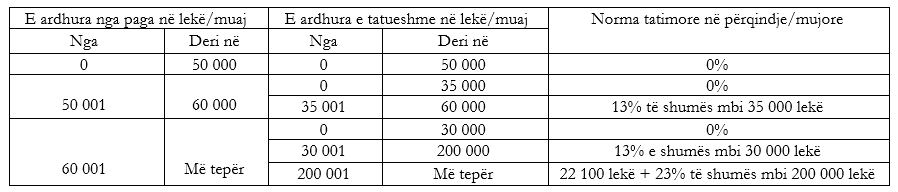
3. Section 54 of this law applies to losses incurred in 2024 and thereafter.
Article 70
Regulations
1. The Council of Ministers is charged with adopting, within three months of the entry into force of this law, the legislative acts implementing Articles 14(3), 17(6), 49, and 69 of this law.
2. The minister responsible for finance is charged with issuing, within three months of the entry into force of this law, the general guidance for the implementation of its provisions and the guidance on price transfers and advance pricing agreements.
3. The minister responsible for finance and the State Land Registry Agency are tasked with adopting, within three months of the entry into force of this law, the guidelines for the tax on the transfer of real property ownership rights.
Article 71
Cancellations
Law No. 8438 of December 28, 1998, “On Income Tax,” as amended, is repealed.
2. Point 1 of Article 9, as well as Chapter III of Law No. 9632 of October 30, 2006, “On the Local Tax System,” as amended, is repealed.
Article 72
Entry into force
This law enters into force 15 days after its publication in the Official Gazette and extends its effects from January 1, 2024, with the exception of letter “ç” of paragraph 1 of Article 69, which takes effect upon the entry into force of this law, and paragraph 2 of Article 69, which takes effect as of June 1, 2023.
Approved on March 30, 2023.
Proclaimed by Decree No. 59, dated April 24, 2023, of the President of the Republic of Albania, Bajram Begaj.
[1] This law has been partially aligned with:
– Council Directive (EU) 2016/1164 of 12 July 2016 “On the establishment of rules against tax avoidance practices that directly affect the functioning of the internal market”, as amended. Number CELEX 32016L1164, Official Journal of the European Union, L series, no. 193, dated July 19, 2016, pp. 1–14.
– Council Directive 2009/133/EC of 19 October 2009 “On the common system of taxation applicable to mergers, demergers, partial divisions, transfers of assets and exchanges of shares in relation to companies of different Member States and for the transfer of the registered office of an SE or SCE between Member States,” as amended. Number CELEX 32009L0133, Official Journal of the European Union, L series, no. 310, November 25, 2009, pp. 34–46
Download
Read also: General Instruction No. 26, dated September 8, 2020: On Income Tax
