

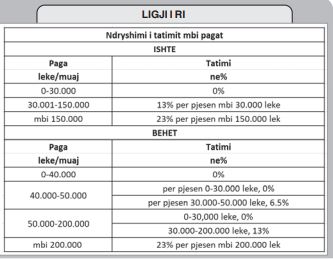
The income tax on salaries up to 40,000 lek is eliminated. After nearly eight years, the government has decided to raise the tax-free salary threshold from the current 30,000 lek to 40,000 lek. The new fiscal package presented for consultation also provides for halving the income tax rate to 6.5% on salaries up to 50,000 lek and for applying the maximum tax rate, specifically 23.1%, to salaries above 200,000 lek.
Other changes that will be officially implemented starting next July include the imposition of a 6-lek excise tax on gas used for heating or cooking, which is expected to lead to a price increase on the market, as well as the taxation of yachts refueling in our country. which until now have been free of any tax obligation. SALARIES The government's intervention in the level of taxation affects two categories: those with low incomes and the “rich.” For the bracket from 50,000 to 150,000 lek, the tax burden remains unchanged at 13%.
Specifically, the draft law on certain amendments to the “Law on Income Tax” sets the non-taxable minimum wage at 40,000 lekë, up from 30,000 lekë. This means that salaries up to 40,000 lekë will not be subject to income tax. Above this threshold, that is, for salaries up to 50,000 lekë, income tax is halved, from the current 13 percent to 6.5 percent. This tax will not apply to the full salary but only to the difference (50,000 – 30,000). “The draft law provides for a 50% reduction in the tax rate for taxpayers with wage income from 40,001 lekë/month to 50,000 lekë/month.
These taxpayers will pay 0% tax on up to 30,000 lek monthly wage income, and on amounts above that they will pay half the 13% tax rate (i.e., 50% * 13%). This ensures that lower-income citizens pay a lower payroll tax and supports the middle class by revising the upper bracket of progressive taxation. The 23% tax is set to begin applying to salaries above 200,000 lek per month, up from the current 150,000 lek per month,” the explanatory memorandum accompanying the draft states.
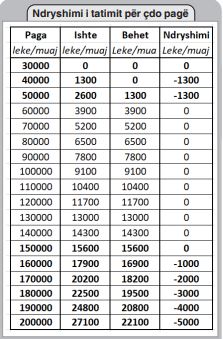
To make it simpler, any employee earning a salary below 40,000 lek will have zero taxes. Meanwhile, for salaries from 40,000 lek to 50,000 lek, the formula for calculating the tax liability is as follows: up to 30,000 lek the tax is zero; the difference is what will be taxed. Put simply, someone with a monthly salary of 46,000 lekë will pay income tax on 16,000 lekë (46,000 – 30,000). The tax on this difference, i.e., on 16,000 lek, will not be 13 percent as it is currently, but 6.5 percent. Therefore, only 1,000 lek in taxes will be paid. Meanwhile, under the current scheme, the tax liability is 13 percent, or about 2,000 lek.
Beneficiaries
According to the report, from the easing of the tax burden—namely, by zeroing the tax on wages up to 40,000 lek—71,500 employees benefit, and the average benefit is 7,800 lek per taxpayer per year, or about 557 million lek for all taxpayers. “Also, in the same vein, to ease the tax burden on needy segments of the population, this draft law proposes that taxpayers with wage income ranging from 40,001 lekë to 50,000 lekë per month, to continue paying 0.3% tax on salary income up to 30,000 lek, and, unlike the previous regime, to pay, on the amount above 30,000 lek, half of the 13% tax rate (13% * 50%).
The number of taxpayers benefiting from this tax relief is approximately 58,000, and the average benefit is 11,700 lek per taxpayer per year, or a total of 678 million lek for all taxpayers,” the report further states. Meanwhile, the change in the top bracket of progressive taxation is also provided for. Thus, the 23.1% tax is expected to begin applying to salaries above 200,000 lek per month, up from the current 150,000 lek. The number of taxpayers benefiting from this tax relief is approximately 5,900, and the average benefit is 23,000 lek per taxpayer per year, or a total of 135 million lek for all taxpayers.
The implementation of these legal changes, according to the Government's report, results in a negative impact on the state budget of -1.37 billion lek per year, while for 2022, since this provision takes effect in July 2022, the negative impact for 2022 is projected to be -685 million lek. GAS Meanwhile, the Government has reduced the excise tax on gas from the current 8 lekë to 6 lekë, but the scheme also includes gas used for heating and cooking, not just that used for transportation. Therefore, as of July 1 of next year, the gas excise tax will be 6 lek, regardless of its intended use, meaning whether it is used by household consumers or for circulation. This is expected to also lead to a price increase on the market.
Milk
Through the new fiscal package, the government has imposed a tax on milk as well. “The tax on the import or production of powdered milk is 100 lek per kilogram,” the draft states, which is also expected to be reflected in a price increase for this product on the market.
Fuel for yachts
Until now, tourist yachts that refuel have been exempt from tax obligations. But as of July next year, these vessels will be subject to tax policies. The draft proposes imposing a tax of 65 lek per liter on fuel (which includes excise duty (37 lek), turnover tax (27 lek), and carbon tax (1.5 lek) used to supply them in these areas. The application of a 65-lek-per-liter tax results in increased budget revenues, while at the same time being lower than the tax on fuel imported under normal conditions, for which total taxes amount to about 90 lek per liter.
Source: Panorama.al