




Key points
- A business that works for you is one that keeps running even when you're not physically there. The test is simple: could it be sold tomorrow with documented processes?.
- The road passes through three stages according to Michael Gerber. Document the processes, automate whatever you can, and write the job manuals.
- Gino Wickman's EOS system is made up of six components, from the 10-year vision to the 90-day objectives.
- The complete example of the write-up is a programming company, with the problems, the solution, and the new structure in a diagram.
Published January 26, 2025 · Updated August 16, 2026 with the table of the six EOS components and the structure diagram.
A business that works for you is one that keeps running even when you're not there. The opposite is easy to spot. It's Sunday at 8:00 PM, and you're once again faced with tasks and decisions, with no one to take them off your hands.
This is the gap between the original dream and the daily reality of many entrepreneurs. Unhappy clients, unclear finances, a team that doesn't meet expectations, and a family you see less and less. The good news is that this gap is closed with method, not with more hours of work.
Below you'll find why these problems occur, the three steps that put the work back into the system, and a complete example from a programming company.
Read also: Self-test: The six signs of a business without a plan
Why do these problems occur?
Because the business depends solely on you. A business that relies on a single person doesn't grow sustainably, no matter how capable that person is.
Two books have described this trap better than anyone. Traction of Gino Wickman and The E-Myth Revisited by Michael E. Gerber. Both lead to the same transition, from the employee within your business to the true entrepreneur who builds it.
The most honest test is the sale question. Could you sell your business tomorrow? A business has independent value only when its processes are documented and repeatable. Otherwise, what you're selling is you, not the business.
The three steps that turn work into a system
Gerber summarizes system construction in three practical steps, which are applied in sequence.
Document the key processes.
From taking the order to communicating with clients. The process that exists only in your head can't be delegated and is lost when you're away.
Automate as much as possible.
Technology replaces manual intervention wherever the work is repetitive. Every hour automated is an hour freed up for running the business.
Write the work manuals.
The manual is the document that allows a new employee to do the work without asking you for every step. Without a manual, there is no real delegation; there is only task distribution that ultimately falls back on you.
The six components of the EOS system
On these three steps, Entrepreneurial Operating System It provides the complete management framework. Its six components cover everything a small business needs to keep under control.
| Component | What does it mean in practice? |
|---|---|
| Vision | The 10-year and 3-year long-term goals that guide every decision. |
| People | The right people in the right places who share the vision and values. |
| The data | Key metrics that indicate whether the business is on the right track. |
| Processes | Documentation and standardization so that the work can proceed even without your physical presence. |
| Problem solving | Clear rules for identifying and resolving problems without blockages. |
| Implementation | 90-day objective for continuous and measurable progress |
For the last component, we have a separate guide. The way it's built. 90-day plan with three objectives and a weekly meeting It has been covered step by step there.
Practical example. The programming company
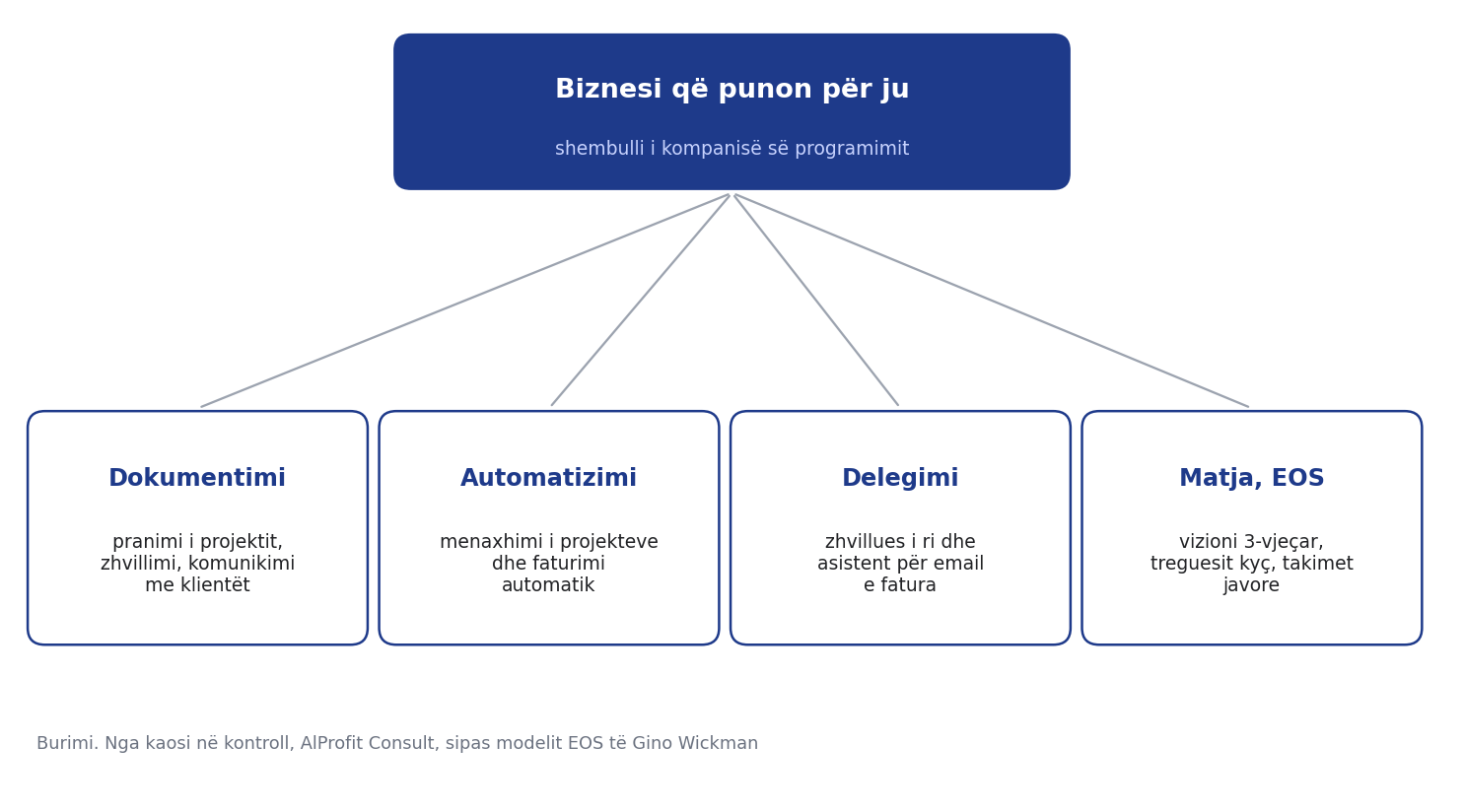
A company offers software solutions to various clients. Many entrepreneurs recognize these symptoms. Small projects are delayed, clients complain, projects run over schedule, and there's never any time for strategic development.
The solution followed four directions simultaneously.
Documentation of three processes
Project acceptance from the initial contact through contract signing. Development steps from analysis to programming, testing, and delivery. And communication with clients, including weekly reports and guidelines for responding to complaints.
Automation with the right tools
Asana or Jira for project management and QuickBooks for automated invoicing. The manual work of tracking and invoicing was replaced by the system.
Delegation with two hires
A new software developer and a virtual assistant for emails and invoices. The owner stepped away from operational work and returned to management.
EOS implementation by figures
The vision was clearly written. Within three years, the business will offer customized software solutions to 50 clients. Two key metrics were set: the number of projects completed on time and the customer satisfaction rate. Progress is discussed in weekly meetings.
The new structure looks like this.
Give the business the purpose it deserves.
Transformation isn't simple, but it's achievable. The path goes through planning, delegation, and systematization, and the result is a business that thrives without relying on your constant presence. Start today with the first documented process.
Frequently asked questions
What does a business that works for you mean?
A business with documented processes, delegated tasks, and clear metrics that runs even when the owner isn't present.
How do I test if my business depends only on me?
The sales question: if the business can't be sold to someone tomorrow with the written processes, then its value lies with you, not with the system.
Where should I start documenting the processes?
From the main processes that involve the client—taking the order or project, the implementation steps, and communication—then come the internal work manuals.
Which tools help with automation?
Examples in the article are Asana or Jira for projects and QuickBooks for invoicing. The principle applies to any tool: it automates work that is performed in the same way.
Is the EOS system only for large companies?
No. EOS is built specifically for growing entrepreneurial businesses and is implemented with simple tools: a vision sheet, a few metrics, and weekly meetings.
