



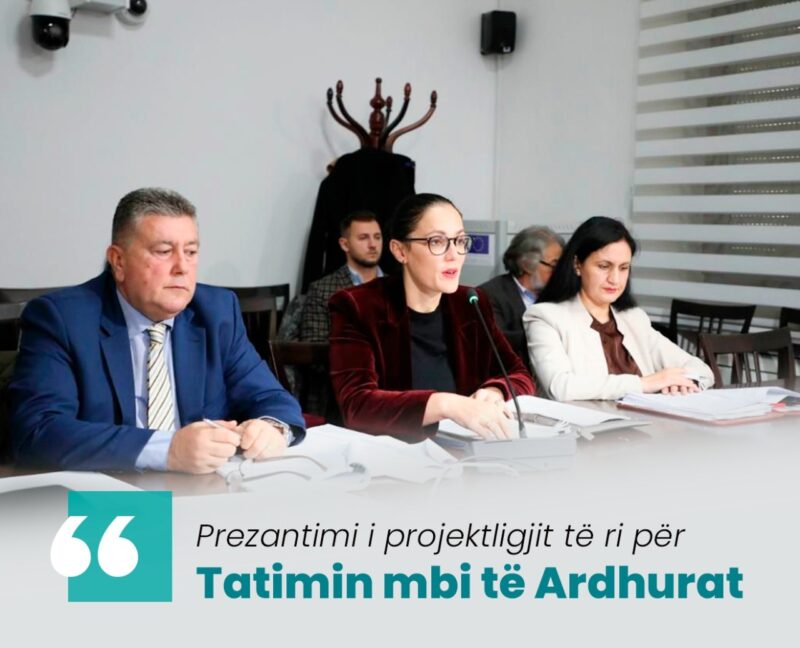
Minister of Finance and Economy, Delina Ibrahimaj, presented the new draft law to the parliamentary committee for Economy and Finance. “For income tax.”.
Introduction
In her speech, the Minister emphasized that the drafting of a new income tax law arose from the need for a new approach to taxing individuals and their income from various sources, because the current law dates back to 1998 and the various amendments made over the years do not address new innovations that have emerged in the field of personal income and corporate profit taxation.
The minister announced that the draft law was prepared with the technical assistance of the IMF and introduces an innovation in Albanian tax legislation, aiming for tax neutrality, increased transparency, and the application of the fairest possible tax system, as well as the gradual alignment of the income tax system in Albania with European Union directives.
“A new approach is needed as a result of various legal amendments over time and due to incentives, exemptions, and reduced rates approved over the years, as the principle of tax neutrality has been violated. Some of these incentives, exemptions, and rates have already fulfilled their mission, or have not fulfilled their mission and therefore are proposed to be changed.”
The Ibrahimaj.
One of the innovations of the draft law is the determination of income taxation into two categories: taxation of individuals and sole proprietors with personal income tax, and taxation of legal entities with corporate profit tax.
Tri grupet e të ardhurave personale
Likewise, he categorizes 3 groups of personal income realized by individuals and sole proprietors, which are subject to personal income tax: employment income; business income; and passive capital income.
Regarding the taxation of individuals and small natural persons in the fields of production, trade, transport, and services, the Minister clarified that the draft law proposes maintaining the existing tax scheme with a rate of 0.1% primarily for small family businesses, where natural persons and legal entities with turnover up to 14 million lek will pay 0% tax on business income and on corporate income until 2029.
The bill proposes the inclusion in the tax scheme from January 1, 2023, of businesses primarily providing professional services, thereby addressing the identified phenomenon related to the provision of services, mainly in liberal professions. This phenomenon has eroded the payroll tax base and created dissatisfaction among medium and high-income employees regarding tax policies applied to liberal professions or service providers in general.
Minister Ibrahimaj's statement:
The Law “On Income Tax” constitutes a very important component of the Albanian tax legislation package.
This draft law is submitted to the Assembly by the Council of Ministers, in accordance with legal procedure, for approval within the framework of last year's Fiscal Package, which will commence in 2023, after consultation with stakeholders, as well as considering the gradual alignment of Albania's income tax system with the principles of European Union directives.
The need for legislative intervention and the repeal of the current law and the drafting of a new law arose naturally, given that the current law dates back to 1998. It also arose from the need for a new approach to taxing individuals and their income from various sources.
In recent years, many changes have occurred in the field of international taxation, information exchange, and tax cooperation, with the aim of preventing unfair tax competition.
Also, new innovations have arisen in the field of personal income and corporate profit taxation, which have not been reflected and regulated through amendments made to the current law.
Therefore, a new approach is needed as a result of various amendments to the law over time and due to incentives, exemptions, and reduced rates approved over the years, as the principle of tax neutrality has been violated.
Pse ndryshohen incentivat dhe përjashtimet
Some of these incentives, exemptions, and tariffs have already fulfilled their mission, or have not fulfilled their mission and are therefore proposed for change. Meanwhile, interventions in tariffs, regimes, and exemptions have in some cases led to tax evasion, encouraging individual taxpayers, sole proprietors, or legal entities to switch from a higher tax regime to a lower tax regime.
The proposed draft law, which was also drafted with the technical assistance of the IMF, introduces an innovation in Albanian tax legislation, aiming for tax neutrality, increased transparency, and the application of the fairest possible tax system. The draft law largely fulfills the requirements related to:
Kërkesat që përmbush projektligji
- improving the tax system for individuals and legal entities in Albania;
- Strengthening the principle of neutrality in the Albanian tax system;
- the gradual approximation of the income tax system in Albania with the EU Directives regarding income and capital taxation;
- the shortcomings and legislative gaps identified during the 23-year period of application of the existing law;
- reflection in Albanian tax legislation on income, of the agreed principles and commitments undertaken by the Republic of Albania and ratified by the Assembly of the Republic of Albania in relation to the Automatic Exchange of Information (AEOI), the Multilateral Instrument (MLI), the Base Erosion and Profit Shifting (BEPS) Inclusive Framework, etc.;
- modernizing the direct tax system by increasing the level of self-declaration for the purpose of processing information at the entity and individual level, which will improve voluntary compliance with the declaration and payment of tax obligations;
- Designing a fairer and more stimulating tax system.
Draft law risks:
It distinguishes income taxation into two categories:
- The taxation of individuals and sole proprietorships on personal income tax;
- Division of legal entities with corporate income tax.
Categorize the 3 groups of personal income earned by individuals and sole proprietors that are subject to personal income tax:
- Employment income.
- Business income.
- Passive capital income.
Income from employment is taxed under the current progressive tax schedule of 0%, 13%, and 23%, with the difference that the 0% rate has been removed, since the law's scheme provides for a deduction from the tax base while maintaining the same outcome as under the current system, but it is provided that the category of employment income between 40,000 and 50,000 lekë will not pay any tax. So we no longer have a zero tax on up to 40,000 lek or 50,000 lek as this law proposes, but rather a different scheme that provides a deduction from the taxable base for the equivalent amount of income up to 50,000 lek per month. For the other brackets, the rates remain 13% and 23%.
Business income is taxed at 15 percent on net profit.
Passive capital income and other income are taxed at a rate of 15%, except for dividends, which are taxed at 8%.
Skema e thjeshtuar deri në 10 milionë lekë
A simplified taxation scheme has been foreseen for business income up to 10 million lekë per year, allowing expenses to be declared as a lump sum without the obligation of maintaining accounting records. This is an optional form, meaning the business chooses to use the simplified declaration method, which does not require maintaining an accounting scheme. Instead, based on the operating sector, a percentage has been determined that will be equivalent to the expenses over the income generated by the business.
Corporate income tax has a tax rate of 15%.
The draft law also provides for several other deductions:
- a deduction of 48,000 Lekë from the employee's tax base for each child under 18 years of age in their charge;
- A deduction of 100,000 leks for the education of each child in his charge, which will be declared in the individual income tax return each year, for the previous year, in order to recognize these as expenses.
The draft law in a balanced way stipulates that:
- Taxation of traders and self-employed individuals, namely at a rate of 15 percent on net profit when net profit is up to 14 million lek per year;
- at a 23% rate on net profit, only for the portion of profit above 14 million lek per year.
The proposed personal income tax system for merchants and the self-employed aims to:
- to treat all taxpayers equally and fairly, regardless of their legal form;
- to discourage tax evasion through the transition from employment to self-employment business relationships.
- to discourage the use of the individual's status and the existing zero-rate tax bracket as a mechanism for shifting profits from the entity taxed at 15% to the individual, which is tax-free.
Self-employed individuals and traders also have the right to deduct from the tax base, thus reducing their tax liability, for all items that are envisaged for employees.
Through the application of tax base deductions, the effective tax rate for traders and the self-employed is reduced below the statutory rate:
The effective tax rate for a trader or self-employed person with annual gross income of 5 million lek is set at 4.5% of income in the case of producers such as bakeries, pastry shops, etc., or 11% of the presumed net profit.;
- merchant of goods 3 % of income or 10 % of presumed net profit;
- for a bar restaurant, 4.5% of revenue or 11.2% of the assumed net profit;
Self-employed in professional services (attorney, consultant, notary, etc.) 91% of income or 12% of presumed net profit.
Regarding the taxation of individuals and small businesses in the fields of manufacturing, trade, transportation, and services:
The draft law proposes maintaining the existing flat-rate tax scheme at a rate of 0.1% primarily for small family businesses (manufacturing, trade, transport, social catering, handicrafts, etc.), where natural persons and legal entities with turnover up to 14 million lek will pay 0% tax on business income and on corporate income, respectively, until 2029.
The bill proposes the inclusion in the tax scheme from January 1, 2023, of businesses that primarily provide professional services.,
addressing the identified phenomenon in the provision of services, mainly in liberal professions, a phenomenon that has eroded the basis of payrolls and created dissatisfaction among medium and high-income employees, in relation to tax policies applied to liberal professions, or service providers in general.
The progressive system with rates of 15% and 23% on self-employment and trading income for natural persons is necessary because a category of taxpayers retain their status as natural persons to avoid dividend tax as business partners.
Natural persons who generate income from self-employment and trade maintain their status as natural persons, regardless of achieving high profit levels. This is to avoid transitioning to legal entity status and to avoid dividend tax as business partners.
Based on data from the Tax Administration, it appears that in the services sector, out of approximately 50,000 taxpayers who are natural persons, the declared net profit exceeding 14 million lek is 4.7 billion lek. If these taxpayers with such high profit levels were legal entities, the theoretical dividend tax that would be paid would be 320 million lek.;
Shifrat nga prodhimi, transporti dhe tregtia
In the production, transport, and trade sectors: 91 individuals declare a net profit each exceeding 14 million lekë annually, totaling 2.3 billion lekë in profit. If these taxpayers with such high profit levels had the status of a legal entity, the theoretical dividend tax that would be paid would be 160 million lekë.
The progressive 23% rate provided for the self-employed and traders with a net profit above 14 million lek per year does not harm small business as a whole. This legal adjustment affects a very small percentage of individuals; their share will continue to maintain its current status, meaning they will not pay income tax since the specified deadline is until 2029.
To illustrate this fact, according to the data, it turns out that among the group of individuals operating in the services sector, out of over 50,000 taxpayers, only 0.3% of their total have a net profit exceeding 14 million. This category will pay a 23% tax rate on profits above 14 million, effective January 1, 2023, while on net profits up to 14 million they will pay a 15% tax rate, the group of self-employed professionals.
Among the group of natural persons engaged in trade, out of over 42,000 taxpayers, only 0.15% of their total have a net profit exceeding 14 million. They will pay 23% tax on the profit above 14 million, while net profits up to 14 million lek are exempt.
Deklarimi i thjeshtuar për të vetëpunësuarit
Projektligji ka parashikuar skema të thjeshta deklarimi për personat fizikë të vetëpunësuar dhe me të ardhura nga tregtia, me qarkullim deri në 10,000,000 lekë në vit.
Corporate profit tax provisions include new developments in international taxation and simultaneously facilitate the corporation through:
- Extension of the loss carryforward period from 3 years to 5 years;
- Simplification and long-term cost reduction through individual straight-line depreciation of machinery/equipment and software/hardware groups.;
- Calculation of taxation rules for long-term contracts;
- Applicable rules for business reorganizations and business asset transfers;
- Recognition of the residual value of an asset that is retired from service as a deductible expense;
- Establishing transparent rules regarding bad debt;
- Establishing universally accepted rules regarding the distribution and boundaries of lending interests, etc.
The draft law foresees taxation rules for gifts and inheritances, while also providing for tax exemptions for gifts/inheritances within the family tree.
Effects and transient period
Regarding revenue, we clarify that generally the draft law proposes maintaining existing tax rates, while also proposing the setting of a time limit for incentives, zero rates, and reduced tax rates for certain sectors, industries, and business groups.
Projektligji parashikon lehtësim të barrës tatimore për tatimpaguesit me të ardhura të ulëta, konkretisht kategorisë me të ardhura nga punësimi në fashën 40, 50 mijë lekë t’u zbritet e gjithë baza tatimore, pra nuk do të paguajnë tatim mbi të ardhurat nga punësimi. Njëkohësisht lehtësohet barra tatimore për të gjithë tatimpaguesit me të ardhura nga punësimi në fashën 50-60 mijë lekë, të cilëve nga 30 mijë lekë që ishte e ardhura e tatueshme me 0%, tashmë u njihet një zbritje tatimore prej 35 mijë lekësh në muaj, duke lehtësuar barrën tatimore të tatimpaguesve. Efektet në buxhetin e shtetit parashikohet të jenë negative me rreth -1.1 miliardë lekë.
Shërbimet profesionale nga 1 janar 2023
The draft law proposes that, in the field of services—and particularly the provision of professional services—due to the risk and market distortion, the taxation of natural and legal persons with income up to 14 million lekë begin on January 1, 2023. According to taxpayer registry data, there are approximately 16,700 registered taxpayers providing professional services, for whom the tax scheme is proposed to begin on January 1, 2023. The Ministry of Finance and Economy considers that the five-year period with a 0% tax rate and, before that, the two-year period with a 5% tax rate on net profit, have been sufficient incentives for this sector. From the implementation of the tax under the provisions of this law for this category, an estimated 2.1 billion lek are expected to be collected into the state budget.
Meanwhile, individuals and legal entities with income above 14 million lekë per year are proposed to enter the taxation scheme in 2029, and for this reason, it is difficult to calculate the effects at this moment.
Source: Ministry of Finance and Economy.
