

- Regulatory Act No. 7, dated December 14, 2023, amended Law No. 29/2023 just days before it was set to take effect.
- The first change divided the payroll period by VAT registration: monthly for those registered, and quarterly for others.
- The second amendment affects the transitional provisions of Article 69 for the 2024 tax period.
- The 2024 prepayments for professional services were calculated based on prior-year statements.
This regulatory act is brief, but its first amendment remains valid today. The payroll deadline is not the same for everyone. Entities and self-employed individuals or VAT-registered traders submit monthly returns by the 20th of the following month. Those not registered for VAT submit quarterly returns by the 20th of the month following the quarter. The full rule is on our page. Declaration in e-Filing.
Part Two, in Article 69, was transitional and took effect in 2024. It explains why that year's installments were calculated on a basis that many taxpayers did not expect. How installments are calculated today is explained on the page of prepayments.
Normative Act
No. 7, dated December 14, 2023
For Certain Amendments and Changes to Law No. 29/2023, “On Income Tax,” as Amended
In support of Article 101 of the Constitution, on the proposal of the Minister of Finance and Economy, the Council of Ministers
SET:
In Law No. 29/2023, “On Income Tax,” as amended, the following changes and additions are made:
Article 1
At point 1 of Article 65, the words “… and no later than the 20th day of the month following each quarter for self-employed individuals or registered traders.” are replaced with “… and self-employed individuals or traders registered for VAT, and no later than the 20th day of the month following each quarter for self-employed individuals or traders who are not registered for VAT.”.
Any employer who is obligated to pay employment income is required to withhold tax on this income, to submit the payroll list and transfer the tax withheld on the payroll list to the budget treasury account no later than the 20th of the following month for entities
and no later than the 20th day of the month following each quarter for self-employed individuals or sole proprietors... and self-employed individuals or traders registered for VAT, and no later than the 20th of the month following each quarter for self-employed individuals or traders who are not registered for VAT.
Neni 2
Article 69 is amended and supplemented as follows:
1. After the letter “dh” the letters “e”, “ë” and “f” are added, with the following content:
“e) For all taxpayers registered before December 31, 2023, who are subject to simplified profit tax or profit tax, as well as for those who register for the first time in the following year, for the 2024 tax period, the tax forms and responsibilities shall be used, in accordance with Law No. 9632, date 10/30/2006, “On the local tax system,” as amended, as well as Law No. 8438, dated December 28, 1998, “On income tax,” as amended;
e) Withholding taxes, pursuant to Article 63 of this law, for categories of persons who provide professional services and are subject to income tax as of January 1, 2024, exceptionally for the year 2024, are calculated based on simplified profit tax and income tax returns for previous years, applying the tax rates provided in this law;
f) The withholding tax return, pursuant to Article 57 of this law, shall apply beginning with the January 2025 tax period. For the year 2024, the existing form shall be used.
2. In point 2, the words “… until December 31, 2023 …” are replaced with “… until December 31, 2024 …”.
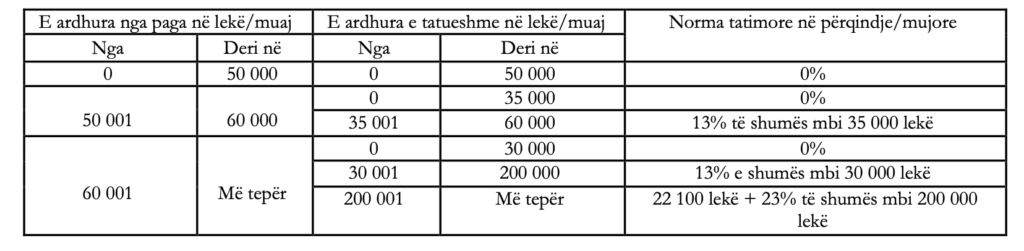
Personal income tax table for employment income for the period from June 1, 2023 to December 31, 2024 is as follows:
Changes to paragraph 5 of the article
3. In point 5, at the end of the sentence, the words “…, with the exception of the letters “e”, “ë” and “f”, of this article, the implementation of which shall be carried out in accordance with the provisions of Law No. 8438, dated 12/28/1998, “On Income Tax,” as amended, until December 2024.”.
Until the date on which this law takes effect, as defined in Article 72 thereof, the provisions of Law No. 8438 of December 28, 1998, “On Income Tax,” as amended, …, shall apply. , with the exception of the letters “e”, “ë” and “f”, of this article, the implementation of which shall be carried out in accordance with the provisions of Law No. 8438, dated 12/28/1998, “On Income Tax,” as amended, until December 2024”.
Article 3
In Article 72, after the words “… January 1, 2024, with the exception of …” the words “… Articles 22, 23, 24, paragraph 1, which extend the effects from January 1, 2025, …” are added.
This law enters into force 15 days after its publication in the Official Gazette and extends its effects from January 1, 2024, with the exception of subparagraph “ç” of paragraph 1 of Article 69, which takes effect upon the entry into force of this law, and paragraph 2 of Article 69, which takes effect as of June 1, 2023, Articles 22, 23, and 24, paragraph 1, which extend the effects from January 1, 2025.
Article 4
This normative act takes effect immediately and is published in the Official Gazette.
Download
Source: Official Gazette.
Every time there is a tax or financial change that affects your business, we notify you directly by email with a practical explanation.
Send me free notifications