



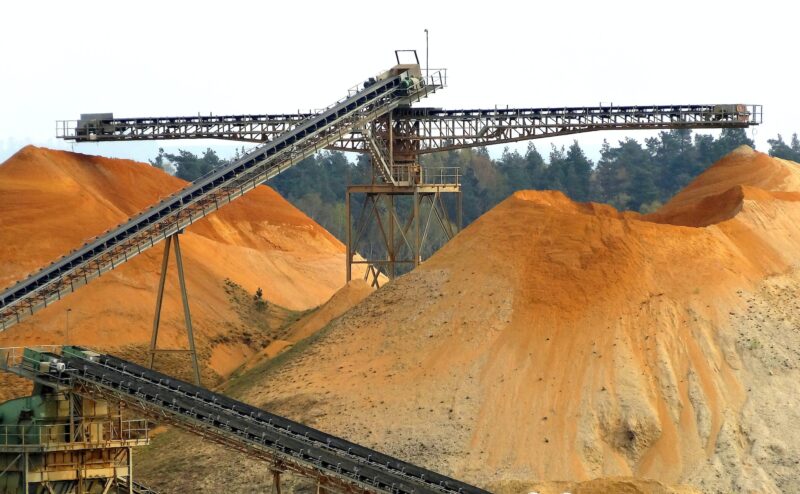
SECTION B – EXTRACTIVE INDUSTRIES
Mining and quarries involve the extraction of minerals found in their natural state as solid (coal and minerals), liquid (petroleum), or gaseous (natural gas). Extraction can be achieved through various methods such as underground or surface mining, with wells, deep-sea mining, etc.
This section covers supplementary activities for preparing raw materials for trade, for example, crushing, grinding, cleaning, drying, sorting, mineral beneficiation, natural gas liquefaction, and agglomeration of solid fuels. These operations are often carried out by extraction units and/or other nearby units.
Extractive activities are classified into divisions, groups, and classes based on the main mineral produced. Divisions 05, 06 relate to underground and quarry extraction of fossil fuels (coal, lignite, oil, gas); divisions 07, 08 relate to metal minerals, other minerals, or quarry products.
Some of the technical operations of this section, particularly those related to hydrocarbon extraction, may be explained in the third part, in specialized units, as an industrial service, which is reflected in division 09.
This section does not include:
- production of extractive materials, see Section C (Production)
- Use of raw materials without further processing for construction purposes, see Section F (Construction) Packaging of water from natural and artesian wells, see 11.07
- Thawing, crushing, or other treatment of soil, rocks, and minerals not carried out in connection with mining and quarrying, see 23.9
05 Coal and Lignite Extraction
This separation involves extracting solid minerals from the underground or open pit mines and includes operations (e.g., crushing, cleaning, compacting, and other steps necessary for transportation, etc.).
This division does not include the manufacture of coke (see 19.10), and manufacture of patent fuels (see 09.90) or the manufacture of briquettes (see 19.20).
05.1 Removal of Hard Coal
05.10 Hard coal extraction
This class includes:
- hard coal extraction: underground or surface extraction, including extraction by liquefaction methods;
- lignite, pelleting, classification, pulverization, compaction, etc. of coal for classification, quality improvement, or to assist with transportation or storage.
This class also includes:
- taking hard coal from exploitation residues.
This class does not include:
- drawing of the lines, see 05.20
- peat extraction, see 08.92
- support for activities for the extraction of hard coal, see 09.90
- Test drilling for coal extraction, 09.90
- Coke ovens for the production of solid fuels, see 19.10
- production of hard coal briquettes, see 19.20
- work performed to improve or prepare assets for the extraction of solid coal see 43.12
05.2 Line Break Output
05.20 Line Removal
This class includes:
- extraction of lignite (brown coal), underground or surface extraction, including extraction through liquefaction methods
- Larjen, tharjen, sprucimin, ngjeshjen e linjiteve për të përmirësuar cilësinë ose për të përmirësuar transportin dhe magazinimin.
This class does not include:
- hard coal extraction, see 05.10
- peat extraction, see 08.92
- Ancillary activities for lignite extraction, see 09.90
- Exploratory drilling for coal, see 09.90
- production of lignite briquettes for combustion, see 19.20
- work performed to improve and prepare assets for coal extraction, see 43.12
06 Extraction of crude oil and natural gas
This division includes the production of crude oil, extraction of oil from oil shale and oil sands, and the production of natural gas and the discovery of hydrocarbon liquids. This division includes activities performed and/or developed for oil and gas properties. Some activities may include drilling, completion, and equipping of wells; separation operations, breaking of emulsions, desalting of equipment, and limiting of field areas containing crude oil and all other activities in the preparation of oil and gas from the point of production to the point of transportation.
This division does not include:
- contractual intermediation, for services in the oil and gas fields, see 09.10
- use of oil and gas wells, see 09.10
- Drilling test, see 09.10
- petroleum refining, see 19.20
- geophysical, geological, and seismic surveys, see 71.12
06.1 Crude Oil Extraction
06.10 Crude oil extraction
This class includes:
- crude oil extraction
This class also includes:
- extraction of bitumens or oil shales and tar sands
- Oil production from rocks and oil sands
- crude oil production processes: decanting, desalting, dehydration, stabilization, etc.
This class does not include:
- Support activities for oil and natural gas extraction, see 09.10
- use of oil and gas, see 09.10
- production of refined petroleum products, see 19.20
- recovery of liquid petroleum gases obtained from oil refinery, see 19.20
- use of oil pipelines, see 49.50
06.2 Natural gas extraction
06.20 Natural Gas Extraction
This class includes:
- Crude gaseous hydrocarbon production (natural gas)
- Condensate discharge
- Processing and separation of liquid hydrocarbon fractions
- Natural gas desulfurization
This class also includes:
- withdrawal of hydrocarbon liquids, obtained from the liquefaction of natural gas
This class does not include:
- Support activities for oil and natural gas extraction, see 09.10
- use of oil and gas, see 09.10
- Liquefied petroleum gas recovery from oil refinery, see 19.20
- industrial gas processing, see 20.11
- use of gas pipelines, see 49.50
07 Extraction of metallic minerals
This division includes the extraction of metallic minerals (ores) from underground or open-pit mines. It also includes operations for the production and beneficiation of ore, such as crushing, grinding, washing, drying, calcining, ore dressing, gravity separation, or flotation operations.
This division does not include:
- Pectus excavatum, see 20.13
- production of aluminum oxide, see 24.42
- furnace processes, see section 24
07.1 Extraction of Iron Ores
07.10 Iron Ore Extraction
This class includes:
- iron ore extraction
- The beneficiation and agglomeration of iron ore
This class does not include:
- production and manufacture of pyrites and pyrothines (except baking), see 08.91
07.2 Non-metallic mineral extraction
This group includes the extraction of non-metallic minerals
07.21 Uranium and Thorium Mineral Extraction
This class includes:
- extraction of a mineral whose value depends mainly on its uranium and thorium content; uranium-thorium mixture, etc.
- concentrations of these minerals
- production of uranium oxide (yellowcake)
This class does not include:
- the extraction of uranium and thorium minerals, see 20.13
- production of uranium metal from alloys or other minerals, see 24.46
- The enrichment and refining of uranium, see 24.46
07.29 Extraction of other non-metallic minerals
This class includes:
- extraction and preparation of a mineral whose value depends mainly on the content of non-metallic minerals:
- aluminum (bauxite), bauxite, lead, zinc, calla, magnesite, chromite, nickelite, cobaltite, molybdenite, taconite, vanadinite, etc.
- Precious metals: gold, silver, platinum
This class does not include:
- Extraction and preparation of uranium and thorium ore, see 07.21
- production of aluminum oxide, see 24.42
- production of copper or nickel metal, see 24.44, 24.45
08 Extraction of other minerals from mines or quarries
This sector includes mining or quarrying, as well as the extraction of alluvial deposits, rock crushing, and the use of salt pans. These products are mainly used in construction (as sand, stone, etc.), manufacturing of materials (as clay, gypsum, lime, etc.), chemical production, and so on.
This division does not include the processing (except crushing, grinding, cutting, cleaning, drying, sorting, and mixing) of extracted minerals.
Extraction of stone, sand, and clay
08.11 Extraction from the career of decorative and building stone, limestone, gypsum, pumice, and slate
This class includes:
- Quarrying, carving, and cutting decorative and building stones such as marble, granite, sandstone, etc.
- Crushing and grinding of decorative and construction stones;
- career extraction, crushing, and pulverization of limestone
- Gypsum and anhydrite extraction
- extraction of uncalcinated chalk and dolomites
This class does not include:
- extraction of chemical minerals and chemical fertilizers, see 08.91
- calcined dolomites production, see 23.52
- dressing, shaping, and finishing of stone outside the quarry, see 23.70
08.12 Gravel and sand extraction operations, clay and kaolin extraction;
This class includes:
- extraction and dredging of industrial sand, construction sand, and gravel;
- crushing and chipping of gravel;
- sand removal;
- Extraction of clay, refractory clay and kaolin.
This class does not include:
- asphalt sand removal, see 06.10
08.9 Extraction of other minerals, n.e.c.
08.91 Extraction of chemical minerals and chemical fertilizers
This class includes:
- extraction of natural phosphates and natural potash salts;
- discharge of sulfur;
- processing and preparation of pies and tarts, excluding baking;
- extraction of natural barium sulfates and carbonates, borates, sulfates, and magnesium;
- extraction of colored earth, fluorite, and other minerals, the value of which is as a source for chemicals
This class also includes:
- Removal of natural waste.
This class does not include:
- salt removal, see 08.93
- For forging of the iron pivot, see 20.13
- production of synthetic fertilizers and nitrogenous fertilizers, see 20.15
Excavation of peat
This class includes:
- peat extraction;
- processing peat to improve quality or facilitate transport and storage.
This class does not include:
- Special auxiliary activities for peat extraction, see 09.90
- peat briquette production, see 19.20
- production of a mixture of peat and soil, soil, natural soil, sand, clay, mineral fertilizer, see 20.15.
08.93 Salt Extraction
This class includes:
- extraction of salt from underground, including dissolution and pumping;
- production of salt from the evaporation of seawater or other saline waters
- Preparation, purification, and refining of salt according to producers
This class does not include:
- For the processing of salt for table salt, e.g. as iodized salt, see 10.84
- production of drinking water from the evaporation of seawater, see 36.00
08.99 Other mining and quarrying industries n.e.c.
This class includes:
- extraction of minerals and various materials from beneath the earth and quarries:
- abrasive materials, asbestos, diatomaceous earth, natural graphite, talc, feldspar, etc.
- natural asphalt, asphaltic rocks, and asphalts; natural solid bitumen
- Precious stones, quartzes, micas, etc.
09 Supporting mining activities
This division includes specialized third-party extraction support services with brokerage. This includes research services through traditional exploratory methods, such as surface sampling and conducting geological studies, as well as drilling, test drilling, or redrilling for oil wells, metallic or non-metallic minerals. Other typical services cover initial oil well construction, cementing of oil and gas wells, cleaning, pumping of oil and gas wells, sealing and breaking of mine shafts, mobile removal services from mines, etc.
09.1 Support activities for oil and natural gas extraction
09.10 Support activities for oil and natural gas extraction
This class includes:
- oil and gas services for third parties
- exploitation services in line with oil and gas extraction, i.e., traditional exploitation methods such as conducting geological surveys to determine the site
- Exploration and drilling, drilling contracting, repair and assembly of metal skeletons, cementing of oil and gas wells, well pumping, well plugging and abandonment, etc.
- liquefaction and regasification of natural gas for transportation purposes, carried out at the mine site
- pumping services, on behalf of third parties
- oil and gas extraction compliance testing
This class also includes:
- firefighting services in oil and gas fields
This class does not include:
- service activities carried out by operators in oil and gas fields, see 06.10, 06.20
- specialized repairs of oil machinery, see 33.12
- liquefaction and regasification of natural gas for transportation purposes, carried out at the mine site, see 52.21
- geophysical, geological, and seismic surveys, see 71.12
09.9 Support activities for other mineral extraction
09.90 Support activities for other mining and quarrying
This class includes:
- support services for third-party accounts, required for mining activities in divisions 05, 07, and 08:
- exploitation services, i.e., the traditional prospecting method, such as taking a sample and conducting geological observations for possible locations.
- drilling and pumping services, for third-party accounts
- test measurements and borehole drilling tests.
- Specialized repair of mining machinery, see 33.12
This class does not include:
- exploitation of mines or quarries for third parties, see divisions 05, 07 and 08
- Geophysical prospecting services, on behalf of third parties, see 71.12
Source: Institute of Statistics (INSTAT)
