

- The property revaluation is carried out through December 31, 2026, with a 5.1% tax on the difference between the new value and the registered value, pursuant to Law No. 85/2025.
- The new value comes from a licensed expert, but it cannot be lower than the tax rates, nor from the Cadastre itself at the minimum tax rates.
- When the property is registered without a value, the purchase value is determined in accordance with Instruction No. 34, dated December 29, 2023.
- Claims paid through December 31, 2026, that have not been finalized by ASHK will be closed by March 31, 2027.
- Legal entities pay 51 TP3T and reflect the difference in their 2026 financial statements.
Law No. 85/2025 “On the Revaluation of Immovable Property” entered into force in January 2026. However, the mere adoption of the law was not sufficient to start the process. The procedures were not clear, the forms did not officially exist, the service fees had not been published, and no Cadastre office could process any application without the implementing instruction. This situation created uncertainty and led many property owners to wait before taking action.
Read also: Local taxes and property tax
What did Directive No. 5/2026 bring?
The instruction of Joint No. 5, dated February 19, 2026, signed by the Minister of Finance and the Director General of the ASHK, closed this gap. The full document, with all sub-points, appendices, and tables, delivered what was missing: the precise calculation rules, the official forms (Annexes 1–4), the service fees, the ASHK's timeframes, the procedure for returning an incorrect payment, and the necessary clarifications for special cases such as properties with no recorded value.
This blog does not aim to re-explain from the beginning why revaluation is worthwhile for tax purposes or how the 5% versus 15% calculation works—we have addressed that extensively in our guide published in January 2026. The purpose here is to explain precisely what this new Instruction introduced, how the situation changed before and after 19 February, and what you should specifically do now.
What was unclear before the instruction and what it clarified
If you had asked an ASHK employee in early February 2026 how to apply for revaluation, you would have received an uncertain answer: “The law exists, but we are waiting for the instruction.” This was not an administrative problem; it was a legal one. Without implementing instructions, no procedure had a legal basis to be processed. That is why ASHK offices were not accepting applications, even if the owner showed up with all documents.
Instruction No. 5/2026 (entered into force February 19, 2026) He put an end to this situation. Here's exactly what wasn't known and was clarified:
The official service fee was not known
Before the instruction, owners did not know how much the administrative process would cost, beyond the 5% tax. The Instruction (Chapter VIII) publishes the full table with three fee levels based on the size of the tax, under the service code RVP.
The revaluation date had remained undefined
It was not clear whether the legally significant date was the date of application, the date of tax calculation, or the date of payment. The guidance makes it perfectly clear: the revaluation date is the date the tax is paid. This has direct implications: if you sell the property two months after revaluation, the sale basis is calculated from the value on the date you paid, not the date you submitted the documents.
The forms did not officially exist
The instruction is accompanied by Annexes Nos. 1–4, which are, respectively: the application form for individuals, the voluntary declaration for businesses, the invoice template, and the payment form for legal entities.
ASHK’s registration deadline had no legal basis
Now it is precise: 5 working days from the confirmation of payment. Before the instruction, this deadline did not exist and owners had no legal instrument to push ASHK to act.
Payment codes were not officially published
Individuals pay using revenue code 7020900, through ASHK’s special account at second-tier banks. Legal entities pay using code 7020400, directly at the Regional Tax Directorate.
The rule for properties with no value had remained unclear
Instruction 5/2026 explicitly refers to the formulas in Instruction 34/2023 and its Annex No. 1, specifying how the deductible value is found for each type of property with no registered value.
The procedure for refunding an erroneous payment was missing
Now Chapter VII of the Instruction regulates it precisely: the deadline, the competent authority, and the refund route.
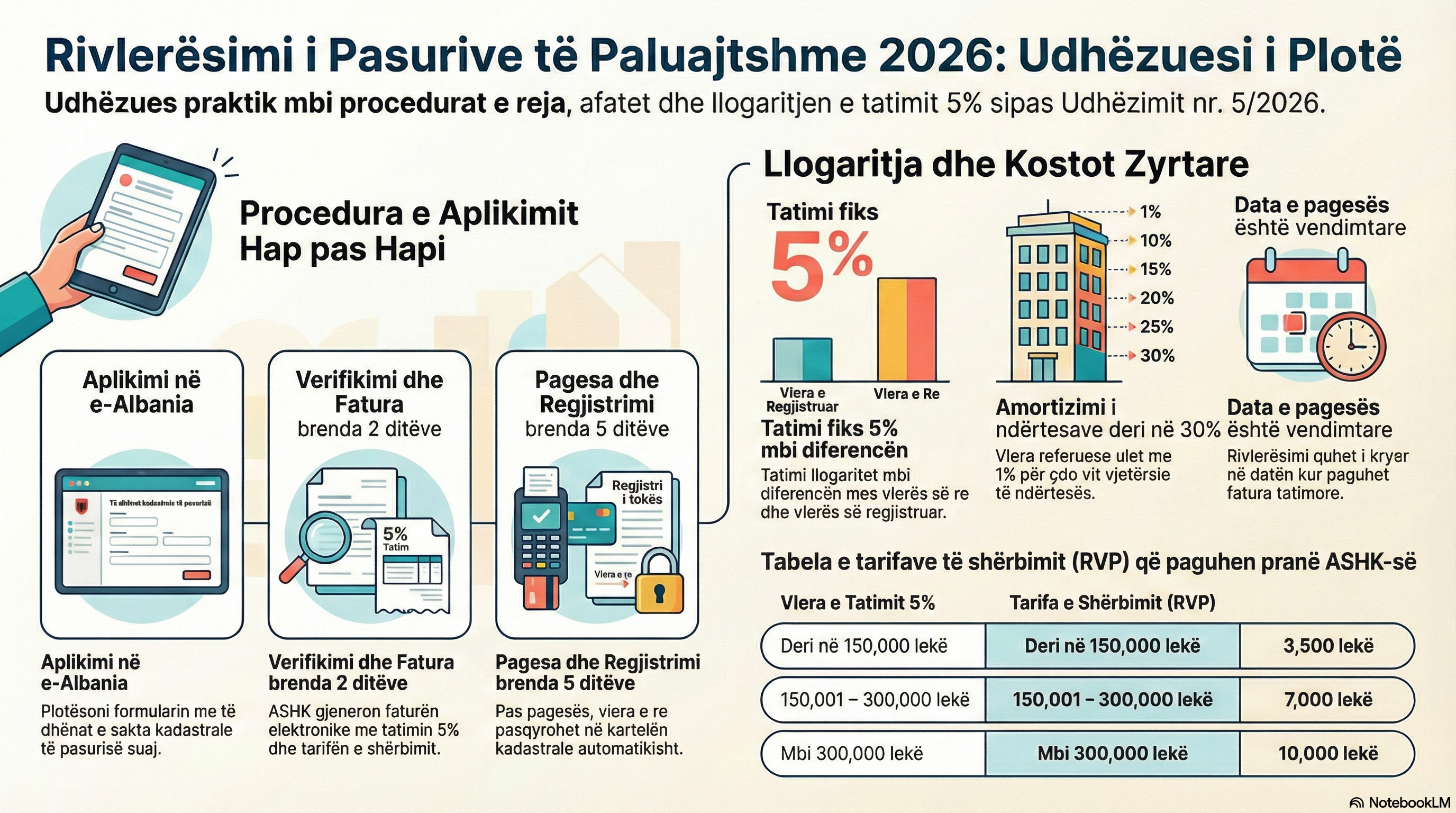
How the tax base is calculated, the correct formula, depreciation deduction, and the case of the minimum taxable price.
Before we talk about the procedure, we need to understand how the tax is calculated in practice, because this directly affects your decision on whether to revalue and at what value.
The basic revaluation formula is:
Tax = (Revaluation Value − Deductible Value) × 5%
Where the “revaluation value” may be the minimum fiscal price according to ASHK or the value in a licensed private expert’s report, and the “deductible value” is the last registered value on which tax was paid (purchase, previous revaluation, inheritance with value, gift with value).
Path 1: Revaluation using fiscal prices through ASHK
When you choose for ASHK to perform the calculation itself without a private expert, the revaluation value is calculated based on the minimum fiscal prices of buildings, according to Government Decree No. 132/2018 and its report with updated zone prices. However, the reference price is not taken as such; it is subject to depreciation deduction.
Depreciation of buildings
Each full year from the date you obtained ownership reduces the reference price by 1%. The maximum reduction is 30% and never exceeds this limit regardless of age. This deduction applies only to buildings, not to land.
Full formula for buildings:
Minimum fiscal revaluation price = Area (m²) × Zone reference price × [1 − (full years × 1%)], where the maximum deduction is 30%.
Example: an 85 m² apartment in Tirana, central zone; the zone reference price for 2026 is 150,000 ALL/m². Ownership was first acquired in 2003, i.e., 23 full years up to 2026. Registered purchase value: 3,200,000 ALL.
Zbritja e amortizimit: 23 × 1% = 23%.
Depreciation deduction: 23 × 1% = 23%.
Çmimi i korrigjuar: 150,000 × (1 − 0.23) = 115,500 lekë/m².
Adjusted price: 150,000 × (1 − 0.23) = 115,500 ALL/m².
Vlera e rivlerësimit: 85 × 115,500 = 9,817,500 lekë.
Revaluation value: 85 × 115,500 = 9,817,500 ALL.
Vlera e zbritshme (blerja 2003): 3,200,000 lekë.
Deductible value (purchase 2003): 3,200,000 ALL.
Baza tatimore: 9,817,500 − 3,200,000 = 6,617,500 lekë.
Tax base: 9,817,500 − 3,200,000 = 6,617,500 ALL.
Tatimi 5%: 330,875 lekë.
5% tax: 330,875 ALL.
Tarifa e shërbimit: 10,000 lekë (tatimi mbi 300,000 lekë).
Service fee: 10,000 ALL (tax over 300,000 ALL).
Kosto e plotë administrative: 340,875 lekë.
Total administrative cost: 340,875 ALL.If this apartment is sold without revaluation for 12,000,000 ALL, the sale tax would be: (12,000,000 − 3,200,000) × 15% = 1,320,000 ALL. Difference in favor of revaluation: 1,320,000 − 340,875 = 979,125 ALL in savings.
Path 2: Revaluation with a report by a licensed expert
This path has an explicit condition in Instruction 5/2026 that many owners overlook: the private expert’s report cannot state a value below the minimum fiscal price with depreciation applied. If the expert values the property below this threshold, ASHK rejects the report automatically and the process restarts. Therefore, the expert must know this limitation before starting the inspection.
Why choose an expert when there's a minimum? Because the real market value is often significantly above the minimum tax price, especially in dynamic areas like Tirana, Durrës, Saranda, or the coast. If you revalue at the real market value, your new cost basis will be as close as possible to the current market price, and the capital gains tax when you sell the property will be minimal, because the difference between the sale price and your new basis will be very small.
Example: If your property is worth 15,000,000 lek today and you revalue it with an expert appraisal at exactly 15,000,000 lek, When you sell it tomorrow for 16,000,000 lekë, you will pay 15% tax only on the 1,000,000 lekë difference, meaning 150,000 lekë in sales tax, a very small amount compared to what you would pay without the revaluation. Therefore, the private expert favors owners who plan a short-term sale and want maximum tax savings.
Unregistered properties without recorded value: how to determine the deductible value by property type.
This has been one of the most debated and confusing issues among our clients. Tens of thousands of properties in Albania have zero value or no value recorded on the title deeds, privatized properties with Law 7652/1992, properties acquired under the AMTP in accordance with the Law 7501/1991, inherited properties without a notarized deed of value, legalized properties. Instruction 5/2026, referring to Instruction 34/2023 and its annexes, he clarifies them with clear formulas according to the type of property.
Buildings with no purchase value
When it comes to registered buildings with no purchase value, such as those privatized under Law 7652, inherited without value, or granted free of charge through administrative acts, the cost of use per square meter as determined by the competent authority is taken as the deductible value. National Housing Authority (NHA), according to the year when the property was registered with DVASHK. So, if your residence was officially registered in 2001, the 2001 EKB cost is multiplied by the area, and that is the deductible value.
Example: a 70 m² privatized apartment registered with DVASHK in 1999. The EKB utilization cost for 1999 according to the tables is 8,000 ALL/m². Deductible value: 70 × 8,000 = 560,000 ALL. If today’s minimum fiscal price (with 27 years of depreciation = 27% reduction) is 7,500,000 ALL, the tax base is 7,500,000 − 560,000 = 6,940,000 ALL and the 5% tax would be 347,000 ALL.
Land with no purchase value
For land acquired free of charge—through AMTP, court decision, or unregistered intestate inheritance—the formula changes. The deductible value is the current price according to the valuation map, divided by the inflation index for the year ownership was acquired. The table of inflation indices is located in Annex No. 1 of Instruction 34/2023 and covers the period from 1989 to 2023.
The logic of this formula is simple: since you paid nothing for the land, the deductible value is calculated by back-calculating the current market value over time, according to inflation. This gives you a reasonable basis without making it zero, which would mean taxing 100% of the current value.
Shembull: tokë bujqësore 5,000 m², zonë periferike Fier, fituar me AMTP në vitin 1993. Çmimi sipas hartës së vlerave sot: 280 lekë/m². Vlera totale sipas hartës: 5,000 × 280 = 1,400,000 lekë. Indeksi i inflacionit për vitin 1993 sipas Aneksit 1: 4.250.
Deductible amount: 1,400,000 ÷ 4.250 = 329,412 lek.
Tax base: 1,400,000 - 329,412 = 1,070,588 lekë.
Tax 5%: 53,529 lek.
Service fee: 3,500 ALL (tax under 150,000 ALL).
Total: 57,029 lek.Example: 5,000 m² agricultural land, peripheral area of Fier, acquired with AMTP in 1993. Current value-map price: 280 ALL/m². Total value per map: 5,000 × 280 = 1,400,000 ALL. Inflation index for 1993 per Annex 1: 4.250. Deductible value: 1,400,000 ÷ 4.250 = 329,412 ALL. Tax base: 1,400,000 − 329,412 = 1,070,588 ALL. 5% tax: 53,529 ALL. Service fee: 3,500 ALL (tax under 150,000 ALL). Total: 57,029 ALL. Compare: if the same land is sold without revaluation for 1,600,000 ALL, the 15% sale tax on gain would be: (1,600,000 − 329,412) × 15% = 190,588 ALL. Savings: 190,588 − 57,029 ≈ 133,000 ALL, almost 2.5 times the difference. And this without factoring in further price increases.
The case of properties privatized under Law 7652/1992: the first apartments
This type of property is subject to special treatment under Directive 34/2023, as confirmed by Directive 5/2026. When it comes to the first sale of a privatized apartment (i.e., the original privatization owner sells for the first time), the minimum tax reference price is applied at 50%, meaning half of the area's reference price is taken without applying any depreciation deductions. This privilege applies only to the first sale by the privatization owner.
If the apartment has already been sold and is now owned by the first buyer, this preferential treatment no longer applies. If that buyer wishes to revalue, the deductible value is their registered purchase price.
Every time there is a tax or financial change that affects your business, we notify you directly by email with a practical explanation.
Send me free notificationsStep-by-step application procedure according to the instruction
Instruction 5/2026 (Chapters III and IV) structures the process into five consecutive steps, with clear deadlines for each phase.
Step 1: Application through e-Albania
An individual applies through the government portal e-Albania, completing the form according to Annex No. 1. The form must include: cadastral zone, property number, and the unique code ZK-Volume-Page. If the individual does not have these details, they may upload a scan of the ownership certificate and the ASHK employee identifies the property.
The application is addressed to the local ASHK directorate where the property is geographically located, not where the owner lives. Therefore, if you live in Tirana and the property is in Shkodra, the application goes to ASHK Shkodra.
Along with the application, you should also submit a request for a copy of the property card, because once the revaluation is finalized you will want the updated certificate with the new value. If it is done through a representative, the latter must have a valid power of attorney.
Step 2: ASHK verification and invoice generation within 2 working days
Within 2 working days of receiving the application, the ASHK employee performs two actions: verifies whether the applicant is a registered owner/co-owner and checks whether the property is correctly identified. If conditions are met, the system generates the electronic invoice according to Annex No. 3, which includes: the 5% tax amount, the service fee, and the payment reference.
The invoice is delivered to the applicant through e-Albania. If the process were done physically at the counter, the invoice would be printed and handed there. The payment deadline is indicated on the invoice and is 30 days from the generation date.
If the application is rejected by ASHK, the individual is notified electronically with the reason and may correct and reapply.
Step 3: Payment of the tax and fee
After receiving the invoice, you pay at any second-tier bank, entering the invoice reference. Individuals pay into the special account of the local ASHK directorate. This system is important to understand: ASHK functions as a tax agent, collects the amount, and by the 10th of each following month transfers the tax collected during the previous month to the state budget account under code 7020900.
This implies something practical: if you pay the revaluation tax on 28 December 2026, ASHK transfers it to the budget by 10 January 2027. The 31 December 2026 deadline refers to the payment date, not the transfer date.
Step 4: Entry in the cadastral register within 5 working days
Within 5 working days from payment verification, ASHK makes the entries on the cadastral card. In section “A” it records: the revaluation date (= the tax payment date), the new value, and the archival reference of the document.
This 5-day deadline is mandatory and legally clear. If ASHK does not act within it, you have a legal basis to submit a written request.
Step 5: Obtaining the updated cadastral card
After registration, you can request copies of the cadastral record with the new value by paying the standard cadastral fee. This new certificate is your new primary document; keep it as the new cost basis for any future property transaction.
If you plan to apply in November or December 2026, be aware that a high volume of applications at ASHKs may slow down the verification process and invoice generation. Since the deadline applies to the payment date, not the application date, any delay by the ASHK risks causing you to miss the deadline. We recommend applying during March or October 2026.
Read also: Property transfer fees, notary, Land Registry, and local taxes
Official service fees, tables, and the RVP code
Instruction 5/2026 (Chapter VIII) publishes for the first time the official cadastral service fee that ASHK applies to the revaluation process. The service code per the table is RVP, and the fee varies according to the size of the 5% tax paid, not the absolute value of the property.
When the 5% revaluation tax is up to 150,000 ALL, the RVP service fee is 3,500 ALL.
When the 5% revaluation tax is from 150,001 to 300,000 ALL, the RVP service fee is 7,000 ALL.
When the 5% revaluation tax is over 300,001 ALL, the RVP service fee is 10,000 ALL.
The service fee is paid separately from the 5% tax, and together they constitute the total administrative cost of the process. If you have chosen a private expert, the cost of his report is also added, which according to the current market currently ranges between 30,000 and 100,000 lekë per property, depending on the type and area.
Total cost example: property with a revaluation difference of 10,000,000 ALL. 5% tax: 500,000 ALL. RVP fee: 10,000 ALL. If you add expert cost, e.g., 60,000 ALL, total process cost: 570,000 ALL. Compared with the sale tax without revaluation: if you sold tomorrow for 13,000,000 ALL, the 15% tax would be around 1,500,000 ALL (if the previous value was low). Net savings: around 930,000 ALL.
Does the property need to be registered? Three possible scenarios.
The question “must the property be registered before revaluation” has come up often and is legitimate, because Albania still has thousands of properties with unclear cadastral status. Instruction 5/2026 (Chapter V) addresses it precisely through three scenarios.
First scenario: the fully registered property and the entry on the cadastral record.
This is the standard case. If your property has a complete cadastral card and appears as active, the revaluation process proceeds without obstacles. The revaluation entries are reflected directly in section “A” of the existing card. No preliminary step is needed.
In the second scenario, the property is located in a registered area but does not appear on the cadastral register.
This often happens with properties that have an ownership title (certificate, AMTP, court decision, inheritance certificate) but were never registered in the cadastral system. Typical cases: inherited property where the inheritance certificate was never submitted to ASHK, purchased property where the notarial deed was not presented for registration, or post-2000 new construction without a final certificate.
The law is clear: you must first apply for property registration through e-Albania, submitting the title deed and supporting documentation. Only after the property has been registered can you apply for a revaluation. This additional step takes time, so plan ahead if you find yourself in this situation.
Scenario three: the property is located in a cadastral area without initial registration.
This is the most delicate case and requires special attention. There are rural and peripheral zones where the state’s initial cadastral registration process (the first inventory of all properties in the zone) has not yet begun or has not been completed. In these zones, properties do not have a classic cadastral card.
The directive provides that a revaluation may also be carried out for these properties, with the entries reflected in the mortgage register or in the provisional records. After the initial registration of the area is completed, if your title is confirmed as lawful, the revaluation entries are transferred to the regular parcel record.
But beware: if your title is rejected during the initial registration process, the revaluation value is not reflected and the tax paid is not refunded. Therefore, before paying the revaluation tax for a property in a zone without initial registration, consult a legal expert about the status and legal strength of your ownership document. The risk is not zero.
What changes for legal entities, procedures, documents, and accounting effects?
Businesses, commercial companies (joint-stock companies, limited liability companies), and any other legal entity have the right and opportunity to request a reassessment, but their procedure differs substantially from that of individuals. Instruction 5/2026 (Chapter VI) addresses this in great detail.
Where are the documents submitted?
Businesses do not apply to ASHK. The application and documentation are submitted to the Regional Tax Directorate (DRT) where the legal entity is registered for tax purposes. This is the first and fundamental procedural difference.
Who performs the valuation?
Businesses do not have the option of valuation by ASHK at fiscal prices. The only legal method for legal entities is valuation by a licensed independent expert. This means additional costs for the expert's compensation, but it also means the actual market value, which, as we explained, is tax-advantageous if you plan to sell.
What serves as the tax base?
Unlike individuals, for whom the deductible amount is the historical purchase price, for businesses the deductible amount is the asset's book value as of the 2025 balance sheet, that is, the purchase price minus accumulated accounting depreciation through December 31, 2025. Therefore, the more depreciated the asset is, the higher the tax base will be and the higher the 5% tax. But at the same time, the greater the savings on the sale tax will be.
Revaluation difference and accounting effects
After revaluation and registration, the difference between the revaluation value and the previous book value is recorded as an increase in the asset’s value in the balance sheet (debit tangible fixed assets), with the corresponding credit either to a revaluation reserve under equity (credit additional capital) or to a reduction of retained losses. Effect: the company’s balance sheet strengthens, the debt-to-equity ratio improves, and the property can serve as collateral at a much higher value with banks.
Required documents to submit to the DRT
, Voluntary declaration for revaluation in accordance with Annex No. 2 of Instruction 5/2026.
, Power of attorney and legal representative, if the procedure is carried out by someone other than the administrator.
, Copy of the license and identity of the independent expert.
, Copy of the private expert's service invoice.
, The original assessment act must be the signed and sealed original, not a photocopy.
, 2025 Financial Statements (balance sheet + income statement), showing the revalued asset as a long-term tangible asset, together with the explanatory notes.
, Copy of the tax payment mandate 5%, issued in accordance with the model in Annex No. 4, code 7020400.
The revaluation date for legal entities, as for individuals, is considered the date the tax payment is made.
Depreciation of the revaluation is not recognized for tax purposes
This section addresses business clients directly and is where misunderstandings are most frequent.
After revaluation, the asset’s value increases significantly in the balance sheet. Logically, many accountants and managers think: “Since the asset value increased by 40,000,000 ALL, we can now depreciate that increase as a tax-deductible expense.” This is incorrect and the law is clear.
Article 2, point 5 of Law 85/2025 and Instruction 5/2026 (Chapter VI, point 2.2) explicitly specify: the difference between the revaluation value and the previous book value is not subject to depreciation for tax purposes.
What does this mean in practice? The company records the new asset value on the balance sheet (positive accounting effect, asset increase, equity increase), but cannot amortize the increase in value as a tax-deductible expense year after year. Only the original historical purchase cost continues to be depreciated according to the existing schedule and rates.
Full example:
Company “Beta LLC” bought a business building in 2013 for 45,000,000 ALL. After 13 years of depreciation at 5% annually, today’s book value is: 45,000,000 − (45,000,000 × 5% × 13) = 15,750,000 ALL. The expert values the building today at 95,000,000 ALL.
Tax calculation and net cost
Revaluation difference: 95,000,000 − 15,750,000 = 79,250,000 lekë.
51% tax on revaluation: 79,250,000 × 51% = 3,962,500 lek.
Tax 5% as a deductible expense from income tax (15% × 3,962,500): −594,375 lek tax savings on income.
Net revaluation cost: 3,962,500 − 594,375 = 3,368,125 lekë.
Additional tax depreciation on the difference of 79,250,000 lek: zero, not allowed.If the property is sold after 2 years for 105,000,000 ALL:
Without revaluation, capital gain: 105,000,000 − 15,750,000 = 89,250,000 → tax at 15%: 13,387,500 lek.
Upon revaluation, capital gain: 105,000,000 − 95,000,000 = 10,000,000 → tax at 15%: 1,500,000 lek.
Sales tax savings: 11,887,500 lekë.
Net revaluation cost: 3,368,125 lek.
Net taxable profit: 11,887,500 − 3,368,125 = 8,519,375 lekë.This substantial difference, about 8.5 million lek net savings, undoubtedly justifies the revaluation for businesses with a short- or medium-term sale plan. Even if you're not planning a sale, the fact that the property is listed as collateral at 95,000,000 lekë (instead of the 15,750,000 lekë on the books) can open up much larger access to bank financing.
If you have overpaid, how is the tax refunded according to the instructions?
Instruction 5/2026 (Chapter VII) explicitly regulates the refund procedure for tax paid in error. This mechanism was missing as an explicit instruction and is now clear.
If you notice that the payment was incorrect—too high, applied to the wrong property, or duplicated—the procedure depends on when you discover the error.
If you submit the request by the 10th day of the month following the payment date, the ASHK's regional director has the authority to refund the amount to you directly and on its own. No further steps are required: submit a written request, attach the original payment order and proof of the error, and the ASHK will process it.
If the 10-day deadline has passed and the amount has already been transferred to the state budget account, the route is different. Submit your request to the competent Tax Directorate (not ASHK). The Tax Directorate requests from the local ASHK directorate the supporting documentation confirming the error. After administering it, it processes the refund to the individual or business.
Practical tip: if after payment you notice any anomaly or suspicion, act within a week, not within a month. The sooner you respond, the simpler the procedure.
Frequently asked questions after the instruction’s issuance
After the instruction was issued, we received concrete questions from clients and readers. Here are the answers directly based on the text of the instruction.
Can I revalue a property if I bought it after 2020 and the value hasn’t changed much?
Yes, you can. There is no restriction based on the purchase year. However, if today’s market value is similar to the purchase price, the tax base will be small and the 5% tax will not be high, but future savings will not be significant either. Revaluation makes sense when there is a significant difference between the existing value and the current market value.
Can I revalue the property if I also performed a revaluation during 2020-2022?
Yes, of course. Instruction 5/2026 (Chapter I, point 1) explicitly specifies: “This also includes cases where the real estate has already been revalued previously under prior revaluation laws.” The deductible value in this case will be the 2020–2022 revaluation value, if that was the last value on which you paid tax.
Can I revalue only one of several properties?
Yes. Reassessment is individual and voluntary for each property. You are not required to reassess all properties at the same time. Analyze each property separately, calculate the difference, the 5% tax, the cost of the process, and the prospects for sale or transfer, then decide on each one.
If I sell the property during 2026 without revaluing, can I revalue before the sale deed?
Theoretically, yes, the revaluation and the sale are separate legal acts. However, the revaluation must have been completed and registered (within five business days of payment) before the notarial deed of sale is signed. The notary will review the cadastral record and calculate the tax on the most recently recorded value. If the revaluation has not yet been reflected on the record, the notary will apply the previous value. Therefore, timing is important.
If the property has co-owners, what happens?
Each co-owner can revalue his share separately, without needing the agreement of the others. The ASHK verifies each applicant's ownership and proceeds with his share. However, from a practical standpoint, if other co-owners do not revalue, they will pay a 15% capital gains tax on their share when they sell it, whereas the one who has revalued will pay much less.
Our business has properties with zero book value (fully depreciated). Is revaluation worth it?
Very often yes. When book value is zero or near zero, the revaluation tax base (= expert value − 0) is high, meaning a high 5% tax. But the 15% sale tax savings, calculated on the same absolute value, will be three times the 5% tax paid. Therefore, the math usually comes out positive, especially if you plan to sell.
Where can I find the reference price for my zone?
Reference prices for buildings are based on Council of Ministers Decision No. 132/2018 “On approving reference prices for categories of immovable property” and its revisions. The value map for land is based on the applicable secondary legislation. These data are administered by ASHK and applied automatically during calculation. You may request preliminary information at ASHK counters or through a licensed expert before applying.
Conclusion
Instruction No. 5/2026 did not bring any changes to the law; the law remains the one from December 2025. What it did bring was the real possibility of implementation. Now the procedure exists, the forms are available, the fees are known, and the ASHK has clear timeframes. The phase of waiting and uncertainty is over.
The December 31, 2026 deadline may seem far off, but considering the processing time (2 business days per invoice + 5 business days for registration) and the possibility of a high volume of applications in the final months, we recommend applying during the March or October 2026 period. The risk of having the application held until December is real, and any tax paid after December 31, 2026 will not be recognized under current law.
Reassessment isn't just a bureaucratic procedure; it's a financial decision. Before you decide, calculate the difference, the 51% tax, the cost of an expert if necessary, and the true potential of your property. Only with concrete calculations can you decide with confidence.
