
Key points
- The fall of the euro hits those who invoice in euros and spend in lek, as well as exporters, tourism, and the IT sector.
- From 117.25 lek in January 2023, the euro fell below 100 lek during 2024 and on October 9, 2026, stood at 91.65 lek.
- Importers benefit from the same exchange rate because they buy more cheaply in lek.
- The defense has six avenues, from currency clauses in contracts to hedging instruments.
- The current exchange rate is verified daily at the Bank of Albania.
Verified on October 11, 2026. All examples were recalculated using the official exchange rate of October 9, 2026, of 91.65 lek per euro. Official exchange rate of the Bank of Albania
The fall of the euro is the most silent financial risk for Albanian businesses earning in euros. During 2023 the European currency fell by about 11.41%, from 117.25 lek per euro in January to 103.88 lek at the end of December. In 2024 it fell below 100 lek and in November reached 98.1 lek. On October 9, 2026, the official exchange rate was 91.65 lek per euro, about 22.3% lower than in January 2023.
This guide shows who loses and who wins from this course, with examples calculated by sector, and six practical defense strategies.
The examples in this article are calculated using the official exchange rate of October 9, 2026, of 91.65 lek per euro, and are compared with 117.25 lek, the peak of January 2023. The rate changes every business day, so the current value is verified at Official exchange rate of the Bank of Albania.
Read also: How are accommodation facilities taxed in Albania?
The effects of the euro's fall on the Albanian economy
The effect is split into two opposing sides. Anyone whose income is in euros and expenses are in lekë loses with every drop, because the same amount of euros is exchanged for fewer lekë. Anyone who imports gains, because they buy more cheaply. The effect is felt more by businesses with narrow margins, because the exchange rate difference entirely cuts into their profit.
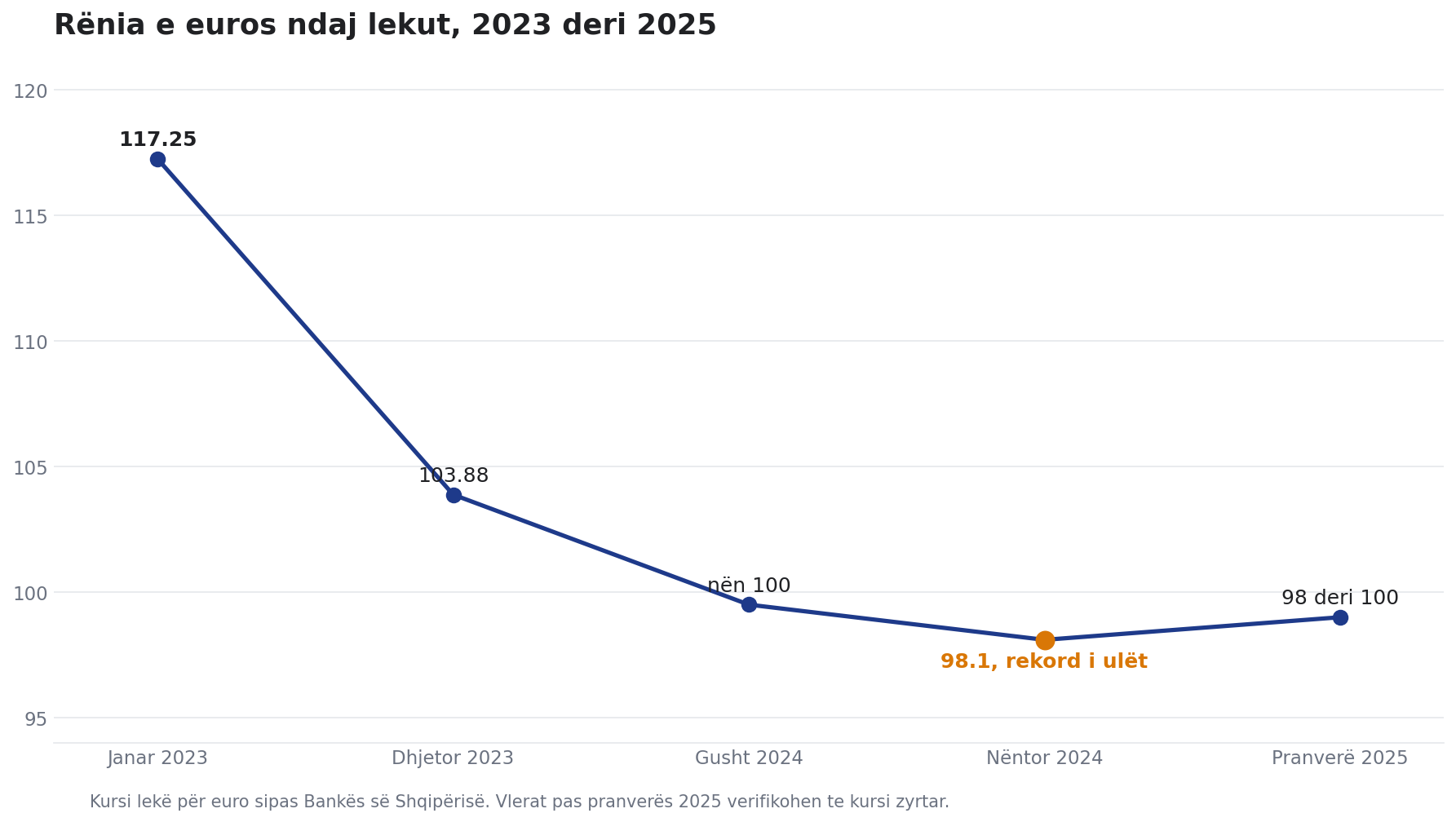
| Period | Lek kurs to euro |
|---|---|
| January 2023 | 117.25 |
| December 2023 | 103.88 |
| August 2024 | Under 100 |
| November 2024 | 98.1 |
| Spring 2025 | 98 to 100 |
| October 9, 2026 | 91.65 |
Source of the exchange rate: Bank of Albania. The daily rate is always verified against the official rate.
| Who loses | Who wins? |
|---|---|
| Exporters, with revenues in euros and costs in lek | Importers who buy the goods more cheaply in lek. |
| Hotels and the tourism sector | Agencies that sell Albanians prepaid packages. |
| IT services and outsourcing for foreign clients | Who has debts and payments in euros? |
| Families receiving remittances from migration |
How the fall of the euro affects sectors
Hotels and tourism
The hotel invoices in euros and pays salaries, suppliers, and taxes in lek. For every 100 euros invoiced, at the 117.25 rate it would receive 11,725 lek. At the 91.65 rate the same invoice brings 9,165 lek, so 2,560 lek less. The season may be full, yet the profit in lek is still lower.
Exporting businesses
A factory that Exports goods For €50,000 you would receive 5,862,500 lek at an exchange rate of 117.25. Today you receive 4,582,500 lek at a rate of 91.65. The difference is 1,280,000 lek on a single shipment, without changing anything in production.
IT and outsourcing
An IT company that invoices €10,000 per month was collecting 1,172,500 lek at an exchange rate of 117.25. At a rate of 91.65 it collects 916,500 lek, so 256,000 lek less each month. Developers' salaries in lek don't decrease, so the entire difference comes out of profit.
Travel agencies
They have two sides. With foreign guests paying in euros, they lose out like the hotels. With Albanian guests who buy packages abroad, they gain, because the euro packages cost them less in lek.
Read also: Who benefits from the 61% and 101% VAT rates?
The three examples, side by side.
| Sector | At the rate of 117.25 | At a rate of 91.65 | Difference |
|---|---|---|---|
| Hotel bill: 100 euros | 11,725 lek | 9,165 lek | 2,560 lek |
| Factory, export €50,000 | 5,862,500 lek | 4,582,500 lek | 1,280,000 lek |
| IT, billing 10,000 euros per month | 1,172,500 lek | 916,500 lek | 256,000 lekë per month |
Risks from the unstable course
Financial loss and profit reduction
The rate spread comes directly from the margin. A business with a narrow margin can go from profit to loss solely because of the exchange.
Difficulty in planning and pricing
Today's bid prices are paid at tomorrow's exchange rate. Without a rate policy, any long-term bid is an uncovered bet.
Strike on the flow of money
Euro receipts translate into fewer lek precisely when payments in lek—wages, rent, and obligations—remain the same. This tightens liquidity even when the business is profitable on paper.
Read more: Late Payments 2026, the new bill, and what businesses need to do today
The counterparty risk for importers
The importer who profits today from a weak euro will lose tomorrow if it strengthens. The exchange rate risk has no permanent direction; it only leaves those unprotected.
Six strategies for hedging against exchange rate risk
Currency clause in contracts
The contract provides for an automatic price review when the rate moves above a certain threshold, e.g., 5%. This allocates the risk between the parties instead of having you bear it alone.
Timely price adjustment
The price list is reviewed periodically at the current exchange rate, not once a year. Delaying adjustments amounts to a silent loss every month.
Billing and Payment Policies
Invoicing in lekë where possible, more frequent and smaller payments, prepayment for large orders, and multi-currency accounts to choose the exchange rate.
Diversification of markets and currencies
New markets, invoicing in additional currencies, and a greater share of the domestic market. The more resources you have, the less your fate depends on a single exchange rate.
Hedging financial instruments
Forward contracts and currency options lock in the exchange rate for future settlements today. They are offered only by banks and licensed financial institutions, carry costs, and require substantial amounts. Be careful, hedging works both ways. If the rate moves in your favor, the contract forfeits your gain. Therefore, the decision is made based on your cash flow structure, not on rate forecasts.
Cost reduction and efficiency increase
Negotiating with suppliers, cutting non-value-adding expenses, and postponing non-urgent investments. When the margin is squeezed by the exchange rate, every lek saved on costs is protection.
Financial Planning and Professional Counseling
None of the strategies is implemented on its own. The right combination depends on the structure of your income and expenses, and that is precisely what matters. financial planning. You can find the basics on our page. Finance and Accounting, While every business handles the tracking of official communications on its own, the Bank of Albania does it.
Every time there is a tax or financial change that affects your business, we notify you directly by email with a practical explanation.
Send me free notificationsFrequently asked questions
Who loses the most from the fall of the euro?
Businesses with euro revenues and lek expenses. Exporters, hotels, tourism, and IT services with foreign clients.
Who benefits from cheap money?
Importers who buy more cheaply in lek, and anyone who has payments or debts in euros.
What is the currency clause?
A contract clause that automatically adjusts the price when the rate moves above a specified threshold, e.g., 5%. It allocates the rate risk between the parties.
What is currency hedging?
Hedging with financial instruments, forward contracts, or currency options that lock in today's exchange rate for future receipts. They are offered only by banks and carry costs, so they are calculated against the risk they cover.
Should I switch to billing in lek?
Where the market accepts it, yes, because it shifts the exchange rate risk to the other party. It's evaluated on a case-by-case basis according to your negotiating power.
Where can I find the official exchange rate?
At the official Bank of Albania exchange rate, updated every business day.
Read also: Closing the 2026 Half-Year: What Your Business Needs to Check Now
