

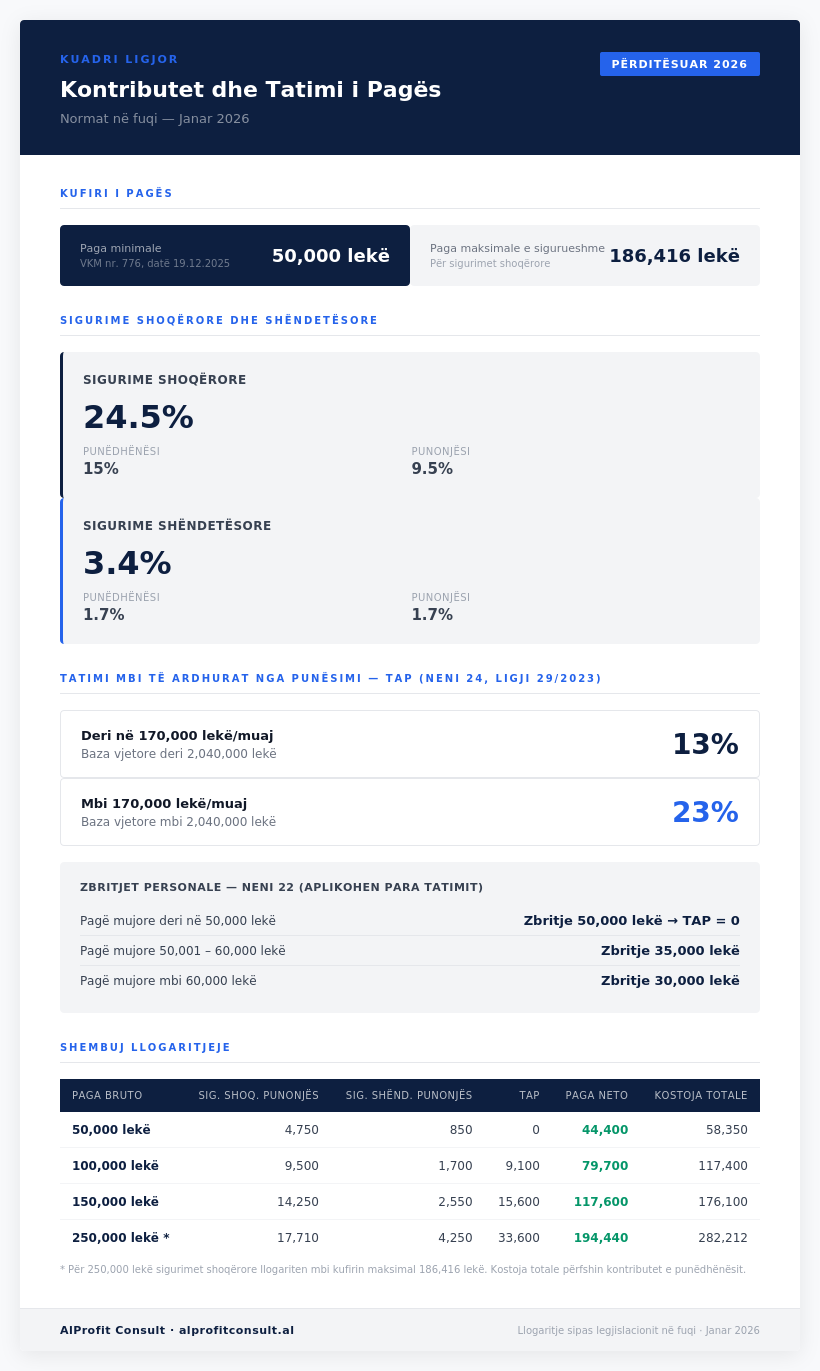
- Contributions and payroll taxes for 2026 are calculated on gross pay. The employee pays 11.21%, namely 9.5% for social security and 1.7% for health insurance.
- The employer pays 16.71% on the salary, namely 15% for social security and 1.71% for health insurance.
- Social insurance is calculated up to 186,416 lekë per month, while health insurance has no cap.
- Salaries up to 50,000 lek are not taxed. Above this level, the 13% and 23% rates apply, as shown in the examples below.
- With a minimum wage of 50,000 lek, the employee receives 44,400 lek net.
Social security contributions and payroll taxes determine how much an employee takes home, while salary is the main source of income for most individuals in Albania. For the majority of families, it accounts for over 60% of total income. The remaining portion comes from renting out property, small-scale commercial activities, and remittances from abroad.
As of January 2026, the minimum wage is 50,000 lekë per month, according to Government Decree No. 776, dated December 19, 2025. The change has a direct effect on the calculation of social security contributions, health insurance contributions, and income tax. The maximum insurable salary is 186,416 lekë. Contribution rates for self-employed individuals have been revised accordingly.
This article explains how liabilities are calculated for the employee and the employer, what the self-employed pay, and what it means for an individual and a business to fail to declare the actual wage.
Read also: Minimum wage in Albania for 2026, 50,000 lekë, and the maximum wage for contributions.
Labor Relations and Legal Protection
Employees in Albania are protected by Labor Code and a series of other laws that guarantee their rights and safety in the workplace. In practice, this includes rights to breaks, annual leave, equal treatment, and protection against unfair dismissal. Employees cannot be dismissed from their jobs without a legitimate reason specified in the contract and without following a procedure prescribed by law.
The shortage of labor and the rising demand for skilled workers have forced many companies to offer better conditions and dignified treatment to attract and retain staff. Many employers have begun investing in improved working conditions, including higher wages and additional benefits.
Social Security Contributions for Employees and the Self-Employed
For employees, social security contributions are split into two parts. 9.51% of the gross wage is withheld from the employee's pay. 15.1% of the gross wage is paid by the employer. Both are calculated on the gross wage.
Read also: Social security, rates, minimum base and ceiling
When an employee's salary exceeds 186,416 lekë, contributions are calculated only on that maximum limit. Even if the employee earns more, social security contributions are not calculated on the amount that exceeds the limit.
In the case of the self-employed, the payment of social security contributions is equal to 23.1% of the amount of 50,000 lekë, or 11,500 lekë per month.
Read also: Albania-Italy pension: how work years are combined
Health Insurance Contributions
Health insurance is also divided into two parts. 1.7% of the gross wage is withheld from the employee's pay, and 1.7% of the gross wage is paid by the employer.
Unlike social security, health insurance has no maximum wage. Contributions are calculated on the total gross wage, without limit.
For the self-employed, health insurance contributions are calculated on double the minimum wage, which is 100,000 lek in 2026. This translates into a 3.41% contribution on that amount, or 3,400 lek per month.
Rates by the five branches of insurance
The amount 27.9% is not a single rate. It is divided into five branches by Law No. 7703 of May 11, 1993, and by Law No. 10383 of February 24, 2011. The division is of practical importance because each branch provides a different benefit.
| Insurance branch | Total | Employer | Employee | The self-employed |
|---|---|---|---|---|
| Illness and temporary disability | 0.30% | 0.12% | 0.18% | Not paid |
| Birthday | 1.40% | 0.83% | 0.57% | 1.40% |
| Pensions | 21.60% | 12.79% | 8.81% | 21.60% |
| Accidents and occupational diseases | 0.30% | 0.30% | 0.00% | Not paid |
| Unemployment | 0.90% | 0.90% | 0.00% | Not paid |
| Amount, social security | 24.5% | 15% | 9.5% | 23% |
| Health insurance | 3.4% | 1.7% | 1.7% | 3.4% |
| Total | 27.9% | 16.7% | 11.2% | 26.4% |
From this arises a distinction that often goes unnoticed. The self-employed person does not pay into unemployment or workers' compensation, so they receive neither unemployment benefits nor compensation for workplace accidents.
When the employer does not pay the wages
There are periods when the employee is not working and the pay does not come from the employer but from the insurance scheme. Medical leave after the 14th day, maternity leave, and unemployment are the most common cases.
In these cases, benefits are applied for with the Social Security Institute or with the Mandatory Health Care Insurance Fund when health care is involved. The application is submitted through the taxpayer—that is, the employer sends it but does not pay it.
The consequence on the payroll is clear. These benefits are not reported by the employer on the contribution statement because they are not wages. The common mistake is reporting them as regular wages, which results in contributions being paid twice. It explains the first 14-day portion. Medical report, who pays and how much.
Tax on Employment Income (TEI)
Personal income tax is calculated according to Article 24 of Law No. 29/2023, which entered into full force on January 1, 2025. A rate of 13% applies to the taxable base up to 2,040,000 lekë per year, while a rate of 23% applies above that threshold. The taxable base is calculated after deducting the amounts provided for in Article 22 of the same law.
Read also: Payroll tax, how it is calculated by tax brackets
The personal deduction under Article 22 is applied by the employer on the monthly payroll, provided that the employee has signed Declaration of Personal Status. The provisions of Article 24 shall enter into force on January 1, 2025.
Examples of TAP based on the current scheme
Gross salary 50,000 lek: income tax is 0 lek.
Gross salary 100,000 lek: tax is calculated as follows: (100,000 – 30,000) × 13.1% = 9,100 lek.
Gross salary 250,000 lek: the calculation is: 22,100 + (250,000 – 200,000) × 23.1% = 33,600 lek.
The above examples are based on the contribution rates and TAP in effect from January 2026. If you want to quickly calculate the net pay and total cost for any pay level, we have prepared a ready-to-use Excel file. Enter the gross salary and the spreadsheet automatically calculates the withholdings, net pay, and total employer cost.
Download: 2026 Salary Calculator (Excel)
Remote Work and Its Impact in Albania
Remote work has become increasingly common, especially since the pandemic. Freelancers who provide services to foreign clients remain subject to Albanian social security and tax obligations, regardless of the client's location.
With a minimum wage of 50,000 lek in 2026, the mandatory and administrative monthly expenses for a freelancer are as follows. Social security contributions are 23% on the portion above 50,000 lek, or 11,500 lek (about 115 euros). Health insurance contributions are 3.4% on amounts above 100,000 lek, or 3,400 lek (about 34 euros). Administrative expenses, including fiscalization, bank commissions, and the economist, range between 150 and 200 euros per month.
In total, the monthly expenses for a freelancer earning €1,500 per month amount to around €300 to €350, including all contributions and operating costs.
The effect of the exchange rate for those paid in euros
The exchange rate is an important factor for those paid in foreign currency. In recent years, the Albanian lek has strengthened against the euro. This has negatively affected the purchasing power of employees earning in euros, even when the nominal amount remains the same.
The situation is of particular importance for those whose cost of living is in lek but whose income is in euros. The same amount in euros now converts into significantly fewer lek than it did a few years ago. This gap is real and must be taken into account in any salary negotiation.
Failure to Declare Actual Salary and Its Effects
Failure to declare the actual salary remains one of the most common problems in the Albanian labor market. Both parties are affected by the consequences.
An employee who is paid 100,000 lek but declares only 50,000 lek loses half of the contribution base. Pension and social security benefits will be calculated on the declared amount, not the actual one. This gap usually becomes apparent when the benefit is needed most.
Failure to declare also harms fair competition among businesses and reduces state revenues. The Tax Administration has intensified inspections and increased penalties for violations in this area.
Minimum, average, and maximum wages for various professions in Albania
Salaries vary significantly by sector and level of qualification. A minimum wage of 50,000 lek is mandatory for every employer, private or public, according to Government Decree No. 776, dated December 19, 2025. The average salary, according to INSTAT data for 2025, is about 83,000 gross lek per month. For specialized professions and managerial positions in the private sector, salaries can exceed 300,000 lek per month.
Unskilled construction workers usually earn 50,000 to 55,000 lek, while skilled ones can earn 70,000 to 90,000 lek. Nurses in the public sector earn around 55,000 to 65,000 lek, while in the private sector salaries go up to 80,000 lek. Beginning teachers earn about 55,000 lek and experienced teachers around 75,000 to 85,000 lek. Engineers and IT professionals in the private sector start at 80,000 lekë and often reach over 200,000 lekë for specialized roles. Senior-level managers in the banking and insurance sectors earn from 200,000 to 400,000 lekë or more.
Every time there is a tax or financial change that affects your business, we notify you directly by email with a practical explanation.
Send me free notificationsWhy it's important to understand pay calculations
The real cost of an employee with a gross salary of 100,000 lek is not 100,000 lek. It's over 117,400 lek, including employer contributions. This change affects budget planning, contract negotiations, and any financial reporting.
Calculate your salary with Our gross and net pay calculator
If you want to understand how these changes affect staff costs or your situation as a self-employed individual, our team is at your disposal.
Frequently asked questions
What is the minimum wage in Albania in 2026?
The minimum wage is 50,000 lek per month, according to Government Decree No. 776, dated December 19, 2025. It will take effect on January 1, 2026.
How much does an employee earn at minimum wage?
An employee with a gross salary of 50,000 lekë receives about 44,400 lekë net. Social security contributions of 4,750 lekë and health insurance contributions of 850 lekë are withheld. Income tax on this salary level is zero.
How much does a minimum-wage employee cost an employer?
The employer pays 7,500 lekë for social security and 850 lekë for health insurance on the gross salary. The total cost is about 58,350 lekë per month.
What do the self-employed pay in contributions?
Social security contributions are 11,500 lekë per month. Health contributions are 3,400 lekë. The total is 14,900 lekë per month, plus administrative expenses.
Has the payroll tax changed in 2026?
No. The progressive scale remains the same. Wages up to 50,000 lek are not taxed. Above this level, the 13% rate applies, while above 200,000 lek, the 23% rate applies.
